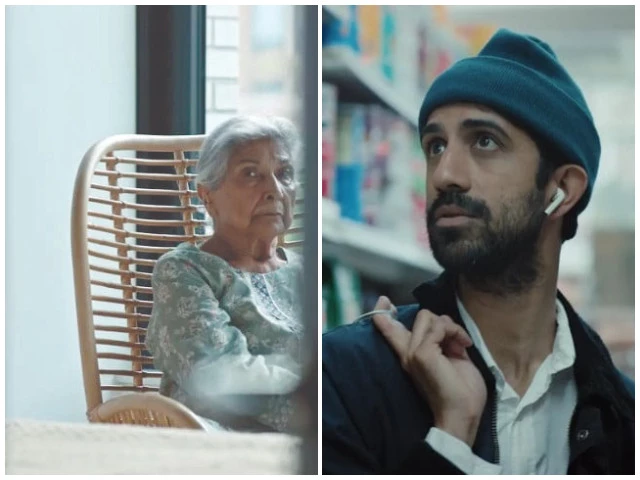
Shehrezad Maher’s first narrative film confronts history, memory and migration
Pakistani cinema marked a fresh milestone this week as ‘The Curfew’, a 19-minute short directed by New York-based filmmaker Shehrezad Maher, premiered at the prestigious Venice Biennale.
Screened on September 4th at Sala Giardino and again on September 5th at Astra 1, the film stood as Pakistan’s sole entry at this year’s festival, a reminder of how voices from the country continue to carve a space in the international film landscape.
Produced by Lindsay Blair Goeldner and Meetra Javed, the short assembles a cast including Sathya Sridharan, Balinder Johal, Sara Haider, Rajesh Bose, Chris Thorn and Salwa Khan.
Cinematography was helmed by Dustin Lane, with production design by Ana Novacic. Distribution rests with Fae Pictures and Baby Daal Productions, with an eventual online release in the pipeline.
For Maher, the screening in Venice was also a personal breakthrough: it is her first narrative project after years of experimental documentary and video art.
At the centre of ‘The Curfew’ is Ayaan, a Pakistani-American man tasked with caring for his grandmother Nayyer, who is frail after a stroke and speaks only Urdu. The two, separated by language and history, struggle to find common ground.
Their relationship is complicated not only by personal distance but by echoes of a political pastNayyer’s memories of Pakistan in the 1970s, when martial law silenced the streets, continue to haunt her through nightmares and sleepwalking.
Ayaan’s sister Zainab, voiced by Sara Haider, relinquishes the role of caregiver early in the film, prompting him to wonder aloud if he is “inheriting anything” from his grandmother beyond the responsibility of her care.
The film’s tension lies in that very question: what passes down across generations when words fail, and how does one reconcile the shadows of colonial and political histories with the needs of the present?
The short doesn’t restrict itself to domestic interactions. Ayaan encounters the subtle pressures of life as a South Asian man in America. In one scene, the doorman at his grandmother’s building mistakes him for an Uber Eats courier.
This quiet moment of racial profiling adds another layer of alienation, making the act of caregiving not only emotionally but socially fraught. His duties lead him back to Pakistan’s past, as he learns to count Nayyer’s medication and recognises how understanding her history might be key to grounding his own identity.
Maher has said that the first seed of the project came not from dialogue but an imagea fruit cart vendor scene that found its way into the film. The director, trained formally in visual arts, describes her process as beginning with images and spaces.
In ‘The Curfew’, those spaces become metaphors: the narrow aisles of a grocery store, the claustrophobic hallways of Nayyer’s apartment building, the sterile view from CCTV cameras. Each visual detail mirrors the overwhelming emotional state of a character suddenly responsible for more than he understands.
For the role of Ayaan, Maher selected Sathya Sridharan after reviewing reels and being struck by his stillness and ability to convey emotion through subtle shifts rather than overt action.
“He has this ability to act with his eyes,” Maher observed, noting that much of the film depends on unspoken tension between Ayaan and Nayyer. That choice proved crucial: much of the narrative unfolds in silence, in stolen glances and quiet discomforts.
 American Dollar Exchange Rate