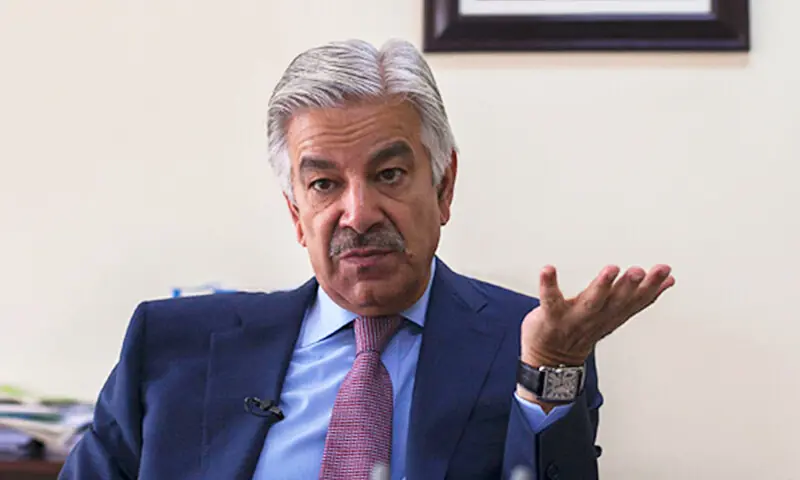
Defence Minister Khawaja Asif on Thursday said the entry of other Arab nations in the mutual defence deal between Pakistan and Saudi Arabia was not ruled out, saying the “doors are not closed” for such developments.
Pakistan and Saudi Arabia entered into a landmark mutual defence agreement, under which any aggression against one state will be considered an attack on both. The ‘Strategic Mutual Defence Agreement’ was signed by Prime Minister Shehbaz Sharif and Saudi Crown Prince Mohammad Bin Salman at the Al-Yamamah Palace in Riyadh on Wednesday.
Talking more about the deal in an interview on Geo News show ‘Aaj Shahzeb Khanzada Kay Sath’ and whether more Arab nations could become part of it, Asif said: “I cannot prematurely answer this, but I will definitely say the doors are not closed.”
Asif said he had always called for a similar arrangement like Nato since there was greater vulnerability for Pakistan, pointing to the history of the region in the last 40-50 years.
“I think it is a fundamental right of the countries and people here, particularly the Muslim population, to together defend their region, countries and nations.”
He said there was no clause in the agreement that ruled out the entry of any other nation or that Pakistan could not sign a similar agreement with anyone else.
Asked about whether Pakistan’s nuclear assets were also up for use under the agreement, Asif said: “What we have, our capabilities, will absolutely be available under this pact. But let me say, since Pakistan has become a nuclear state, never has anyone challenged our status of being a responsible nuclear power.”
Asif said Pakistan had always offered its nuclear facilities for inspection and never committed any violation. He added that this is in contrast to Israel, which had not allowed any inspection.
Questioned about whether any attack on one country would lead to the involvement of the other and vice versa, the minister said: “Yes, absolutely. There is no doubt in this.”
He said neither Pakistan nor Saudi Arabia had named or conditioned the implementation of the defence deal with any specific country. “It is an umbrella that has been provided by both sides, that, if there is aggression against any side from any side, it will be jointly defended against and responded to.”
Asif clarified it was not an “aggressive pact” but a defensive arrangement, similar to that of Nato.
He added that Pakistan had also been involved in training Saudi forces for quite a while and the recent development was only a formalised “extension” of all that, adding that it was a positive thing.
“If there is aggression, whether against Saudi Arabia or Pakistan, we will jointly defend against it.”
He said Pakistan had always had talks on the issue with Saudi Arabia, saying the former had always had a large military and air force contingent present in the latter for many decades.
“I think that [pre-existing] relationship has been more defined now and that understanding has been given the form of a defence agreement. This is embedded in the history of our military cooperation and our brotherly relationship with Saudi Arabia.”
Asif also said the protection of the holy Islamic sites in Saudi Arabia was also a matter of a “sacred duty” for Pakistan.
Questioned about whether the United States was taken into confidence on the matter, Asif said he felt there was no ground or justification for any other third party to be involved in the development.
“This agreement will not be a hegemonic arrangement but a defensive arrangement … we don’t have any plans to conquer territory or attack anyone. But our fundamental right can’t be denied to us and we exercised that yesterday.”
He reiterated that Pakistan could also pursue similar arrangements with other countries.
‘Afghanistan is a hostile country’
To a question about terrorist attacks on security forces, Asif reiterated that Afghan soil is being used to stage acts of terrorism in Pakistan.
“We were swept into two wars in Afghanistan. The US, on both occasions, left the region and we are still dealing with the consequences, be it the Taliban, the TTP (Tehreek-e-Taliban Pakistan), the BLA (Balochistan Liberation Army) or anyone else,” Asif said, referring to the Soviet-Afghan War of the 1980s and the US-led International Security Assistance Force mission after 2001.
“People embrace martyrdom daily; this liability emerged due to those two wars,” he added. “The Kabul government is not innocent in this, I am being categorical. Through these people, we are being blackmailed by them.
“I say with no ambiguity: Afghanistan is a hostile country.”
The defence minister added that Afghanistan was the last country to recognise Pakistan and that discussions on terrorism went nowhere.
When asked if Arab states would act in response to Afghan aggression, Asif encouraged it.
“I would not be against it, but how many times have we been there? They are involved in our politics as well, with a party I will not name,” he stated. “This party advocates for these people who have our children’s blood on their hands.
“This is a subject Pakistan should be clear on, and we are very clear.”
Defence deal
According to the text of the joint statement, issued simultaneously by Islamabad and Riyadh at the end of PM Shehbaz’s day-long state visit, the pact “reflects the shared commitment of both nations to enhance their security and to achieve security and peace in the region and the world”.
“[It] aims to develop aspects of defence cooperation between the two countries and strengthen joint deterrence against any aggression,” the statement said, without going into details.
Importantly, the text underscored that “any aggression against either country shall be considered an aggression against both”.
The timing of the accord, coming on the heels of an Arab summit that signalled a shift towards collective security — in the wake of Israel’s attack on Qatar — hints that it is rooted in current world affairs and reflects the defence concerns of both countries.
The agreement marks the most significant upgrade in Pakistan-Saudi defence ties in decades. Cooperation between the two states dates back to 1967 and deepened after the 1979 Grand Mosque seizure, when Pakistani special forces helped Saudi troops reclaim Masjid al-Haram.
In 1982, the two sides institutionalised security ties through a Bilateral Security Cooperation Agreement that enabled Pakistani training, advisory support and deployments on Saudi soil. At times, as many as 20,000 Pakistani troops were stationed in the kingdom, and Saudi Arabia became a key purchaser of Pakistani-made arms.
In recent years, the partnership has gained urgency amid regional instability. In February, a meeting of the Joint Military Cooperation Committee in Riyadh pledged to expand training and exchanges.
The new pact formalises commitments that had long existed in practice, creating what some analysts saw as a de facto joint defensive umbrella, though finer details of the agreement were not made public.
For Pakistan, the agreement offers both strategic and economic benefits. It secures vital Saudi investment and funding at a time of fiscal strain, while reinforcing Islamabad’s standing as a pan-Islamic security provider.
For Saudi Arabia, it strengthens defences against threats from Iran, Houthi militias and regional turbulence caused by Israel’s genocidal actions in Gaza and aggression against other countries in the neighbourhood. The Israeli attack targeting the Hamas delegation in Doha heightened the urgency for this agreement that had been under discussion for some time.
Pakistan’s earlier defence alignments, such as Cold War-era agreements with the United States and those under Seato and Cento, have long since eroded. Islamabad’s partnerships with China, Turkiye and other Gulf states remain important but lack binding mutual defence clauses.
Against this backdrop, Wednesday’s signing represented Pakistan’s most consequential formal defence commitment in decades, tying its security role inextricably to the evolving strategic architecture of the Gulf.
 American Dollar Exchange Rate