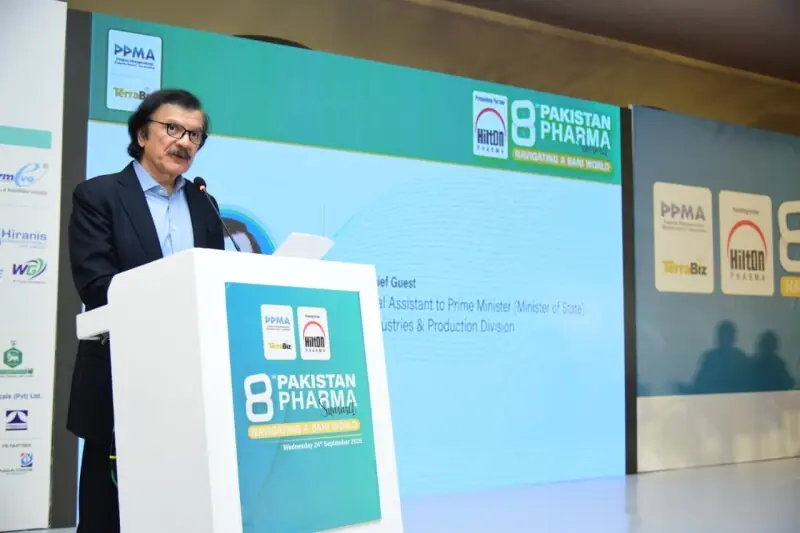
ISLAMABAD: Pakistan government has called on the pharmaceutical industry to enhance its competitiveness and increase exports, aiming to capture a larger share of the $2.5 trillion global market.
“In today’s interconnected world, aligning with global benchmarks—such as WHO [World Health Organization] standards, pharmaceutical inspection convention scheme compliance, and medicines and healthcare products regulatory agency certifications—is no longer optional but essential,” Special Assistant to the Prime Minister (SAPM) on industries and Production Haroon Akhtar Khan said while speaking at the 8th Pakistan Pharma Summit and 4th Pharma Export Summit and Awards 2025 (PESA 2025) on Wednesday.
“These standards will open the doors of advanced markets, enhance our credibility, and help Pakistan emerge as a reliable partner in global healthcare,” he said.
“The global pharmaceutical market today is worth over $2.5 trillion. With resilience, determination, and the right policies, there is no reason why Pakistan cannot capture a much larger share of this market.”
The Pakistan Pharmaceutical Manufacturers Association (PPMA) gave awards to top 50 exporters of pharmaceuticals and allied products at the summit.
Earlier in the summit, Federal Minister for National Health Services, Regulations and Coordination Syed Mustafa Kamal said the government had set the country’s pharmaceutical export target at an ambitious $30 billion for the next five years.
SAPM Khan further said that the industry needed to accelerate local production of Active Pharmaceutical Ingredients (APIs/raw material for medicine).
“Reducing dependence on imports is critical for our national security, economic resilience, and competitiveness.
“The road ahead is both challenging and full of opportunities. The industry must compete on quality, trust, and innovation—not merely on price. We must invest in research and development , create robust partnerships with universities, and strengthen indigenous capacity,” he said.
Being a representative of the government, he assured that the Parliament was standing firm behind pharma industry.
“Through our committees in the Senate and National Assembly, we are actively engaged in supporting industries like pharmaceuticals.”
He further said that industrialisation consistently delivered higher average incomes and standards of living for entire populations. “The UK, Japan ,Taiwan , South Korea and Singapore have all gone through this transformation.”
“China’s rise provides the most dramatic recent example – government policy shifts in the late 20th century propelled a nation dependent on farming into the world’s largest manufacturing economy, lifting hundreds of millions of people out of poverty along the way,” he said.
“Pakistan stands at a similar crossroads today. It possess the human capital, strategic location, and natural resources that these successful nations leveraged during their industrial transformations,” he added.
Pakistan pharmaceutical exports reached $457 million in the financial year 2024-25, a record achievement with 34% growth, the highest in the last two decades, as per the Ministry of Industries and Production.
 American Dollar Exchange Rate