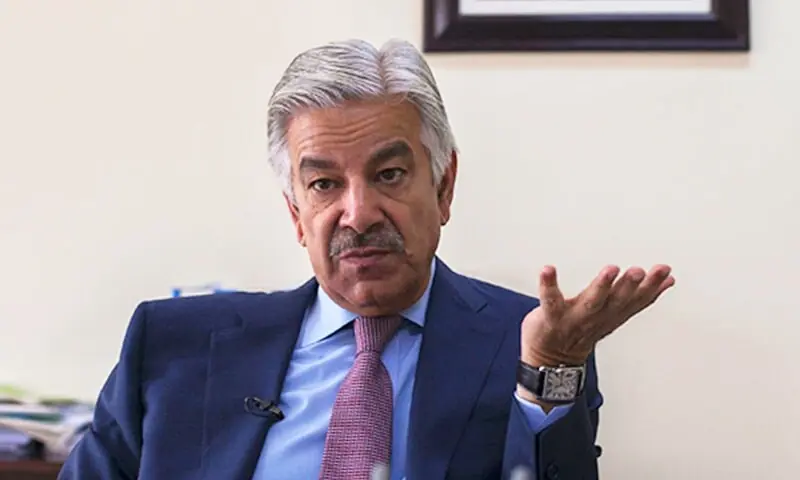

Defence Minister Khawaja Asif on Tuesday rejected the comparison between Islamabad‘s actions against the banned Tehreek-i-Taliban Pakistan (TTP) and New Delhi’s unprovoked action against the country in May as “wrong and inappropriate”.
The defence minister‘s remarks come a day after Jamiat Ulema-i-Islam Fazl (JUI-F) Chief Maulana Fazlur Rehman questioned Pakistan’s objection to Indian attacks when the country also allegedly conducted cross-border strikes against terrorist targets in Afghanistan.
Pakistan has either denied or not commented on striking targets inside Afghanistan.
In a post on X, Asif also said that India, to date, has “not been able to provide evidence” of Pakistan’s involvement in the Pahalgam attack, despite Pakistan’s offer of “neutral investigations”.
“The report issued by the United Nations also clarifies that the Indian aggression was illegal and unsubstantiated, and Pakistan’s response was fully justified,“ said the defence minister.
He elaborated that the international community and the United Nations are also concerned about terrorism under the regime of the Afghan Taliban, and maintained that the presence of terrorist formations and terrorists infiltrating Pakistan “are a clear proof of this”.
He further stated that “any doubts raised by India, its proxies, and sympathisers” were addressed by the country “earlier and continue to be addressed today”.
Relations with neighbours
Pakistan’s bilateral relations with Afghanistan have come under strain in recent times as the Tehreek-i-Taliban Pakistan (TTP) remains the main point of contention between the two countries.
Pakistan has demanded that the rulers in Kabul take action to stop cross-border terrorism, but the Afghan Taliban deny Islamabad’s allegations of terrorists being allowed to use Afghan soil to carry out attacks in Pakistan.
During a process of dialogue, which followed border clashes between the two countries in October, the two sides had met in an effort to work on mechanisms for lasting peace and stability between the two countries.
However, two additional rounds of talks were held, but did not bear any fruit. Asif said that the talks addressing cross-border terrorism were “over” and “entered an indefinite phase”. Following the failure of the talks, the Afghan Taliban suspended trade ties with Islamabad.
Meanwhile, in May, tensions between Pakistan and India boiled over and led to a four-day military conflict.
The fighting was sparked by an attack on tourists in occupied Kashmir, which New Delhi, without evidence, linked to Pakistan. Islamabad strongly denied responsibility while calling for a neutral investigation.
But, New Delhi launched deadly air strikes in Punjab and Azad Kashmir on May 7, marking the beginning of the four-day clash. After tit-for-tat strikes on each other’s airbases by the two sides, it took American intervention on May 10 for both sides to finally reach a ceasefire.
Pakistan initially said it downed five Indian planes in air-to-air combat during the conflict, but later raised the tally to seven. Islamabad has denied any losses of its planes and said it hit 26 Indian targets after three air bases were targeted.




 American Dollar Exchange Rate