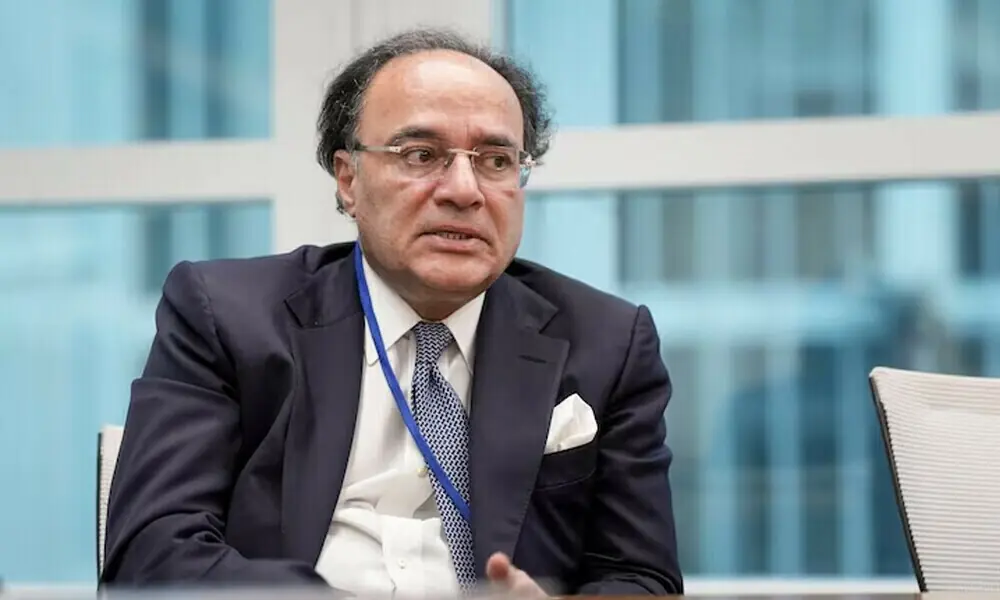
Finance Minister Muhammad Aurangzeb on Saturday said he will travel to the United States next week to advance economic engagement, as Pakistan reassesses its trade positioning following recent agreements between New Delhi and Washington, with Bangladesh also reaching an understanding with Washington, which has unsettled local industry.
“I am leaving for the United States next week; all your recommendations in terms of how we need to further negotiate with the US will be discussed,” he said, while addressing industrialists at Pakistan’s Economic Growth and Stability program at the Federation of Pakistan Chambers of Commerce & Industry (FPCCI) Regional Office, Lahore.
“We totally aligned with your ask,” he said, while urging the local industry to review the revenue model and improve productivity.
“We are in a new world order.”
The United States remains Pakistan’s largest single-country export destination, accounting for 18% of total exports—or approximately $5.8 billion—during FY2024-25, according to FBR data.
Textiles and garments constitute about 82% of Pakistan’s exports to the US market. This heavy dependence underscores Pakistan’s vulnerability to shifts in US trade policy and highlights the strategic importance of maintaining uninterrupted access to the American market.
Days ago, Pakistan’s textile industry approached the government for a better trade arrangement with the USA. In this regard, the Pakistan Textile Council (PTC) wrote a letter to Prime Minister Shehbaz Sharif, while the All Pakistan Textile Mills Association (APTMA) has also written to Commerce Minister Jam Kamal Khan.
Meanwhile, Aurangzeb on Saturday said that Pakistan continues to approach the International Monetary Fund (IMF) from time to time, “because the balance of payment is a binding constraint on us in terms of our growth”.
“Therefore, we need an export-led growth.”
He reiterated that the economy has achieved stabilisation, “the hard way”.
25pc US tariff threat: Govt adopts cautious approach to trade with Iran
Expects interest rate to decline
On the policy rate, the finance minister said that “the policy rate should be lowered further”.
“However, this is the mandate of the SBP and its Monetary Policy Committee (MPC). But I do think that if the inflation continues to move in the right direction, we will see the policy rate dropping to a single digit.”
On external repayments, the finance minister said that Pakistan repaid $500 million Eurobond and would meet the $1.3 billion payment due in April.
Aurangzeb said that industrial activity has received a boost amid a decline in the policy rate.
NFC Award
He emphasised that climate change and population are existential issues. “I am not ready to accept that a 2.5% population growth rate must be taken as a given.”
“As we move forward with the NFC Award, where 82% allocation is based on population, this has to change. We will change it in consultation with the provinces. But if the voice of industry and chambers supports this, it will help,” he said.
Aurangzeb maintained that the government believes the private sector has to lead this country. “We will do anything and everything we can to help, support, and assist.”

Finance Minister Muhammad Aurangzeb on Saturday said he will travel to the United States next week to advance economic engagement, as Pakistan reassesses its trade positioning following recent agreements between New Delhi and Washington, with Bangladesh also reaching an understanding with Washington, which has unsettled local industry.
“I am leaving for the United States next week; all your recommendations in terms of how we need to further negotiate with the US will be discussed,” he said, while addressing industrialists at Pakistan’s Economic Growth and Stability program at the Federation of Pakistan Chambers of Commerce & Industry (FPCCI) Regional Office, Lahore.
“We totally aligned with your ask,” he said, while urging the local industry to review the revenue model and improve productivity.
“We are in a new world order.”
The United States remains Pakistan’s largest single-country export destination, accounting for 18% of total exports—or approximately $5.8 billion—during FY2024-25, according to FBR data.
Textiles and garments constitute about 82% of Pakistan’s exports to the US market. This heavy dependence underscores Pakistan’s vulnerability to shifts in US trade policy and highlights the strategic importance of maintaining uninterrupted access to the American market.
Days ago, Pakistan’s textile industry approached the government for a better trade arrangement with the USA. In this regard, the Pakistan Textile Council (PTC) wrote a letter to Prime Minister Shehbaz Sharif, while the All Pakistan Textile Mills Association (APTMA) has also written to Commerce Minister Jam Kamal Khan.
Meanwhile, Aurangzeb on Saturday said that Pakistan continues to approach the International Monetary Fund (IMF) from time to time, “because the balance of payment is a binding constraint on us in terms of our growth”.
“Therefore, we need an export-led growth.”
He reiterated that the economy has achieved stabilisation, “the hard way”.
25pc US tariff threat: Govt adopts cautious approach to trade with Iran
Expects interest rate to decline
On the policy rate, the finance minister said that “the policy rate should be lowered further”.
“However, this is the mandate of the SBP and its Monetary Policy Committee (MPC). But I do think that if the inflation continues to move in the right direction, we will see the policy rate dropping to a single digit.”
On external repayments, the finance minister said that Pakistan repaid $500 million Eurobond and would meet the $1.3 billion payment due in April.
Aurangzeb said that industrial activity has received a boost amid a decline in the policy rate.
NFC Award
He emphasised that climate change and population are existential issues. “I am not ready to accept that a 2.5% population growth rate must be taken as a given.”
“As we move forward with the NFC Award, where 82% allocation is based on population, this has to change. We will change it in consultation with the provinces. But if the voice of industry and chambers supports this, it will help,” he said.
Aurangzeb maintained that the government believes the private sector has to lead this country. “We will do anything and everything we can to help, support, and assist.”






 American Dollar Exchange Rate