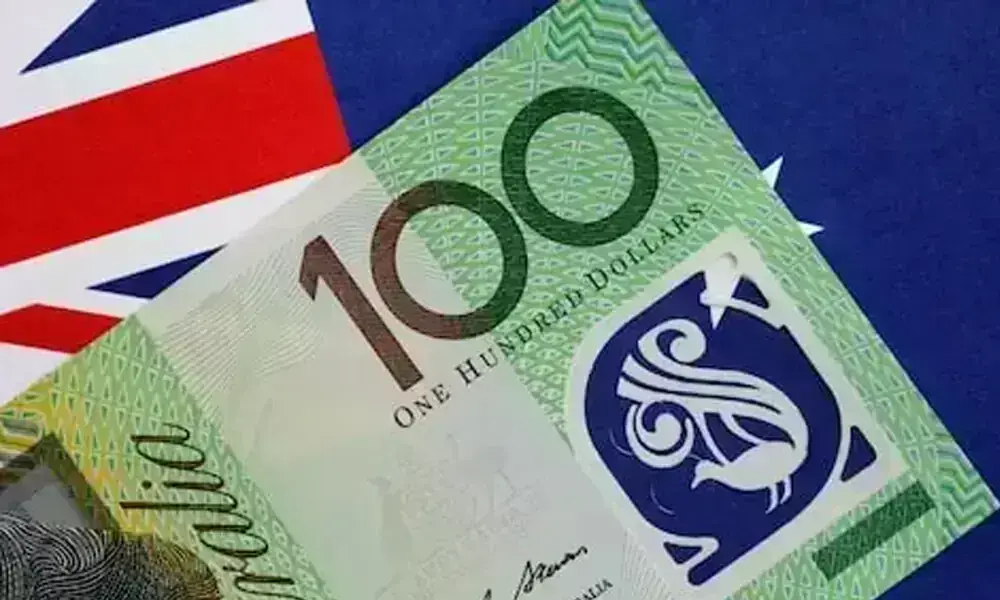

SYDNEY: The Australian and New Zealand dollars edged lower against a broadly firmer greenback on Tuesday, while Australia’s central bank left the door open to a further increase in interest rates without committing to anything.
Minutes of the Reserve Bank of Australia’s last policy meeting showed the board felt there had been a “material shift” in the balance of risks around inflation that had required a quarter-point hike to 3.85%.
The board was uncertain about whether further hikes would be needed, but highlighted that inflation had already been above target for three years and financial conditions were not tight enough to restrain excess demand.
“Those aspects suggest a second hike is more likely than not and our base case remains for a 25bp rate hike in May,” said Andrew Boak, an economist at Goldman Sachs.
Markets imply around a 60% chance of a May move, with 4.1% fully priced by August.
“Further out, we expect that inflation will ease meaningfully more over 2026 than implied by the RBA’s forecasts,” added Boak.
“We continue to expect ‘normalisation’ cuts starting in early 2027.”
The Aussie dollar eased 0.2% to $0.7061, having barely budged overnight as holidays around the world thinned trade. Support lies at $0.7043 and $0.6897, with resistance at the recent three-year top of $0.71465.
The kiwi dollar dipped 0.1% to $0.6024, and a break of $0.6015 would risk a pullback to $0.5929. Resistance lies around its recent high of $0.60925.
The Reserve Bank of New Zealand holds its first meeting of the year on Wednesday and it is considered certain to hold rates at 2.25%, having signalled the end of its easing cycle last year.
Analysts are keen to see if the RBNZ sticks with mid-2027 as the likely timing for a first hike in the official cash rate, and to hear how its new Governor Anna Breman sees the outlook.
Markets imply a 68% chance a hike could come as soon as September this year, and are fully priced for a move to 2.5% by October.
Breman has already pushed back on pricing for an early tightening, which was pushing up current mortgage rates and hobbling a much-needed recovery in the housing market.






 American Dollar Exchange Rate