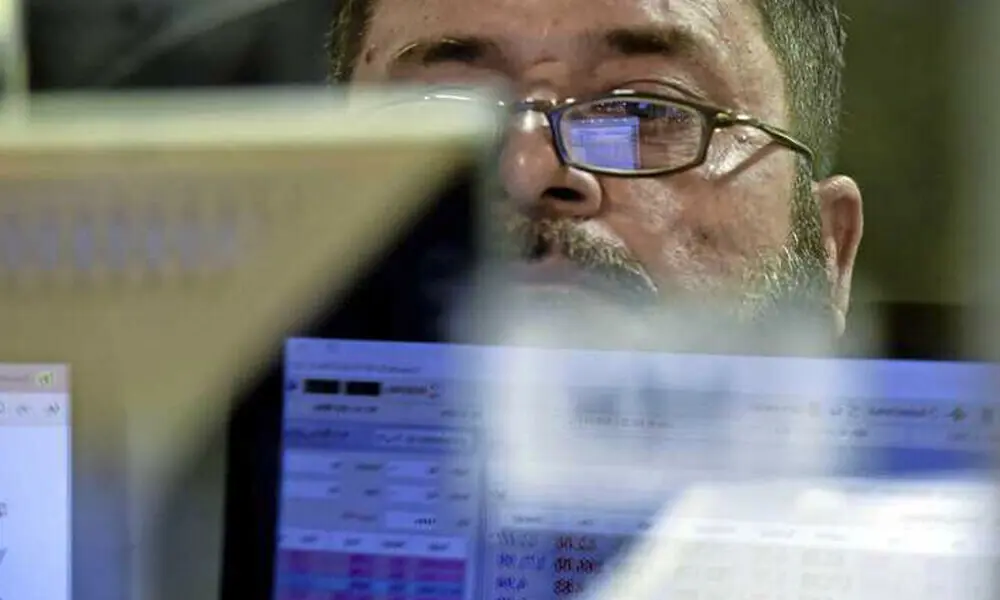

The Pakistan Stock Exchange (PSX) witnessed massive selling on Monday as the benchmark KSE-100 Index plunged over 9% amid escalating geopolitical tensions in the region.
Selling pressure gripped the PSX from the start of trading. By 9:22am, the benchmark index plunged to 152,991.15, down by 15,071.01 points or 8.97%.
Following the nearly 9% drop, trading activity at PSX was halted for one hour.
“All TRE Certificate Holders are hereby informed that due to a 5% decrease in the KSE-30 index from the previous trading day’s close of the same, a Market Halt has been triggered as per PSX Regulations, and all equity-based markets have been suspended accordingly,” read the notice.
Following the resumption of trading around 10:22am, strong recovery momentum emerged, pushing the index rapidly higher by over 6,000 points from the day’s intraday low of 152,717.46.
However, selling pressure intensified in the final hours of trading.
At close, the KSE-100 Index settled at 152,871.98, a decrease of 15,190.18 points or 9.04%.
Analysts attributed the selling pressure to regional tensions, sparking fears of rising economic pressures on the country.
“Elevated oil prices are highly detrimental to Pakistan’s external account, and persistently high commodity prices are likely to trigger a new wave of inflation,” Waqas Ghani, Head of Research at JS Global, told media.
Across-the-board selling was observed in key sectors, including automobile assembler, cement, commercial banks, fertiliser, oil and gas exploration, OMCs, power generation and refinery. Index-heavy stocks, including HBL, MCB, MEBL, MARI, OGDC, POL, PPL, HUBCO, ARL, traded in the red.
During the previous week, Pakistan’s equity market remained under sustained pressure, as rising geopolitical tensions and domestic security concerns continued to weigh heavily on investor sentiment.
The benchmark KSE-100 Index at the PSX declined by 5,107.53 points, or 2.9% week-on-week, to close at 168,062.17 points.
Internationally, oil prices surged on Monday, and shares slid as military conflict in the Middle East looked set to last weeks, sending investors flocking to the relative safety of the dollar and gold.
Brent jumped 4.5% to $76.07 a barrel, though it had briefly topped $82.00 at one stage, while US crude climbed 3.9% to $69.59 per barrel.
Gold rose 1.0% to $5,327 an ounce.
Military strikes by the United States and Israel on Iran showed no sign of lessening, while Iran responded with missile barrages across the region, risking dragging its neighbours into the conflict.
President Donald Trump suggested to the Daily Mail that the conflict could last for four more weeks, while posting that attacks would continue until US objectives were met.
All eyes were on the Strait of Hormuz, where around a fifth of the world’s seaborne oil trade flows and 20% of its liquefied natural gas.
While the vital waterway has not yet been blocked, marine tracking sites showed tankers piling up on either side of the strait, wary of attack or maybe unable to get insurance for the voyage.
A prolonged spike in oil prices would risk reigniting inflationary pressures globally, while also acting as a tax on business and consumers that could dampen demand.
OPEC+ did agree on a modest oil output boost of 206,000 barrels per day for April on Sunday, but a lot of that product still has to get out of the Middle East by tanker.
Chinese blue-chips went their own way and held steady.
MSCI’s broadest index of Asia-Pacific shares outside Japan fell 1.2%.





 American Dollar Exchange Rate