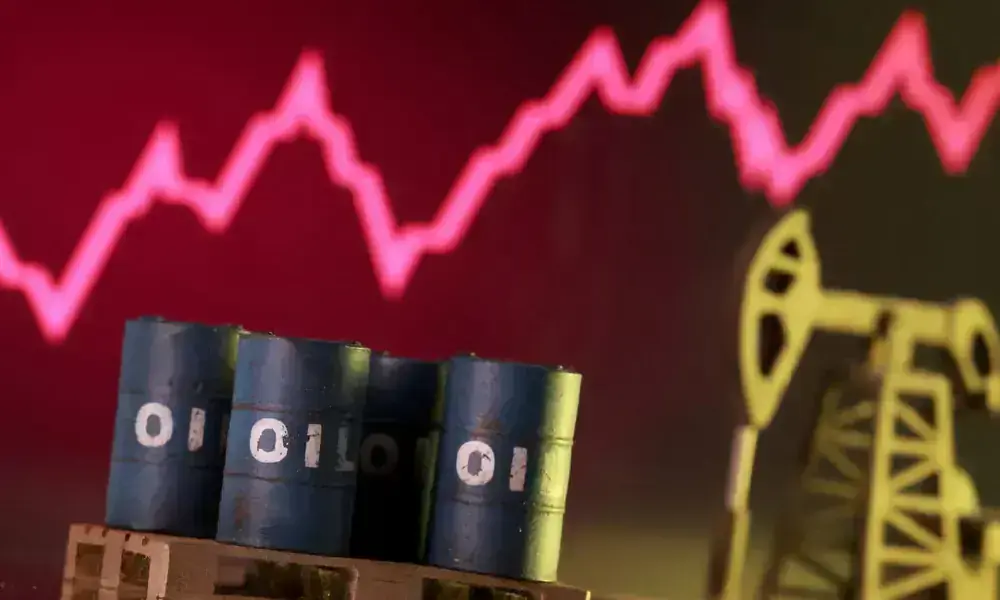
NEW YORK: Brent oil prices slipped on Monday after Group of Seven finance leaders signalled readiness to act to stabilize energy markets, paring earlier gains that had pushed the global benchmark close to USD117 a barrel following the Yemeni Houthis’ attacks on Israel.
Brent futures rose to a high of USD116.89 a barrel earlier in the session but pared gains later in the day to trade down 52 cents or 0.5 percent at USD112.05 at 12:36 p.m. ET (1646 GMT). US West Texas Intermediate futures were up USD3.45 or 3.5 percent at USD103.09 a barrel.
Finance ministers and central bankers from the G7 countries said they stood ready to take “all necessary measures” to safeguard energy market stability and limit broader economic spillovers from recent volatility.
Conflict has spread across the Middle East since US and Israeli strikes on Iran began on February 28, stoking concerns over shipping routes around the Arabian Peninsula and the Red Sea.
Iran’s effective closure of the Strait of Hormuz, a chokepoint for roughly a fifth of global oil and gas supplies, has sent oil prices up about 58 percent this month, the steepest monthly jump in LSEG data going back to 1988, exceeding gains made during the 1990 Gulf War. US crude, meanwhile, has climbed by 51 percent for its biggest monthly gain since May 2020.
US Treasury Secretary Scott Bessent said on Monday that the global oil market is well supplied, with more boats travelling through the Strait of Hormuz.
“Over time, the US is going to retake control of the straits and there will be freedom of navigation, whether it is through US escorts or a multinational escort,” Bessent said in an interview with Fox News.
Two Chinese container ships sailed through the Strait of Hormuz on their second attempt to leave the Gulf after turning back on Friday, ship-tracking data showed.
Israel’s military said it intercepted two drones launched from Yemen on Monday, two days after Iran-aligned Houthis fired missiles at Israel for the first time since the start of the US-Israeli war on Iran.
The Houthis have yet to target shipping in the Red Sea, which handles about 15% of global maritime traffic.
If the Houthis were to attack shipping and shut down the southern entrance to the Red Sea, it could drive prices up by USD5 to USD10 per barrel, said Robert Yawger, director of energy futures at Mizuho.
Trump issues Iran Warning Again
Adding to price pressures, US President Donald Trump on Monday demanded that Iran reopen the Strait of Hormuz or face US attacks on its oil wells and power plants.
Previously, Trump said he would pause attacks on Iran’s energy network until April 6 and that the US and Iran have been meeting “directly and indirectly” and that Tehran’s new leaders have been “very reasonable”. Iran, however, described US proposals to end a month of war in the Middle East as “unrealistic, illogical and excessive” and unleashed more missiles on Israel.
“Trump’s extended deadline of April 6 – when the US could potentially resume attacks on Iranian energy infrastructure – has had no reassuring effect. The market is now asking for concrete signs of de-escalation, not just rhetoric,” SEB Research said in a note.

NEW YORK: Brent oil prices slipped on Monday after Group of Seven finance leaders signalled readiness to act to stabilize energy markets, paring earlier gains that had pushed the global benchmark close to USD117 a barrel following the Yemeni Houthis’ attacks on Israel.
Brent futures rose to a high of USD116.89 a barrel earlier in the session but pared gains later in the day to trade down 52 cents or 0.5 percent at USD112.05 at 12:36 p.m. ET (1646 GMT). US West Texas Intermediate futures were up USD3.45 or 3.5 percent at USD103.09 a barrel.
Finance ministers and central bankers from the G7 countries said they stood ready to take “all necessary measures” to safeguard energy market stability and limit broader economic spillovers from recent volatility.
Conflict has spread across the Middle East since US and Israeli strikes on Iran began on February 28, stoking concerns over shipping routes around the Arabian Peninsula and the Red Sea.
Iran’s effective closure of the Strait of Hormuz, a chokepoint for roughly a fifth of global oil and gas supplies, has sent oil prices up about 58 percent this month, the steepest monthly jump in LSEG data going back to 1988, exceeding gains made during the 1990 Gulf War. US crude, meanwhile, has climbed by 51 percent for its biggest monthly gain since May 2020.
US Treasury Secretary Scott Bessent said on Monday that the global oil market is well supplied, with more boats travelling through the Strait of Hormuz.
“Over time, the US is going to retake control of the straits and there will be freedom of navigation, whether it is through US escorts or a multinational escort,” Bessent said in an interview with Fox News.
Two Chinese container ships sailed through the Strait of Hormuz on their second attempt to leave the Gulf after turning back on Friday, ship-tracking data showed.
Israel’s military said it intercepted two drones launched from Yemen on Monday, two days after Iran-aligned Houthis fired missiles at Israel for the first time since the start of the US-Israeli war on Iran.
The Houthis have yet to target shipping in the Red Sea, which handles about 15% of global maritime traffic.
If the Houthis were to attack shipping and shut down the southern entrance to the Red Sea, it could drive prices up by USD5 to USD10 per barrel, said Robert Yawger, director of energy futures at Mizuho.
Trump issues Iran Warning Again
Adding to price pressures, US President Donald Trump on Monday demanded that Iran reopen the Strait of Hormuz or face US attacks on its oil wells and power plants.
Previously, Trump said he would pause attacks on Iran’s energy network until April 6 and that the US and Iran have been meeting “directly and indirectly” and that Tehran’s new leaders have been “very reasonable”. Iran, however, described US proposals to end a month of war in the Middle East as “unrealistic, illogical and excessive” and unleashed more missiles on Israel.
“Trump’s extended deadline of April 6 – when the US could potentially resume attacks on Iranian energy infrastructure – has had no reassuring effect. The market is now asking for concrete signs of de-escalation, not just rhetoric,” SEB Research said in a note.






 American Dollar Exchange Rate