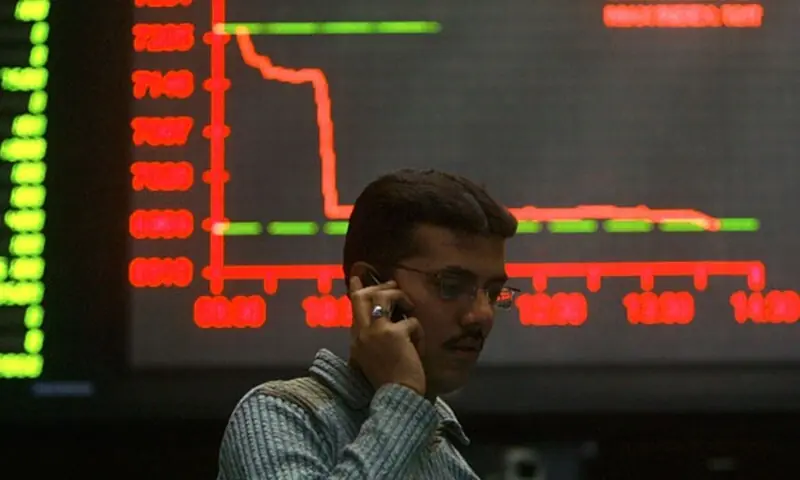
The Pakistan Stock Exchange (PSX) witnessed a second consecutive negative session on Friday, as its benchmark KSE-100 closed lower by over 1,700 points amid selling pressure.
The KSE-100 started the session with some buying, hitting an intra-day high of 156,519.14.
However, the bears emerged stronger in the latter hours and pushed the index into the negative territory.
At close, the benchmark index settled at 154,439.68, down by 1,701.56 points or 1.09%.
“Correction was observed at the exchange due to rising cost of leverage (Margin Trading System (MTS) & Future Market), as KSE 100 Index declined by -1.09%,” brokerage house Topline Securities said in its post-market report.
Top negative contribution to the index came from UBL, FFC, ENGROH, HUBC & LUCK, as they cumulatively contributed 900 points to the index, it added.
On Thursday, PSX closed the session in negative territory as profit-taking dominated the trading floor, snapping the bullish streak seen in earlier sessions.
“Despite surrendering early-week gains, the KSE-100 wrapped up the week nearly flat, edging up 163 points. After opening at 155,057, the index navigated a wide range, slipping to 154,360 at its low and scaling a record 157,817 at its high, before ultimately closing at 154,440, holding its ground,” Ali Najib, Deputy Head of Trading at Arif Habib Ltd said in a statement.
“Looking ahead, bouts of profit-taking and cautious sentiment may keep volatility alive, but 154k continues to anchor as the market’s sturdy safety net,” he said.
Internationally, Asian share markets followed Wall Street higher on Friday as the growing prospect of several more US rate cuts promised to lower borrowing costs globally, a relief to stressed bond markets and a drag on the dollar.
Indexes in Japan, South Korea and Taiwan all scaled record peaks, urged on by extravagant expectations for AI-related earnings growth.
The US consumer price report had been the last major hurdle to the Federal Reserve cutting interest rates next week, and it proved unthreatening, if a little firm.
Indeed, costs in the CPI that feed into the Fed’s preferred measure of core personal consumption expenditures (PCE) were on the soft side, leading analysts at Citi to predict a steady reading of 2.9% for August.
Markets continue to imply a 100% chance of a quarter-point cut to 4.00%-4.25% next week, and ramped up the probability of two further easings this year to around 90%.
The Treasury market has already eased in anticipation, with 10-year yields down 20 basis points in the past two weeks, effectively a rate cut given mortgage rates are tied to yields in the United States.
That drop helped soothe concerns in some other major bond markets, particularly in Europe, pressured by political uncertainty and expanding fiscal burdens.
In Asia, Japan’s Nikkei climbed 0.6% to another all-time high, bringing gains this week to 3.7%. South Korea added 1.1%, taking its weekly rise to more than 5%.
Chinese blue chips edged up 0.2% to the highest since early 2022. MSCI’s broadest index of Asia-Pacific shares outside Japan jumped 1.2%.
Meanwhile, the Pakistani rupee maintained its positive momentum against the US dollar, appreciating marginally in the inter-bank market on Friday. At close, the rupee settled at 281.55, a gain of Re0.01 against the greenback. This was the rupee’s 26th successive gain against the greenback.
Volume on the all-share index decreased to 987.59 million from 1,279.94 million recorded in the previous close. The value of shares declined to Rs39.91 billion from Rs50.21 billion in the previous session.
F. Nat.Equities was the volume leader with 61.99 million shares, followed by Agha Steel Ind. with 61.30 million shares, and Pervez Ahmed Co with 47.22 million shares.
Shares of 476 companies were traded on Friday, of which 180 registered an increase, 263 recorded a fall, while 33 remained unchanged.

The Pakistan Stock Exchange (PSX) witnessed a second consecutive negative session on Friday, as its benchmark KSE-100 closed lower by over 1,700 points amid selling pressure.
The KSE-100 started the session with some buying, hitting an intra-day high of 156,519.14.
However, the bears emerged stronger in the latter hours and pushed the index into the negative territory.
At close, the benchmark index settled at 154,439.68, down by 1,701.56 points or 1.09%.
“Correction was observed at the exchange due to rising cost of leverage (Margin Trading System (MTS) & Future Market), as KSE 100 Index declined by -1.09%,” brokerage house Topline Securities said in its post-market report.
Top negative contribution to the index came from UBL, FFC, ENGROH, HUBC & LUCK, as they cumulatively contributed 900 points to the index, it added.
On Thursday, PSX closed the session in negative territory as profit-taking dominated the trading floor, snapping the bullish streak seen in earlier sessions.
“Despite surrendering early-week gains, the KSE-100 wrapped up the week nearly flat, edging up 163 points. After opening at 155,057, the index navigated a wide range, slipping to 154,360 at its low and scaling a record 157,817 at its high, before ultimately closing at 154,440, holding its ground,” Ali Najib, Deputy Head of Trading at Arif Habib Ltd said in a statement.
“Looking ahead, bouts of profit-taking and cautious sentiment may keep volatility alive, but 154k continues to anchor as the market’s sturdy safety net,” he said.
Internationally, Asian share markets followed Wall Street higher on Friday as the growing prospect of several more US rate cuts promised to lower borrowing costs globally, a relief to stressed bond markets and a drag on the dollar.
Indexes in Japan, South Korea and Taiwan all scaled record peaks, urged on by extravagant expectations for AI-related earnings growth.
The US consumer price report had been the last major hurdle to the Federal Reserve cutting interest rates next week, and it proved unthreatening, if a little firm.
Indeed, costs in the CPI that feed into the Fed’s preferred measure of core personal consumption expenditures (PCE) were on the soft side, leading analysts at Citi to predict a steady reading of 2.9% for August.
Markets continue to imply a 100% chance of a quarter-point cut to 4.00%-4.25% next week, and ramped up the probability of two further easings this year to around 90%.
The Treasury market has already eased in anticipation, with 10-year yields down 20 basis points in the past two weeks, effectively a rate cut given mortgage rates are tied to yields in the United States.
That drop helped soothe concerns in some other major bond markets, particularly in Europe, pressured by political uncertainty and expanding fiscal burdens.
In Asia, Japan’s Nikkei climbed 0.6% to another all-time high, bringing gains this week to 3.7%. South Korea added 1.1%, taking its weekly rise to more than 5%.
Chinese blue chips edged up 0.2% to the highest since early 2022. MSCI’s broadest index of Asia-Pacific shares outside Japan jumped 1.2%.
Meanwhile, the Pakistani rupee maintained its positive momentum against the US dollar, appreciating marginally in the inter-bank market on Friday. At close, the rupee settled at 281.55, a gain of Re0.01 against the greenback. This was the rupee’s 26th successive gain against the greenback.
Volume on the all-share index decreased to 987.59 million from 1,279.94 million recorded in the previous close. The value of shares declined to Rs39.91 billion from Rs50.21 billion in the previous session.
F. Nat.Equities was the volume leader with 61.99 million shares, followed by Agha Steel Ind. with 61.30 million shares, and Pervez Ahmed Co with 47.22 million shares.
Shares of 476 companies were traded on Friday, of which 180 registered an increase, 263 recorded a fall, while 33 remained unchanged.





 American Dollar Exchange Rate