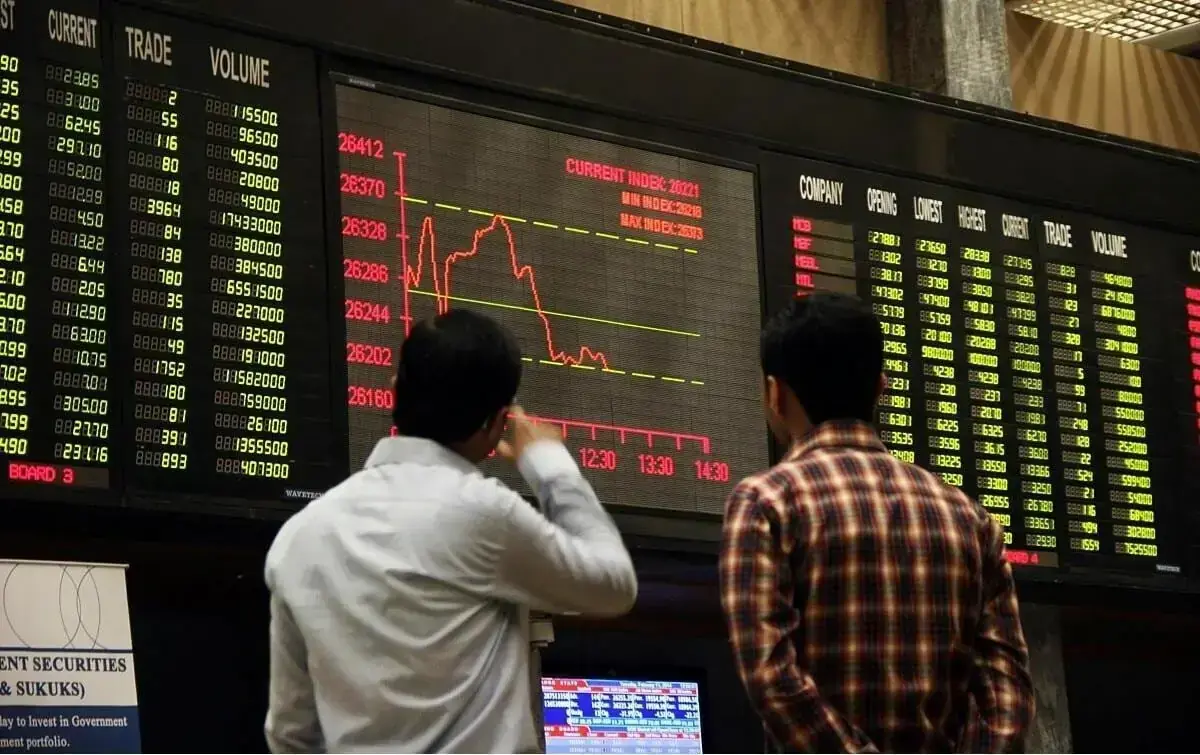

A day after intense selling pressure, buying momentum returned at the Pakistan Stock Exchange (PSX), with the benchmark KSE-100 Index gaining over 2,200 points during the opening minutes of trading on Tuesday.
At 9:35am, the benchmark index was hovering at 149,106.44, up by 2,263.47 or 1.54%.
Buying was observed in key sectors, including automobile assemblers, cement, commercial banks, oil and gas exploration companies, OMCs, power generation and refinery. Index-heavy stocks, including ARL, HUBO, MARI, POL, PSO, SNGPL, SSGC and WAFI, traded in the green.
On Monday, PSX remained under heavy selling pressure, extending its losing streak for a fourth consecutive Monday as geopolitical tensions over the weekend and cautious investor participation dragged the Index. The KSE-100 Index closed at 146,842.97 points, shedding 4,864.54 points or 3.21%.
Globally, oil prices on Tuesday were set for a record monthly rise while Asian shares were headed for their steepest fall since 2022, capping a tumultuous month as the war in the Middle East stoked fears of higher inflation and slower growth.
Bonds were headed for their largest decline in months, owing to the hawkish sea change in the global outlook for interest rates, while the dollar recorded its strongest gain in eight months.
A month into the war, investors continue to be whipsawed by a barrage of headlines as tensions and attacks between the U.S., Israel and Iran escalate.
Markets turned a little more upbeat after The Wall Street Journal reported that US President Donald Trump told aides he is willing to end the military campaign against Iran even if the Strait of Hormuz remains largely closed.
US futures reversed early losses, with Nasdaq futures up 0.34% and S&P 500 futures gaining 0.4%.
EUROSTOXX 50 futures rose 0.15%, and DAX futures were up 0.26%.
MSCI’s broadest index of Asia-Pacific shares outside Japan was down 0.55% and on track for a monthly fall of more than 12%, the most substantial decline since September 2022.
Japan’s Nikkei was down 0.93% and was set to lose 12.6% this month, while South Korea’s Kospi was headed for a monthly decline of more than 17%, the most since 2008.
This is an intra-day update





 American Dollar Exchange Rate