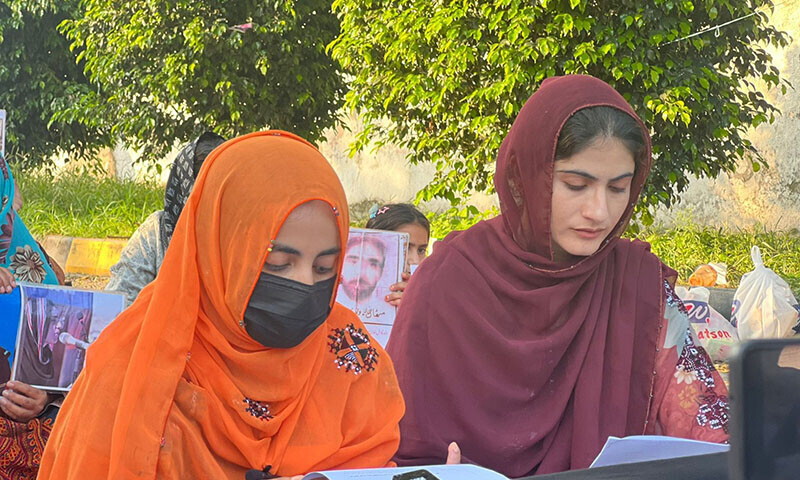

The Baloch Yakjehti Committee (BYC) on Sunday stated that it will continue its “peaceful” Islamabad sit-in, now in its 40th day, a press release from the group said.
The Islamabad sit-in began on July 16, with BYC leaders and members demanding the release of its activists. Its chief, Dr Mahrang Baloch and other activists were arrested on March 22 for allegedly attacking Quetta Civil Hospital and inciting violence, a day after police cracked down on their protest.
According to the press release, available with media.com, the group, during a press conference in Islamabad, expressed its willingness to continue the ongoing sit-in in the federal capital, stating that “one day these institutions will be forced to listen to our voice”.
“This protest is not just a protest of the Baloch people, it is a protest for justice,” the press release read. “This is a fight for human dignity and truth and it is the duty of all of us to support this fight.”
The statement read that the demonstrators had two demands: the release of Dr Mahrang and BYC activists Beebarg Baloch, Shaji Baloch and Gulzadi Baloch, among others, and the recovery of “all the forcibly disappeared persons” in Balochistan.
“We make it clear that Dr Mahrang Baloch and her associates are peaceful political activists and political prisoners, but under a systematic plan, they are being presented as terrorists so that the real voice of the Baloch nation can be suppressed,” the statement read.
“These demands are not the desire of any specific group but the voice of the collective conscience of society.”
Indirectly addressing journalists, the BYC’s statement regretted that the media and courts are “unable to fulfil their basic responsibilities”.
“The media distorts our legitimate and straightforward demands,” the statement read. “It was hoped that the courts would provide justice to the oppressed, but they are only strengthening oppression by repeatedly extending remand.”
The BYC noted that after a total of 45 days of remand, when the group’s leaders appeared in court on Friday, further remand was sought again on the same FIRs.
“Our lawyers insisted on not granting remand, on which the court rejected the remand in these FIRs and discharged them,” the statement read. “However, by bringing five new, baseless FIRs, the BYC leaders have been sent on remand for another 15 days.”
“We will continue our protest peacefully. We know that no matter how long the oppression lasts, it will not last forever,” the statement added. “We appeal to the people of the entire country, civil society, human rights institutions and the international community to stand with us.”
The BYC said it will expand its protest in the coming days, warning that it would take “strict action, the consequences of which will be the responsibility of the state itself”. Neither the action nor the consequences were elaborated upon in the statement.
“We want to make it clear that our protest is peaceful, will remain peaceful and we will not leave this place until our loved ones are released,” the BYC stated. “We stand by our demands, we will continue our struggle.”
BYC, a Baloch advocacy group active since 2018, has been campaigning against enforced disappearances.
Friday’s remand extension was the fourth time the BYC leaders have been presented before the court since their arrest. Initially, they were detained under Section 3 of the Maintenance of Public Order (3MPO). Following the expiry of their MPO detention, terrorism-related charges were filed against them.
A day earlier, Supreme Court Justice Athar Minallah elaborated on the difficulties judges faced regarding cases of missing persons and enforced disappearances in the face of non-cooperation by the state and lawmakers.
He said that when he ordered that disappearances be investigated or missing people be found, “the authorities would come and they would all say that we don’t know where they are”. At this, the judge pointed out: “The judge and the court cannot do anything when you don’t have independent investigators.”
Minallah said that during the four years he served as the Islamabad High Court’s chief justice, students from Balochistan would approach the court about disappearances in the province.
“When the Balochistan students came, I didn’t know what to do because it was out of my jurisdiction. The investigations had to take place in Balochistan. But the law did provide me with that jurisdiction.”
Earlier this year, former PPP senator and prominent human rights defender Farhatullah Babar warned against labelling Dr Mahrang, the BYC, or anyone “a terrorist” without evidence or trial, terming such statements “extremely problematic” that could “backfire”.




 American Dollar Exchange Rate