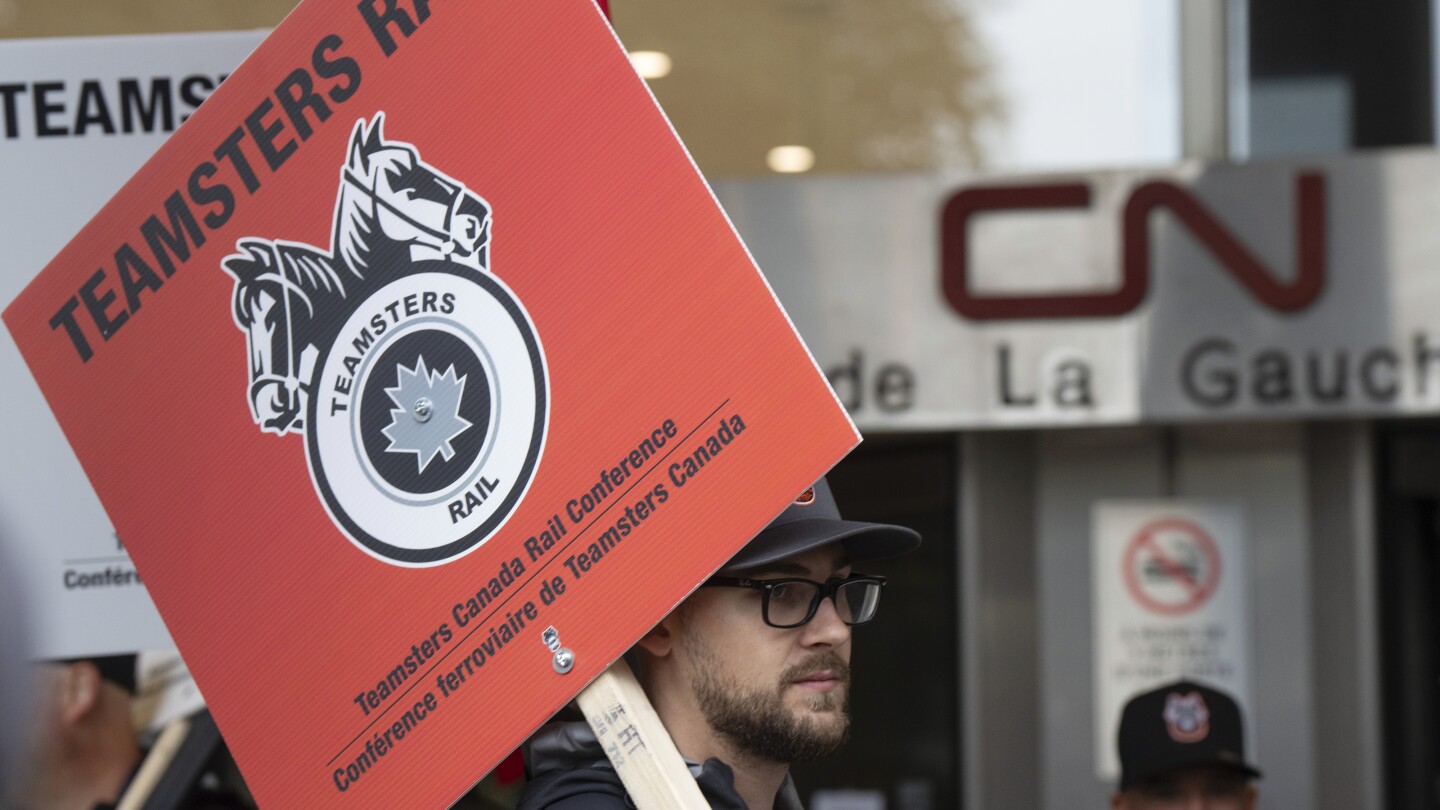
TORONTO (news agencies) — Canada’s two largest railroads have ground to a halt after an ongoing labor dispute couldn’t be resolved before the overnight deadline Thursday.

Canadian National and CPKC have shut down all their trains in Canada and stopped shipments into the U.S. after failing to reach new agreements with the Teamsters Canada Rail Conference union. The impasse could bring significant economic harm to business and consumers in both countries, which rely on billions of dollars of goods running on trains each month.
The big questions are how long the shutdown will last and whether the government will intervene. Here’s what to know.
It comes down to a labor-contract dispute.
CPKC and CN locked out nearly 10,000 engineers, conductors and dispatchers after the deadline passed. As a result, none of their trains are moving in Canada, but both railroads continue operating in the United States and Mexico.
Bargaining resumed Thursday, with picketing already underway. Both railroads have said they would end the lockout if the union agrees to binding arbitration. But in a Thursday post to X, Teamsters Canada Rail Conference President Paul Boucher accused CPKC and CN of “holding the Canadian economy hostage” in order to pressure the government to impose binding arbitration.
Both railroads are offering raises to what are already well-paying jobs that they say are consistent with other recent deals in the industry. The negotiations are primarily hung up on issues related to worker schedules and concerns about rules designed to prevent train crew fatigue.
CN had been negotiating with the Teamsters for nine months while CPKC had been trying to reach an agreement for a year, the unions said. While the full stop came to head Thursday, both railroads began shutting down shipping networks last week.
Billions of dollars of goods move between Canada and the U.S. via rail each month. The current impasse is halting all rail traffic from CPKC and CN in Canada as well as shipments from these two railroads crossing into the U.S., although trains will continue operating within in the U.S. and Mexico.
The consequences will be felt by both businesses and consumers.
Chemical businesses and food distributors will be among the first to be affected. The railroads already stopped accepting new shipments of hazardous materials when they began gradually shutting down last week, in order to keep dangerous commodities from being stranded along the tracks. Perishable goods were also put on hold early.
But Greg Moffatt, executive vice president of the Chemistry Industry Association of Canada, said most chemical manufacturers have said they will be OK for about a week. It just depends on how many supplies they have on hand, how much room they have to store their products, and whether they can cut production.
The auto industry may see problems, too. If the lockouts last more than two weeks, people who want to buy a new vehicle in the U.S. and Canada could start to see spot shortages, industry analysts say.
That’s because General Motors, Stellantis, Ford, Honda and Toyota either assemble whole vehicles in Canada or ship engines and other components across the border. About 80% of vehicles put together in Canada are shipped to the U.S., largely by rail. Michael Robinet, executive director at S&P Global Mobility, notes that most auto assembly plants operate on “just-in-time” inventories of parts — making it difficult to stockpile farther out.
Automakers could try to divert vehicles built overseas to U.S. ports, or ship parts over the border by truck, but capacity is limited, Robinet added.
And it’s not just cargo. More than 30,000 commuters in Vancouver, Toronto and Montreal were the first to feel the pain of the lockouts. They had to scramble Thursday morning to find ways to get to work because their commuter trains aren’t operating while CPKC is shut down.
Prime Minister Justin Trudeau declined to immediately force the parties into binding arbitration, out of fear of offending the Teamsters Canada Rail Conference and other unions.
But that could change.
“We are not taking this lightly because Canadians across the country are worried about it,” Trudeau told reporters in Sherbrooke, Quebec, Thursday. He added that “we will have more to say” shortly on finding a solution.
Still, the lack of early government intervention angered business leaders.







 American Dollar Exchange Rate