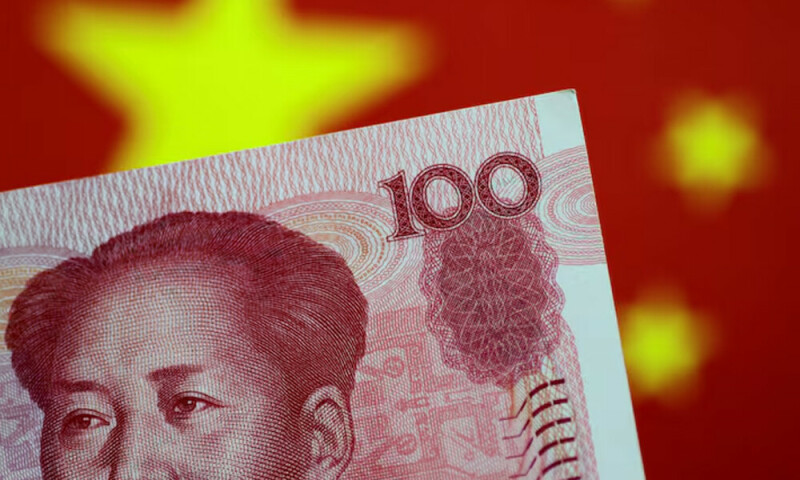

China’s top leaders and policymakers are considering allowing the yuan to weaken in 2025 as they brace for higher U.S. trade tariffs in a second Donald Trump presidency.
The contemplated move reflects China’s recognition that it needs bigger economic stimulus to combat Trump’s threat of bigger tariffs, people with knowledge of the matter said.
Trump has said he plans to impose a 10% universal import tariff, and a 60% tariff on Chinese imports into the United States.
Letting the yuan depreciate could make Chinese exports cheaper, thus blunting the impact of tariffs, and creating looser monetary settings in mainland China.
Reuters spoke to three people who have knowledge of the discussions about letting the yuan depreciate but requested anonymity because they are not authorized to speak publicly about the matter.
The People’s Bank of China (PBOC) did not immediately respond to Reuters requests for comments. The State Council Information Office, which handles media queries for the government, did not also immediately respond to a request for comment.
Allowing the yuan to depreciate next year would deviate from the usual practice of keeping the foreign exchange rate stable, the sources said.
China’s yuan inches higher as investors await key economic meeting
The tightly managed yuan is allowed to move 2% on either side of a daily mid-point fixed by the central bank. Policy comments from top officials typically include commitments to keeping the yuan stable.
While the central bank is unlikely to say it will no longer uphold the currency, it will emphasize allowing the markets more power in deciding the yuan’s value, a second source with knowledge of the matter said.
At a meeting of the Politburo, a decision-making body of the Communist Party officials, this week, China pledged to adopt an “appropriately loose” monetary policy next year, marking the first such easing of its policy stance in some 14 years.
The comments did not include a reference to the need for a “basically stable yuan”, which was last mentioned in July but missing in the September readout, too.
Yuan policy has figured heavily in financial analysts’ notes and other think-tank discussions this year.
In a paper published by leading thinktank China Finance 40 Forum last week, analysts suggested China should temporarily switch from anchoring the yuan to the U.S dollar to linking it instead to the value of a basket of non-dollar currencies, particularly the euro, to ensure the exchange rate is flexible during a period of trade tensions.
A third source privy to the central bank’s thinking told Reuters the PBOC has considered the possibility the yuan could drop to 7.5-per-dollar to counteract any trade shocks.
That’s a roughly 3.5% depreciation from current levels around 7.25.
During Trump’s first term as president, the yuan weakened more than 12% against the dollar during a series of tit-for-tat tariff announcements between March 2018 and May 2020.
Difficult choice
Yuan weakness could help the world’s second-biggest economy as it seeks to reach what is expected to be a challenging 5% economic growth target and relieve deflationary pressures by boosting export earnings and making imported goods more expensive.
A sharp downturn in exports would give further cause for authorities to try and use a weak currency to protect the one sector of the economy that has been doing well.
China’s exports “To be fair, it is a policy option. Currency adjustments are on the table as a tool to be used to mitigate the effects of tariffs,” said HSBC’s chief Asia economist Fred Neumann.
But that would be a short-sighted policy choice, he said.
“If China takes the currency aggressively lower, it raises the risk of a tariff cascade and other nations then essentially say, well, if the Chinese currency is weakening dramatically, then we may not have a choice to impose import restrictions on goods from China ourselves,” Neumann said.
“So there is a bit of a risk here that if China uses its currency angle too aggressively, it could lead to a backlash among other trading partners and that’s not in the interest of China.” ?
Analysts’ average forecast is for the yuan to fall to 7.37 per dollar by the end of next year. The currency has lost nearly 4% of its value against the dollar since the end of September as investors positioned for a Trump presidency.
The central bank has in the past contained volatility and disorderly moves in the yuan through its daily guidance rate to markets and through state banks’ buying and selling of the currency.
The yuan, or renminbi (RMB) as it is sometimes known, has struggled since 2022, weighed down by an anaemic economy and a drop in foreign capital inflows into China’s markets. Higher U.S. rates and falling Chinese ones have also kept it under pressure.
The yuan fell around 0.3% to 7.2803 per dollar after the Reuters story. The Korean won also dipped as did the China-sensitive Australian and New Zealand dollars.
In the coming days, next year’s growth, budget deficit and other targets will be discussed – but not announced – at an annual meeting of Communist Party leaders, known as the Central Economic Work Conference (CEWC).
A pledge to “maintain the basic stability of the RMB exchange rate at a reasonable and balanced level” was included in the CEWC summaries from 2020, 2022 and 2023. It was not included in those from 2019 and 2021.



 American Dollar Exchange Rate