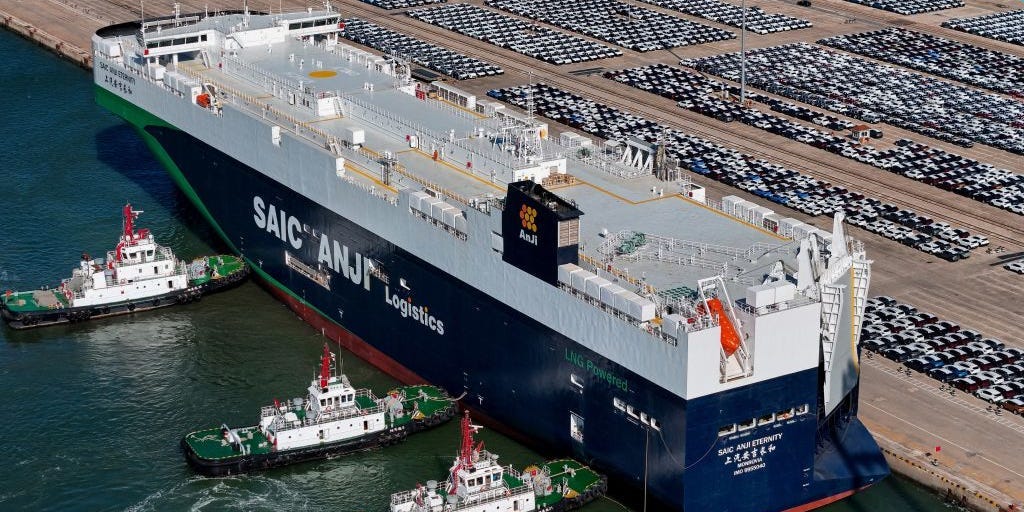
- Chinese firms that are setting up operations in countries outside China could face more scrutiny.
- Governments could start focusing on the ownership of companies rather than where goods come from.
- This means that Chinese firms working outside China to avoid tariffs would not be spared from levies.
America could lock out Chinese companies that use other countries to circumvent tariffs, said a top think tank chief.
Companies — including Chinese ones — have been shifting some production out of China. They’re trying to diversify their supply chains, which have been under more pressure in recent years thanks to the first Trump administration’s tariffs and Beijing’s disruptive pandemic lockdowns.
“I think there will be a lot of focus on if China’s using other countries for transshipment or if it’s Chinese companies that are going into another country, you’re going to see a new form of protectionism where we focus on rules of ownership, not rules of origin,” Michael Froman, the president of the US-based Council on Foreign Relations, said at a panel on Thursday at the World Economic Forum in Davos, Switzerland.
Trade is traditionally viewed based on the rules of origin, or which country a product came from. This is also how tariffs are generally applied.
However, governments could soon start to look at trade in a new way: through the lens of company ownership, said Froman, who served as the US Trade Representative from June 2013 to January 2017 under the Obama administration. This change would hit Chinese companies that are using transshipment hubs to avoid punitive measures.
“So it doesn’t matter that it’s coming from Mexico or Indonesia. If it’s a Chinese company and they’re violating rules, or they’re trying to circumvent the tariffs, they may well find themselves blocked from the United States,” said Froman.
In his first week in office, President Donald Trump said a 10% tariff on Chinese goods could come as soon as next month. While on the campaign trail, he threatened to put much higher tariffs — 60% — on Chinese goods.
Mexico, an auto hub, is becoming a prime location for Chinese manufacturers to relocate because the US is a key market for vehicles and parts.
In 2023, Chinese companies announced $2.7 billion worth of investments in Mexico’s auto sector, according to an analysis from research provider Rhodium Group. This is nearly three-quarters of Chinese investment into Mexico and is dominated by vehicle parts manufacturers.
The West is concerned about Chinese overcapacity
The West has slammed China’s overproduction of goods that have poured into global markets and hurt their economies.
“China is flooding strategic sectors with supply that’s well beyond what global demand can plausibly absorb, and therefore wiping out the competition,” said Daleep Singh, then the deputy national security advisor at the White House, in October.
Meanwhile, China is framing the West’s concerns about overcapacity as protectionism and as moves to curtail the country’s economic development.
“The US and Europe basically maintained an open rules-based system, but the rest of the world greatly benefited from including China,” said Froman.
“But all throughout that period, that benign international environment, we were warning China that if they continue to engage in protectionism, close their market to foreign investment, subsidize their industries at the expense of other countries, that benign international environment would disappear — and that’s exactly what’s happened,” he said.

- Chinese firms that are setting up operations in countries outside China could face more scrutiny.
- Governments could start focusing on the ownership of companies rather than where goods come from.
- This means that Chinese firms working outside China to avoid tariffs would not be spared from levies.
America could lock out Chinese companies that use other countries to circumvent tariffs, said a top think tank chief.
Companies — including Chinese ones — have been shifting some production out of China. They’re trying to diversify their supply chains, which have been under more pressure in recent years thanks to the first Trump administration’s tariffs and Beijing’s disruptive pandemic lockdowns.
“I think there will be a lot of focus on if China’s using other countries for transshipment or if it’s Chinese companies that are going into another country, you’re going to see a new form of protectionism where we focus on rules of ownership, not rules of origin,” Michael Froman, the president of the US-based Council on Foreign Relations, said at a panel on Thursday at the World Economic Forum in Davos, Switzerland.
Trade is traditionally viewed based on the rules of origin, or which country a product came from. This is also how tariffs are generally applied.
However, governments could soon start to look at trade in a new way: through the lens of company ownership, said Froman, who served as the US Trade Representative from June 2013 to January 2017 under the Obama administration. This change would hit Chinese companies that are using transshipment hubs to avoid punitive measures.
“So it doesn’t matter that it’s coming from Mexico or Indonesia. If it’s a Chinese company and they’re violating rules, or they’re trying to circumvent the tariffs, they may well find themselves blocked from the United States,” said Froman.
In his first week in office, President Donald Trump said a 10% tariff on Chinese goods could come as soon as next month. While on the campaign trail, he threatened to put much higher tariffs — 60% — on Chinese goods.
Mexico, an auto hub, is becoming a prime location for Chinese manufacturers to relocate because the US is a key market for vehicles and parts.
In 2023, Chinese companies announced $2.7 billion worth of investments in Mexico’s auto sector, according to an analysis from research provider Rhodium Group. This is nearly three-quarters of Chinese investment into Mexico and is dominated by vehicle parts manufacturers.
The West is concerned about Chinese overcapacity
The West has slammed China’s overproduction of goods that have poured into global markets and hurt their economies.
“China is flooding strategic sectors with supply that’s well beyond what global demand can plausibly absorb, and therefore wiping out the competition,” said Daleep Singh, then the deputy national security advisor at the White House, in October.
Meanwhile, China is framing the West’s concerns about overcapacity as protectionism and as moves to curtail the country’s economic development.
“The US and Europe basically maintained an open rules-based system, but the rest of the world greatly benefited from including China,” said Froman.
“But all throughout that period, that benign international environment, we were warning China that if they continue to engage in protectionism, close their market to foreign investment, subsidize their industries at the expense of other countries, that benign international environment would disappear — and that’s exactly what’s happened,” he said.







 American Dollar Exchange Rate