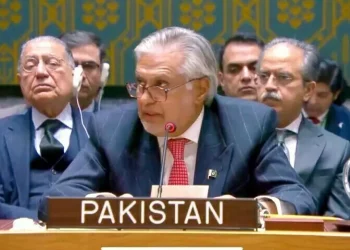
Inter-Services Public Relations (ISPR) Director General (DG) Lieutenant General Ahmed Sharif Chaudhry is currently addressing a press conference.

At the outset of the press conference, the military’s spokesperson said that the purpose of the briefing was to give a comprehensive overview of counter-terrorism measures taken in the past year.
This “is the only purpose of this press conference, and I would request that we remain focused on counterterrorism as terrorism is the biggest threat that is being faced by the state of Pakistan right now,” he added.
The DG ISPR said 2025 was a “landmark and consequential year in our fight against terrorism”, adding there were four reasons behind this conclusion.
Saying that the fight against terrorism was the entire nation’s and was being fought for more than two decades, the DG ISPR further stated that the past year witnessed “unprecedented intensity in counter-terrorism efforts”.
In 2025, he continued, the state of Pakistan, as well as the people, gained “complete clarity on terrorism”.
“The state already had this clarity, which permeated slowly and gradually down[ward] that these terrorists are khawarij [and] they have no relation with Islam. They are Fitna-al-Hindustan and have no relation with Pakistan or [the people of] Balochistan,” he elaborated.
Fitna-al-Khawarij is a term that the state has designated for the banned Tehreek-i-Taliban Pakistan (TTP), and it uses Fitna-al-Hindustan for Balochistan-based terrorist groups to highlight India’s alleged role in terrorism and destabilisation across Pakistan.
Lieutenant General Chaudhry further highlighted that in 2025, the world accepted and acknowledged Pakistan’s stance and narrative regarding terrorism, particularly about Afghanistan having become a “base of terrorism” operations.
Moreover, he said the last year also saw “how the National Action Plan (NAP) was reinvigorated and how it was being implemented”.
In this connection, he also mentioned that the vision for Azm-i-Istehkam — a counter-terrorism operation that was launched by the military in 2024 — had also been drawn from the revised NAP, and that all political parties and segments of society had reached a consensus that the implementation of the NAP was necessary to eliminate terrorism.
But “there are still deficiencies, and there is a lot of room for improvement” in the implementation of NAP, he acknowledged.
After outlining these four factors as the reasons behind the declaration of 2025 as a “landmark and consequential year” in terms of counter-terrorism, the DG ISPR went on to speak about them in detail.
He began with sharing data, according to which, law enforcement agencies of Pakistan — including the army, police, Federal Constabulary and intelligence agencies — conducted a total of 75,175 intelligence-based operations (IBO) in 2025.
“Which comes down to 206 IBOs per day,” he said. Giving a breakdown, he said that of these operations, 14,658 were conducted in Khyber Pakhtunkhwa, 58,778 in Balochistan and 1,739 in the rest of Pakistan.
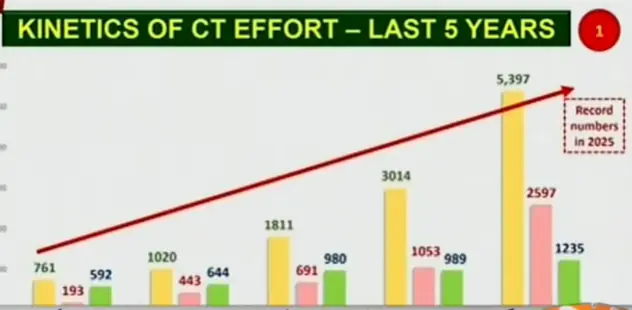
He added that 5,397 terror incidents took place in Pakistan during the last year, of which 3,811 were reported from KP (71pc), 1,557 from Balochistan (29pc) and 29 from other areas.
Moreover, 2,597 terrorists were killed in Pakistan in 2025, the DG ISPR said. Among them, 1,800 were killed in KP, 784 in Balochistan and 10 in other areas.
Last year, he continued, 1,235 law enforcement personnel and civilians were martyred in the fight against terrorism during 2025.
Sharing data about incidents of suicide bombing, he said a total of 27 had taken place in 2025. Of them, 16 took place in KP, 10 in Balochistan and one in Islamabad, at the judicial complex.
“Out of them, two [involved] female suicide bombers.”
In light of these facts and figures, he said, the question that came to mind was why the majority of terror incidents took place in KP.
“The primary reason for this is the politically conducive environnment that is being provided [to terrorists] there, and the political-terror nexus that is flourishing there,” he said.
The DG ISPR highlighted that data show that terrorism began rising from 2021. And a total of 193 terrorists were killed in comparison to 592 law enforcement personnel being martyred that year, he said, adding that it was a ratio of 1:3.
Moving to 2025, he pointed out that 2,597 terrorists were killed during last year and 1,235 law enforcement personnel were martyred. This would reduce to a ratio of 2:1, he added.
“But, more importantly, what happened in 2021 that terrorism rose?” he questioned, and went on to elaborate on the reason behind this development.
The DG ISPR explained that there was a change in Afghanistan in 2021 following the Doha Agreement.
“An armed group, the Afghan Taliban, sat down with the US and international partners and enter an agreement. Under the agreement, they made three commitments — that they will form an inclusive government in Afghanistan, use of Afghan soil for terrorism will not be allowed and women will be given rights [in Afghanistan],” the DG ISPR recalled.
But were the commitments fulfilled, the military spokesperson questioned.
“They were not. Is there a government there? There is no government there. They [just] call themselves interim Afghan government […] Is there an inclusive government there? No, there is not.
“Has terrorism been eradicated [from Afghanistan]? Contrarily, Afghanistan becomes a hub of terrorists and non-state actors. Terrorists of different creeds operate from there. So that is what started happening in 2001.”
More to follow




 American Dollar Exchange Rate