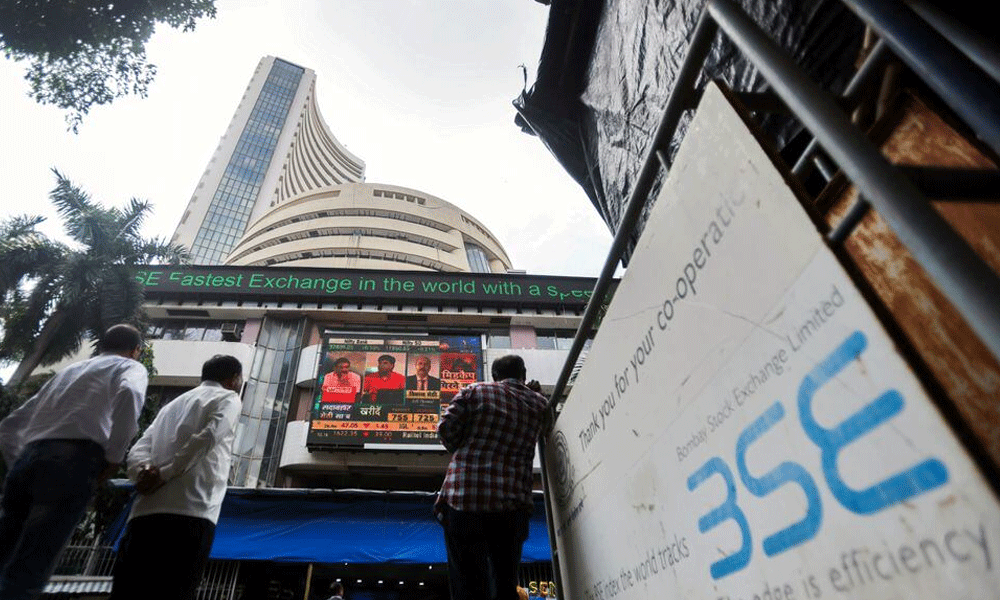

India’s stock benchmarks are poised for stronger returns in 2026, underpinned by improving earnings outlook, steady economic growth and more reasonable valuations after lagging global peers this year.
The Nifty 50 and Sensex advanced about 10.5% and 9.1%, respectively, in 2025, marking their tenth straight year of annual gains, but floundered in comparison to emerging and Asian markets, which rose 30% and 27%.
“We see scope for Indian equities to perform better over the coming year,” said Sunil Koul, global emerging market equity strategist at Goldman Sachs, citing policy support, stronger earnings and improving foreign risk appetite as valuations become more palatable.
Indian markets were subdued for much of 2025 amid concerns over weak earnings growth, a crumbling rupee, trade tensions with the U.S. and record foreign outflows.
The benchmarks returned to record highs in November after a 14-month gap, aided by tax cuts, Reserve Bank of India rate reductions and early signs of a pickup in corporate profitability in the second half, but failed to sustain the rally in December.
Market volatility stayed near record lows touched earlier this year as steady domestic inflows, earnings resilience and a stable macro backdrop curbed uncertainty and compressed risk premiums despite foreign selling.
A BETTER 2026
Brokerage estimates suggest the Nifty could climb to 28,992 by end-2026, implying an upside of about 12% from current levels, based on the average of 11 forecasts.
Large-cap valuations appear relatively attractive, with India’s premium to global and emerging markets dipping below the 10-year average after the 2025 underperformance, according to Goldman Sachs.
Equity mutual fund inflows stood at 3.22 trillion rupees ($35.88 billion) though November, while overall domestic institutional inflows totalled $87 billion, according to provisional NSE data.
Analysts, however, say market performance will be divided in 2026 as small-caps are expected to stay under pressure.
While the Nifty and mid-caps trade near their 10-year average price-to-earnings, small-caps remain expensive, commanding 12-month forward P/E multiples of 28x, well above the long-term average of 17x.
“With large-caps trading cheaper than the broader market, we expect market polarisation to persist,” said Gaurav Mehta, head of specialised investment fund of equity at SBI Mutual Fund.
The small-cap index fell 5.6% in 2025, while mid-caps rose 5.7%.
GAINERS AND LOSERS
Eleven of 16 major sectors advanced in 2025. Financials led gains on expectations of stronger credit growth, attractive valuations and RBI liquidity measures alongside big foreign investment deals in the sector.
Auto stocks rose about 24% on improving demand following tax and interest rate cuts, while metals jumped 29% on firmer demand signals from China and expectations of U.S. rate cuts in 2026.
IT fell 13% on weak U.S. client spending and a record $9 billion in foreign outflows from the sector.
Among individual stocks, Shriram Finance surged 72.4% on steady earnings and Japan’s MUFG 20% stake purchase.
Maruti Suzuki and Eicher Motors gained about 54% and 52% on improved earnings expectations after tax cuts.
Tata Consultancy Services fell about 20.5%, its worst year since 2008, while Trent slid 41%, making it the biggest percentage loser on the Nifty.







 American Dollar Exchange Rate