Hu Yousong/Xinhua via Getty Images
The Fed cut rates at its last meeting of the year
The Federal Reserve cut rates by a quarter-point Wednesday afternoon in alignment with expectations. Business Insider is covering developments live throughout the day, including Chair Jerome Powell's press conference, market moves, the 2026 outlook, and what it all means for your wallet.

The Fed's "dot plot" suggested one cut next year. The central bank was more split than usual, with three FOMC members voting against — the most since September 2019 — a mix of those who wanted to cut further and those who wanted to hold rates steady for now.
Stocks popped on the rate decision, even as the dissent among Fed officials points to heightened uncertainty over the path of monetary policy in 2026.
Check back here for updates — and tune into our live Q&A with reporters this afternoon at 4 p.m. ET.
The median Fed member expects one cut during 2026's Fed meetings. Most other members called for something more ambitious, outlining up to one full percentage point of cuts, or the equivalent of four typical reductions. Two voters hope for a slight rate hike instead.
"The Fed delivered its widely anticipated December rate cut but left a lot to be desired in terms of 2026 expectations," Ryan Weldon, investment director, portfolio manager at IFM Investors, said. "There were two dissenters in favor of holding, and the 2026 and 2027 dots remained stable, showing a median projection of one cut in each year."
Powell said the Fed has made progress this year in non tariff-related inflation. As levees flow through the economy, they will continue to have an impact in 2026. High consumer prices right now are due to inflation from months and years past.
"If you get away from tariffs, inflation is in the low-twos," he added, referring to the Fed's 2% inflation goal. Committee members haven't made a decision about January yet, but he said they are confident in monetary strategy aside from President Donald Trump's trade plans.
The announcement of new tariffs could shift the Fed's price outlook, he said.
The labor market may be able to stabilize in 2026 because of recent rate cuts, Powell said, though it's been a challenging year. "I think you can say that the labor market has continued to cool gradually," he said. Even as interest-rate sensitive sectors like housing remain volatile, he doesn't expect the unemployment rate to rise significantly going forward.
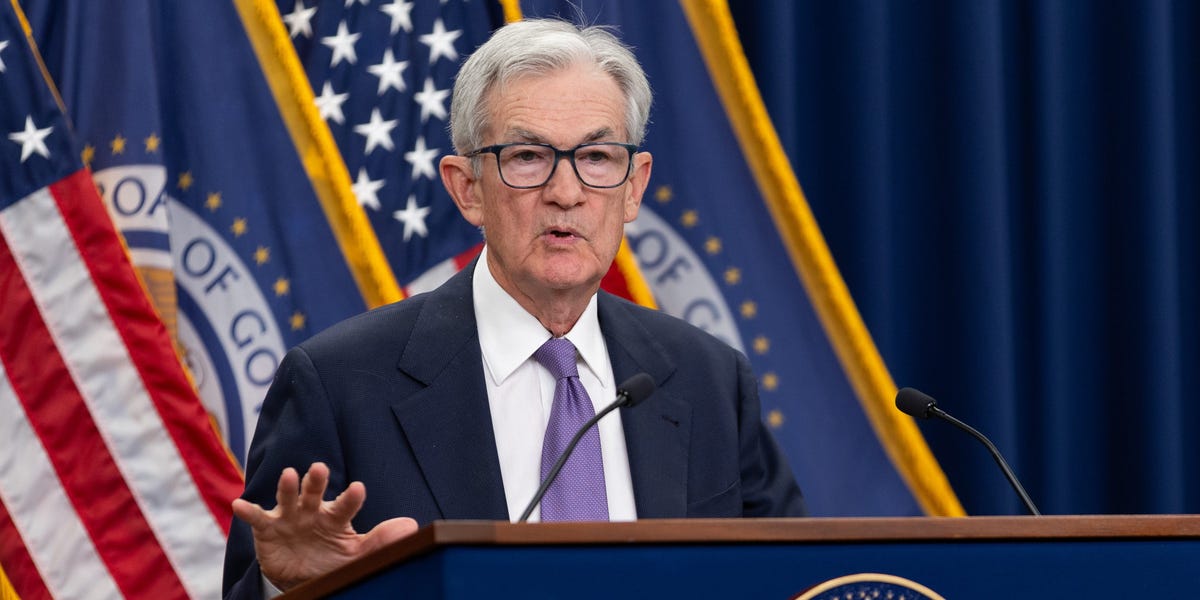
Powell addressed the Fed's uncharacteristic division — and said the disagreement shouldn't be a concern. All committee members agree that inflation is too high and the labor market has softened, he said. But, with the dual mandate goals in tension, "the difference is how you weigh those risks."
"The discussions we have are as good as any we've had in my 14 years at the Fed," Powell said. "They're very thoughtful and respectful and people have strong views. We come together and we make a decision."
The Fed chair said that interest rates are now within a broad range of its neutral value, and the central bank feels "well positioned to see how the economy evolves." Consumer spending has remained resilient and AI and data centers have been holding up the business environment, Powell said.
"Fiscal policy is going to be supportive, AI spending will continue and the consumer continues to spend," he said. "It looks like the baseline will be solid growth next year."
Elizabeth Renter, senior economist at NerdWallet, told Business Insider that balancing the Fed's dual mandate is more challenging without all the usual information that they could have used to make their call. She noted before the Fed's rate decision that the data picture was cloudy, given some canceled and delayed reports due to the government shutdown.
"But today's rate cut signals that though there may be disagreement at the Fed on the best path forward, most believe the risks to the labor market are more pressing," Renter said. "Though inflation remains elevated, it's not accelerating, and they're betting it will stay that way."
To open the press conference, Powell said the Fed remains "squarely focused on our dual mandate goal" to stabilize prices and balance the labor market.
There have been "no significant changes" to the jobs outlook since last month's meeting based on available private and public data. Economic activity is "expanding at a moderate pace," he said, emphasizing solid consumer spending, above-goal inflation, and a weak housing sector. Powell said the Fed expects higher GDP growth next quarter, though the "downside risks to employment appear to have risen in recent months."
Today's economic projections show the US median growth estimate as 2.3%, up from 1.8% in September. This faster growth outlook is a bright spot alongside sluggish labor market data, and the Fed expects the unemployment rate to stay muted around 4.4% next year.
Stocks popped on the rate decision, even as dissent among Fed officials points to heightened uncertainty over the path of monetary policy in 2026. The S&P 500 rose 0.4% and the Dow gained 300 points.
"We're looking for more discussion of the dissent at the press conference," said Paul Hickey, cofounder of Bespoke Investment Group, adding that beyond that, the market's expectations for what Jerome Powell could say may be more muted compared to past meetings. That's because the Fed chief is nearing the end of his term, and investors have already penciled in fewer rate cuts in 2026.
"This is just about exactly what the market expected, so any potential surprises will need to be teased out at the press conference," Art Hogan, chief market strategist for B. Riley Wealth, said after the decision. The move higher in bond yields since the middle of last month reflects a growing expectation among investors that rates aren't poised to fall much more and could actually rise again down the road.
"At the last meeting, there was a big reaction because the market was expecting cuts going forward, but they're not much of expecting anything now. I don't expect much between now and the end of his term," Hickey said.
Lower interest rates will ease the borrowing burden for consumers. A quarter-point cut could mean lower returns on investment for savers using high-yield savings accounts or certificates of deposit, though it would become cheaper to pay off credit cards. Thirty-year fixed mortgages, two-year auto loans, and credit card rates tend to fluctuate alongside the federal funds rate. Home equity lines and small business loans could also become more affordable over time.
Savers, however, could see less return on their high yield savings accounts.
Read full story
Dissenting to the quarter-point interest rate cut this afternoon were Governor Stephen Miran, who preferred a higher cut, as well as Austan Goolsbee and Jeffrey Schmid, who preferred a hold.
This is the most dissent among Fed members this year, and the first time there were three dissenters since September 2019.
Economic projections released this afternoon show the Fed has penciled in one more cut in the new year, though not all members agree.
The Fed publishes projections at the end of each quarter, which have shown a common theme in 2025. Some committee members are more cautious about inflation risks, while others have often called for steep cuts and quick relief to borrowers.
"It's natural," Powell said after the last set of projections showed division among Fed members. "I think it would actually be surprising if you didn't have a wide range of views in this highly unusual situation, and we do."
The Fed will cut interest rates by a quarter-point, in alignment with expectations. The move is the central bank's third rate reduction this year. Powell will hold a press conference at 2:30p EST to discuss.
Long-dated bonds in many developed markets have sold off. That's because rate-cut expectations for the months ahead have come down in recent weeks on expectations of sticky inflation and continued deficit spending by governments around the world.
"While we think these moves are overdone in many economies, we think there is still room for investors to pare back expectations for Fed easing," economists at Capital Economics wrote on Tuesday.
The 10-year Treasury yield—a benchmark for everything from mortgages to corporate debt—will edge up next year, Deutsche Bank says. That's because after its expected cut on Wednesday, the central bank is going to be more hawkish than markets expect. Key factors in the rate outlook the bank is watching include fiscal policy, oil prices, and AI.

Alex Wong/Getty Images
Trump has consistently put pressure on Powell to cut rates. "Jerome 'Too Late' Powell should have lowered rates long ago," the president wrote in a September Truth Social post. "As usual, he's "Too Late!"
Still, Powell has minimized the impact of White House influence: "We are strongly committed to maintaining our independence," he said in September. "It's deeply in our culture to do our job based on the incoming data and never consider anything else."
Like most of Wall Street, UBS sees the Fed cutting by 25 basis points on Wednesday.
Brian Buetel, managing director of UBS Wealth Management, believes that the easing cycle will continue into early 2026, with two additional rate cuts expected after December. For that reason, he expects the stock market to continue inching higher into year-end.
"The combination of lower rates, artificial intelligence, more productivity and additional fiscal support from government spending on infrastructure could help the markets achieve escape velocity in 2026."
Ahead of today's meeting, economists told Business Insider that the Fed is looking at a murky economic picture — but there's no major cause for alarm.
Claudia Sahm, the chief economist for New Century Advisors, expects the Fed to cut rates today but remain more cautious in the new year: "I have a feeling that if all goes well in the economy, the Fed probably is not going to be doing a whole lot because they took steps right now to ensure against the worst outcomes," she said. "Then it's just going to take time for the inflation to start moving back down."
Indeed Hiring Lab economist Cory Stahle said "We're still off to one of the worst starts we've had since 2010 after you take out the pandemic" from a labor market standpoint.
At the macro level, more Fed cuts would be good news for jobs. If companies can borrow money more cheaply, it would free up funds to hire and pay employees, which would speed up labor market churn and encourage more consumer spending.
Job growth has substantially slowed in recent months, and the Fed's cuts at its last two meetings aimed in part to stem that decline.

Thos Robinson/Getty Images for The New York Times
Without the most timely jobs and price data, the Fed may have to lean more on soft economic indicators. Consumer sentiment is making a recovery following midyear dips, but remains low.
On recent earnings calls, leaders at major companies like Amazon, Walmart, and more have said they are feeling the heat of tariffs and hoping to streamline their workforces. Many major employers have announced layoffs and cost cutting in 2025, with some carving out their middle management tier.

Anna Moneymaker/Getty Images
Investors anticipate a rate cut on Wednesday, with more to follow in 2026, but longer-term bond yields have been steadily rising. The 10-year Treasury yield is up 20 basis points from its November low, hovering around 4.20% on Wednesday.
Sources say the bond market is telegraphing a growing anxiety about the path of inflation in 2026. Trump ally Kevin Hassett, who recently shot to the top of the list of most likely next Fed chiefs, could lower rates aggressively if he takes over from Jerome Powell next year.
The calculus being made in the bond market seems to be that Hassett could lower rates too far, too fast, aggravating inflation and prompting a hawkish response from the Fed down the road.
Read full story
Powell has been the Fed chair since 2018 and his term ends in May 2026. Trump is set to announce his successor early next year — a decision that will steer future monetary policy.
Frontrunners to lead the central bank include Trump's economic advisor Kevin Hassett, Fed Governor Christopher Waller, Fed Governor Michelle Bowman, former Fed Governor Kevin Warsh, and Chief Investment Officer of global fixed income at BlackRock Rick Rieder.
Read full story

Alexi J. Rosenfeld/Getty Images
Fed leaders have shown uncharacteristic division in their decision-making this year. Minutes from recent meetings show that some Federal Open Market Committee members would prefer larger and more consistent interest rate cuts.
President Donald Trump has also been a vocal advocate for lower rates, at times threatening to fire Powell before the end of the chair's term. Trump appointee and Fed newcomer Stephen Miran joined the committee in August and has consistently pushed for more aggressive rate reductions.
The stock market opened nearly flat ahead of the 2 p.m. ET rate move. The S&P 500 was hovering around 6,840, while the Dow was up slightly to 47,580.
The week has been mostly quiet as investors await the central bank's decision. Major indexes are hovering close to records after climbing back from a tech-led sell-off in November. Investors are eagerly awaiting more rate cuts to help fuel further gains in 2026 as stocks head into the fourth year of the bull market.
The most recently released unemployment rate was still low, a little over 4%, but has slowly crept up this year. Job seeker frustration is compounded by a decline in job openings over the last few years.
Some demographics are also experiencing job market challenges more than others. Twenty-something college graduates are increasingly stuck submitting applications into the void, and the unemployment rate for Black Americans is nearly twice that of the general population.
The most timely inflation data won't be released in time for today's meeting, but Powell and his colleagues can look back on recent trends. Inflation rates remained above the Fed's 2% goal throughout 2025. The consumer price index — a key measure of inflation — cooled during the first few months of the year but began to creep up again in May.
Business Insider also asked our readers in November how prices have changed. About 200 readers responded; many said that the cost of groceries, dining out, and coffee has increased.
While investors expect the Fed to cut rates by 25 basis points, officials will probably send out some hawkish signals to the market on Wednesday, Goldman Sachs said.
Fed officials will likely suggest that the bar is higher for rate cuts going into next year, David Mericle, Goldman's chief US economist, wrote in a client note on Sunday. There will also likely be a handful of central bankers who will give "soft dissents" on where they see monetary policy going forward in the dot plot, he added.
The Fed is expected to pencil in just one more rate cut in 2026, followed by one rate cut in 2027, per Goldman's forecast.
With 60 minutes until the US stock market opens, it still looks like investors plan to spend Wednesday morning very much in wait-and-see mode.
As of 8:30 a.m. ET, futures tied to the Dow and the S&P 500 are roughly 0.1% higher, while Nasdaq futures are 0.25% lower.
Minimal moves in futures mirror Tuesday's quiet trading session, which saw the S&P 500 lose 0.1%, the Dow lose 0.4%, and the Nasdaq gain 0.1%

Marco Bello/REUTERS
If the current pattern of rate cuts continues, American consumers may soon feel relief. Thirty-year fixed mortgages, two-year auto loans, and credit card rates tend to fluctuate alongside the federal funds rate.
And, while inflation remains above the Fed's 2% goal, mortgage rates have largely cooled in recent months in anticipation of rate reductions. Lower rates could also make home equity lines and small business loans more affordable — though savers might see less return on their high-yield savings accounts.
Investors seem to be pricing in a "sell the news" reaction to Wednesday's rate decision, strategists at Morgan Stanley wrote in a note on Monday.
The bank added, though, that it remains optimistic about the market's direction over the medium term. That's because the job market looks on track to show moderate weakness in the coming months, which should clear the path for Fed rate cuts in 2026. Stronger earnings should also help lift the market higher, the bank said.

Spencer Platt/Getty Images
Powell has said the Fed's cautious strategy this year stems from uncertainty over President Donald Trump's fast-changing tariff policies and stubborn inflation rates. The job market, meanwhile, has had a rocky 2025.
Business Insider has heard from frustrated job seekers at all levels of the career ladder, particularly those feeling pushed out of white collar roles. This past summer, the number of Americans looking for work eclipsed the number of vacancies, though the unemployment rate itself is still relatively low.
There is no risk-free path for policyJerome Powell
"There is no risk-free path for policy as we navigate this tension between our employment and inflation goals," Powell said in October, adding, "Ultimately, lower rates will support more demand, and that'll support hiring over time. And, of course, we also have to be careful about this."
The Fed's dual mandate is to keep America's prices stable and the labor market healthy. These two goals have been challenging to balance this year: higher interest rates can help curb inflation but risk cooling down an already chilly labor market.
The Fed is also missing key pieces of data due to the government shutdown. The Bureau of Labor Statistics canceled the October consumer price index and unemployment rate releases, and the November jobs report and inflation data won't be released in time for today's meeting. December's decision will be more difficult without this information.
US stock futures are virtually unmoved as of just before 6:20 a.m. ET. Futures for all three of the Dow Jones, the Nasdaq, and the S&P 500 have moved less than 0.1% lower so far in this morning's trading.
There's a little more movement in European stocks, though nothing too drastic. Britain's benchmark, the FTSE 100, is up 0.2% on the day to 9,660, while Germany's DAX is 0.5% lower.
Away from stocks, the US dollar index is around 0.4% lower. The gold price is 0.3% down at roughly $4,200 per ounce.
Fed leaders have kept monetary policy moderately restrictive in recent months, holding rates steady until September before introducing two quarter-point cuts.
Chair Jerome Powell said in the last meeting that a rate change in December is "not a foregone conclusion, far from it" and "policy is not on a preset course," though on Wednesday morning, CME FedWatch is showing a roughly 90% chance of another quarter-point reduction.
Investors and consumers are hopeful for more cuts. Americans could see more affordable mortgage, auto, and credit card rates in the new year, and businesses would be able to borrow money more easily — a move that could juice the sluggish job market.







 American Dollar Exchange Rate