

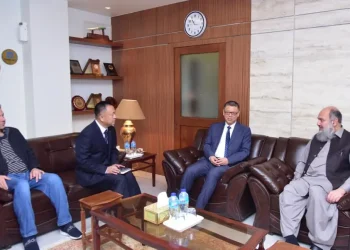
Finance Minister Senator Muhammad Aurangzeb on Monday met Saudi Finance Minister Mohammed Aljadaan on the sidelines of the World Economic Forum (WEF) Annual Meeting 2026 to discuss Pakistan’s economic outlook and avenues for enhanced investment cooperation.
During the meeting, both sides exchanged views on Pakistan’s recent economic progress and reaffirmed their commitment to strengthening the long-standing economic partnership between Pakistan and Saudi Arabia.
Aurangzeb briefed his Saudi counterpart on key macroeconomic indicators, saying Pakistan’s economy was firmly on a stabilisation and growth trajectory. He said foreign exchange reserves had improved, providing an import cover of around three months, reflecting enhanced macroeconomic resilience.
READ MORE: Trump to attend World Economic Forum in Davos next week: organisers
Highlighting improving investor sentiment, the finance minister said 16 initial public offerings (IPOs) were currently in the pipeline, following the completion of nine IPOs last year. He added that more than 120,000 new investors had entered the capital market, signalling renewed confidence in the economy.
The finance minister said interest rates had started to decline, while reaffirming the independence of the State Bank of Pakistan in setting monetary policy. He noted that economic growth stood at 3.1% last year and had accelerated to 3.7% in the first quarter of the current fiscal year.
Aurangzeb said the government remained focused on maintaining a sustainable current account balance alongside steady GDP growth. He also highlighted the role of remittances in supporting economic stability, with inflows expected to rise from $38 billion last year to over $41 billion this year.
READ MORE: World Economic Forum chief warns of three possible ‘bubbles’ in global economy
He said growth in IT services was contributing positively to the current account and acknowledged Saudi Arabia’s continued support to Pakistan in this regard.
The finance minister outlined the government’s efforts to attract foreign direct investment, particularly in priority sectors including minerals and mining, agriculture and export-oriented industries.
He also briefed the Saudi minister on Pakistan’s privatisation programme, noting recent progress including foreign investment in a digital venture and developments related to Pakistan International Airlines. He said the government planned to proceed with phased privatisation of selected state-owned enterprises, including certain power distribution companies and major airports in Islamabad, Lahore and Karachi.
Saudi Finance Minister Mohammed Aljadaan shared Saudi Arabia’s experience with privatisation, citing the transformation of airports into revenue-generating assets as an example of successful economic reform.
The meeting concluded with both sides reaffirming their commitment to deepening economic cooperation and expanding investment ties between Pakistan and Saudi Arabia.



 American Dollar Exchange Rate