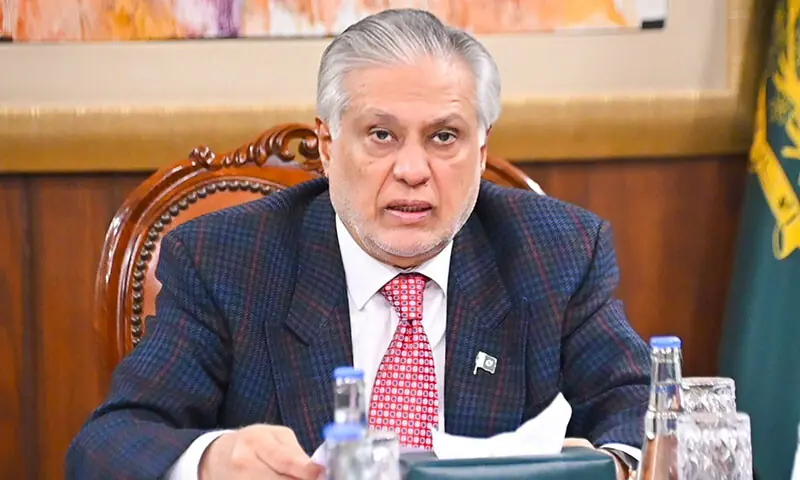

Deputy Prime Minister and Foreign Minister Ishaq Dar was on Friday elected chairman of the Economic Cooperation Organisation’s Council of Ministers (ECO-COM), according to the Foreign Office (FO).
The ECO was founded as the Regional Cooperation for Development (RCD) in 1964 by Pakistan, Iran and Turkiye, before it changed its name in 1985. The organisation’s website states that its purpose is “to create amenable and conducive conditions for the continued promotion of sustainable economic development in the region”.
The 10 member states include Pakistan, Iran, Turkiye, Afghanistan, Azerbaijan, Kazakhstan, Uzbekistan, Turkmenistan, Kyrgyzstan and Tajikistan.
According to an FO statement, today’s meeting of the COM was held virtually and Dar underscored the body’s important role in fostering prosperity, economic integration and connectivity in the region.
“He reaffirmed Pakistan’s commitment to the ECO Vision 2025 and expressed Pakistan’s intent, as incoming chair of the ECO COM, to work closely with member states in finalising the ECO Vision 2026-2035,” the FO stated.
“The deputy prime minister/foreign minister emphasised Pakistan’s priority to strengthen multimodal transport corridors, harmonise customs frameworks, and align transport systems for seamless regional integration,” it added.
According to the FO, Dar reiterated Pakistan’s commitment to key regional connectivity projects, including the Islamabad–Tehran-Istanbul Rail Corridor, the Eurasian Multimodal Corridor and the Uzbekistan, Afghanistan and Pakistan Railway.
The FM recalled the Regional Transport Ministers’ Conference in Islamabad last month and noted that Pakistan is “actively shaping regional transport cooperation in road, rail, maritime and digital connectivity”.
“He (Dar) also highlighted Pakistan’s liberalised visa policy, enabling easier access for businesspersons and tourists from 126 countries,” the statement read.
Dar stressed the need for ECO members to bolster cooperation in various sectors and spheres, including sustainable transport, transit trade, customs harmonisation, climate-resilient infrastructure and counter-terrorism.
In an address to the meeting, he said that Pakistan sees the ECO as a useful platform to reinforce ties among members through multilateral engagements.
“Pakistan remains steadfast in its efforts to advance the goals of regional connectivity through integrated and efficient transport corridors,” he said, adding that establishing transport corridors in the region was a key goal of Islamabad’s.
“Despite the above efforts, we all need to acknowledge that there is significant untapped potential for improving the sustainability of transport and transit trade among the ECO regional countries,” he said, outlining four key areas of focus:
- Full implementation of the Transit Transport Framework Agreement (TTFA);
- Development of a coordinated multimodal transport network;
- Simplification and harmonisation of customs and border procedures through capacity building and technology transfer; and
- Promotion of sustainable and climate-resilient transport systems aligned with our international environmental commitments.




 American Dollar Exchange Rate