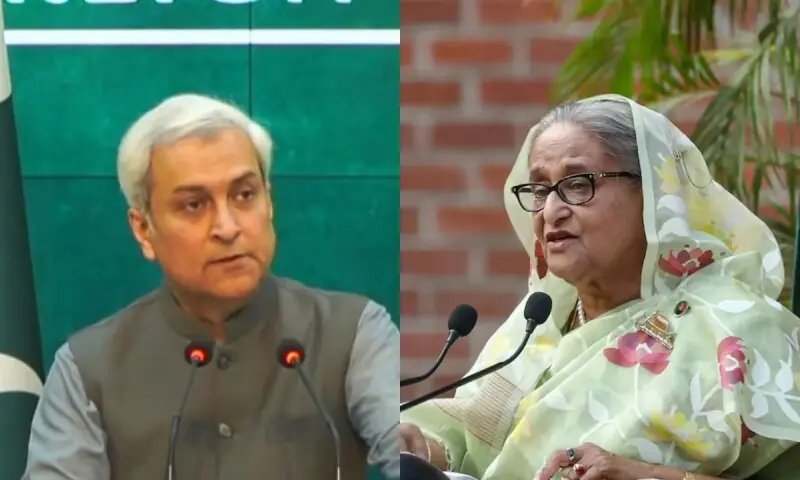

Pakistan on Friday said that the recent death sentence for former Bangladesh prime minister Sheikh Hasina was an “internal matter” for the country and that its people were fully capable of solving their own issues.
A Bangladesh court had sentenced Hasina to death on Monday, concluding a months-long trial that found her guilty of ordering a deadly crackdown on a student-led uprising last year.
The ruling came months ahead of parliamentary elections expected to be held in early February.
Addressing his weekly press briefing today, Foreign Office (FO) Spokesperson Tahir Andrabi said several queries were received regarding the development, on which he said: “This is an internal matter of Bangladesh. The people of Bangladesh are fully capable of addressing their issues in accordance with their own democratic and constitutional processes.”
Hasina was found guilty of ordering lethal force by a tribunal in the capital Dhaka, 15 months after resigning and fleeing to India in the face of a student-led uprising that killed hundreds or more.
The verdict by the International Crimes Tribunal — a court that Hasina set up to try war crimes from Bangladesh’s 1971 war for independence from Pakistan — marked a dramatic turn for a political career that began when she avoided death during the 1975 coup because she happened to be in Europe.
After the sentence was handed down, the Bangladesh government had told India that failure to return her would be a highly unfriendly gesture and an affront to justice.
“Under the existing extradition treaty between the two nations, this is a binding obligation for India,” Bangladesh’s foreign ministry had said in a statement.
But all previous efforts so far to persuade New Delhi to send her back have faltered.
New Delhi said it was committed to “the best interests of the people of Bangladesh, including in peace, democracy, inclusion and stability in that country. We will always engage constructively with all stakeholders to that end”.
The development also came amid a thaw in ties between Islamabad and Dhaka, with trade and bilateral relations seeing a marked improvement.
FO condemns targeting of Kashmiris in wake of Delhi blast
Andrabi issued a statement condemning the recent wave of arbitrary arrests and detention of people in India-occupied Kashmir after a bomb blast in New Delhi.
“Pakistan remains gravely concerned about the persistent and serious human rights situation in the Indian Illegally Occupied Jammu and Kashmir,” he said.
“The prevailing policies, marked by widespread detentions, arbitrary arrests, and extensive restrictions on fundamental freedoms, continue to amount to collective punishment of the occupied Kashmiri population.”
Andrabi added that reports of Kashmiri youth being profiled based on their identity and faith “further heighten these concerns”.
“India continues its efforts to alter the demographic character of the occupied territory and to erode the religious, cultural, and social heritage of the Kashmiri people,” the statement added.
“These measures appear to form part of a deliberate strategy to suppress the legitimate aspirations of the Kashmiri population.”
Andrabi added that thousands of Kashmiri youths remain missing, while political representatives remain in custody. He said that these actions cannot undermine the Kashmiri people’s “enduring commitment to realising their internationally recognised right to self-determination”.
“Pakistan calls upon the international community, including the United Nations, the Human Rights Council and the Office of the UN High Commissioner for Human Rights, to take full cognisance of the grave human rights situation in IIOJK,” the statement read.
The FO requested that international bodies urge India to take immediate remedial measures, ensure accountability for documented violations and allow international human rights organisations to conduct independent and impartial assessments.
“A just, peaceful, and lasting resolution of the Jammu and Kashmir dispute, in accordance with relevant UN Security Council resolutions and the aspirations of the Kashmiri people, remains essential for durable peace and stability in South Asia,” the statement concluded.






 American Dollar Exchange Rate