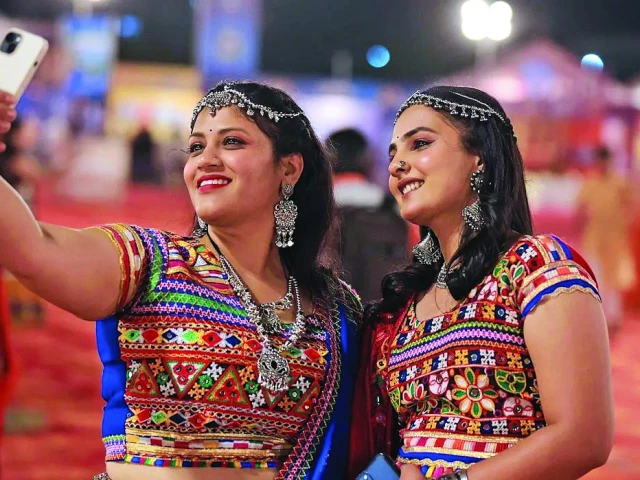
How India’s Gen Z is redefining spirituality

Rohit Singh was born into a Hindu family, but he doesn’t identify as religious. The 24-year-old does, however, occasionally go to the local temple as well as gurudwara, a place of worship and assembly in Sikhism.
Singh also believes in astrology, and this month joined his cousins on the Kanwar Yatra, an annual pilgrimage of devotees of Lord Shiva, one of the three major Hindu deities revered in India.
“I am not religious, I am spiritual,” he told DW. “I don’t go to the temple as frequently as my parents, I go sometimes for the calm and peaceful vibe. I started going when I was unable to find a job and my mental health was at its worst.”
The resident of Gurugram, a tech and finance hub just outside the capital, New Delhi, still hasn’t found a job. But he says his spirituality has helped his mental health.
“A lot of my friends are like me. We just want some solace,” he says.
Interest in religion is declining worldwide. A study by Pew Research Center showed that religious affiliation fell globally by 1 per cent in the decade spanning 2010 to 2020. In the same period, the percentage of people who showed no religious affiliation grew from 23 to 24.2 per cent.
But in India, it’s a different story.
Spirituality to cope
In the same Pew study, the global population of Hindus — 95 per cent of whom live in India, where they form 80 per cent of the population — held steady, whereas the number of Muslims, who represent more than 14 per cent of Indians, grew.
Unlike many around the world, India’s youth, which makes up 65 per cent of its population, seem to be reconnecting with religion and spirituality. But they are doing it in their own way.
A YouGov-Mint survey showed 53 per cent of India’s Gen Z — which refers to people born roughly between 1997 and 2012 — believe religion is important and 62 per cent of them pray regularly.
An MTV Youth Study in 2021 found that 62 per cent of India’s Gen Z believe spirituality helps them gain clarity. Almost 70 per cent said they felt more confident after prayer.
“Gen Z has a lot of different vocabulary that they can lean on to explain what they are feeling, which is different from previous generations,” counselling psychologist Manavi Khurana told DW.
“Terms like healing, grounding, getting in touch with the self. Spirituality, religion, wellness and well-being all get mixed up, though they have intersections as well,” Khurana added.
She is the founder of the mental health organization Karma Care in Delhi, which has a mix of Millennial (people who were born roughly between 1981 and 1996) and Gen Z clients.








 American Dollar Exchange Rate