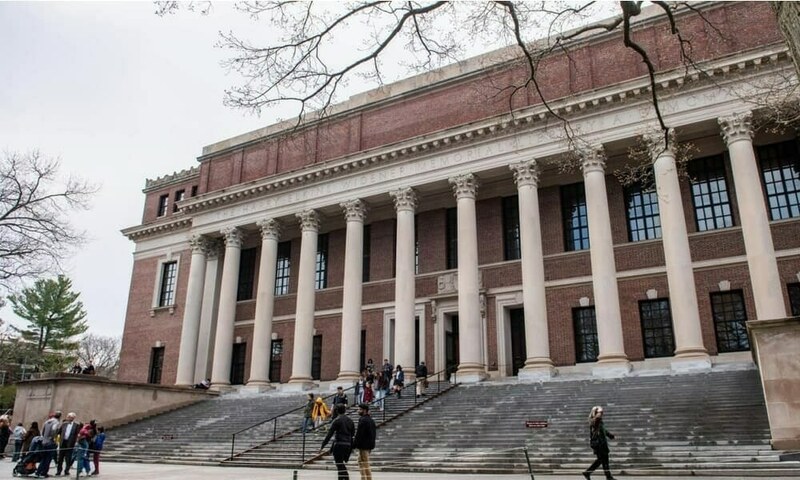

TOKYO/BEIJING/LONDON: Universities around the world are seeking to offer refuge for students impacted by US President Donald Trump’s crackdown on academic institutions, targeting top talent and a slice of the billions of dollars in academic revenue in the United States.
Osaka University, one of the top ranked in Japan, is offering tuition fee waivers, research grants and help with travel arrangements for students and researchers at US institutions who want to transfer.
Japan’s Kyoto University and Tokyo University are also considering similar schemes, while Hong Kong has instructed its universities to attract top talent from the United States. China’s Xi’an Jiaotong University has appealed for students at Harvard, singled out in Trump’s crackdown, promising “streamlined” admissions and “comprehensive” support.
Trump’s administration has enacted massive funding cuts for academic research, curbed visas for foreign students – especially those from China – and plans to hike taxes on elite schools.
Trump alleges top US universities are cradles of anti-American movements. In a dramatic escalation, his administration last week revoked Harvard’s ability to enrol foreign students, a move later blocked by a federal judge.
Masaru Ishii, dean of the graduate school of medicine at Osaka University, described the impact on US universities as “a loss for all of humanity”.
Japan aims to ramp up its number of foreign students to 400,000 over the next decade, from around 337,000 currently.
Jessica Turner, CEO of Quacquarelli Symonds, a London-based analytics firm that ranks universities globally, said other leading universities around the world were trying to attract students unsure of going to the United States.
Germany, France and Ireland are emerging as particularly attractive alternatives in Europe, she said, while in the Asia-Pacific, New Zealand, Singapore, Hong Kong, South Korea, Japan, and mainland China are rising in profile.
SWITCHING SCHOOLS
Chinese students have been particularly targeted in Trump’s crackdown, with US Secretary of State Marco Rubio on Wednesday pledging to “aggressively” crack down on their visas.
More than 275,000 Chinese students are enrolled in hundreds of US colleges, providing a major source of revenue for the schools and a crucial pipeline of talent for US technology companies.
International students – 54% of them from India and China – contributed more than $50 billion to the US economy in 2023, according to the US Department of Commerce.
Trump’s crackdown comes at a critical period in the international student application process, as many young people prepare to travel to the US in August to find accommodation and settle in before term starts.
Dai, 25, a Chinese student based in Chengdu, had planned to head to the US to complete her master’s but is now seriously considering taking up an offer in Britain instead.
“The various policies (by the US government) were a slap in my face,” she said, requesting to be identified only by her surname for privacy reasons. “I’m thinking about my mental health and it’s possible that I indeed change schools.”
Students from Britain and the European Union are also now more hesitant to apply to US universities, said Tom Moon, deputy head of consultancy at Oxbridge Applications, which helps students in their university applications.
He said many international students currently enrolled at US universities were now contacting the consultancy to discuss transfer options to Canada, the UK and Europe.
According to a survey the consultancy ran earlier this week, 54% of its clients said they were now “less likely” to enrol at an American university than they were at the start of the year.
There has been an uptick in applications to British universities from prospective students in the US, said Universities UK, an organisation that promotes British institutions. It cautioned, however, that it was too early to say whether that translates into more students enrolling.




 American Dollar Exchange Rate