
• Overhaul aims to cut customs, regulatory duties
• Reforms expected to boost exports by $5bn in five years
• Simple average tariff to fall from 19pc to 9.5pc
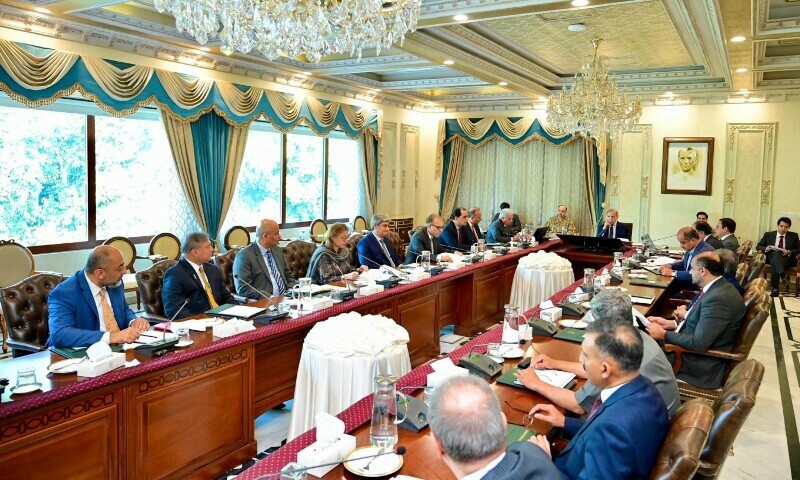
ISLAMABAD: In a major policy shift, Prime Minister Shehbaz Sharif has approved a comprehensive five-year tariff reform plan to be announced in the federal budget 2025-26, aiming to drastically reduce customs duties, additional customs duties, regulatory duties on raw materials and semi-finished goods, and a phased reduction in overall tariff protections for select industries.
The first phase of the reform, set to be launched with the next budget, introduces a simplified customs duty structure with slabs of 0, 5, 10, 15, and 20 per cent. The existing 16pc slab will be reduced to 15pc, while the 11pc rate will drop to 10pc. The 3pc slab will be abolished, with products either moved to a zero-duty category or the new 5pc slab.
The proposed tariff overhaul, seen by media, is set to eliminate the additional customs duty of 2pc on 4,294 tariff lines in the upcoming budget. The plan also includes a reduction of additional customs duty from 4pc to 2pc on 545 tariff lines, from 6pc to 4pc on 2,227 tariff lines, and from 7pc to 6pc for all products currently subject to a customs duty above 20pc.
The government is set to slash regulatory duties, which currently reach as high as 90pc on various products, bringing them down to a maximum of 30pc. Finance Minister Muhammad Aurangzeb has also supported the major overhaul of the tariffs to boost industrial production in the country.
A further substantial cut is scheduled for next year’s budget, while the final three years of the plan will see a gradual, nominal reduction in tariffs.
According to estimates, this tariff rationalisation is projected to boost exports by approximately $5 billion by the end of the plan’s implementation, reinforcing Pakistan’s drive towards a more competitive global trade position.
Five-year roadmap
Industries such as auto, iron and steel, textiles, chemicals and plastics — currently shielded by effective tariff rates ranging between 100pc and 150pc — will see those rates reduced to around 50pc to 60pc. The premier said his government’s priority is to shift away from import substitution to an export-led growth strategy.
Under its ambitious reform agenda, the government has set a target to slash the simple average tariff from the current 19pc to 9.5pc within five years. A key adjustment in the plan includes restructuring duty slabs, replacing the existing slabs of 0pc, 3pc, 11pc, 16pc and 20pc with a streamlined system of 0pc, 5pc, 10pc and 15pc. This will not only simplify the tariff structure but also bring certainty, transparency, and uniform cascading margins that are easy to administer and comply with.
By the end of the five-year implementation period, the tariff overhaul will establish a uniform maximum duty slab of 15pc, eliminating sector-specific peaks that previously exceeded 20pc — primarily affecting the auto industry.
The additional customs duties currently set at 2pc, 4pc, 6pc and 7pc across various slabs will be gradually phased out to zero within the next three to four years.
Regulatory duties, which presently range from 5pc to 90pc on various products, will also be fully eliminated over five years, easing import costs and improving market accessibility.
Moreover, the 5th Schedule of Customs, which provides industry-specific tariff concessions, will be dissolved, with all products covered under it transitioning to the 1st Schedule in a phased manner.
According to the tariff reform plan, these concessions will either be discontinued or extended universally, ensuring a more equitable trade policy across industries.
Exports-led growth strategy
The government has decided to embark on an outward-looking, export-led growth tariff policy. This major shift in the trade and tariff policy is based on thorough research, evidence from successful economies and Pakistan’s own experience.
The drastic cuts in duties will provide full support to the vulnerable sectors and industries. The cascading principle will be maintained and industries will still enjoy substantially high effective rates of protection.
The current high, complex, and discriminatory tariff structure has favoured only a few big businesses, which over time have become less efficient and unproductive.
The vested interests taking advantage of the myths and disconnects around tariff reforms are raising their voice against the reforms, a senior Customs officer said. “There is no truth to the assertions that tariff rationalisation would affect external balance or revenue generation negatively,” the officer claimed.
Scientific models used in policy analysis suggest that while imports may rise slightly, exports are expected to grow at a faster pace, improving the trade balance. More than 45pc of imports are inelastic — comprising food and energy — and historically, spikes in the import bill have stemmed from global price hikes rather than imports of industrial inputs.
It is expected that this shift from import substitution to an export-led policy will give a much-needed boost to the economy. Lower tariffs will reduce anti-export bias and help businesses, especially small businesses in textile, agriculture and light engineering sectors, to integrate into global value chains, the policy said.
Published in media, May 16th, 2025



 American Dollar Exchange Rate