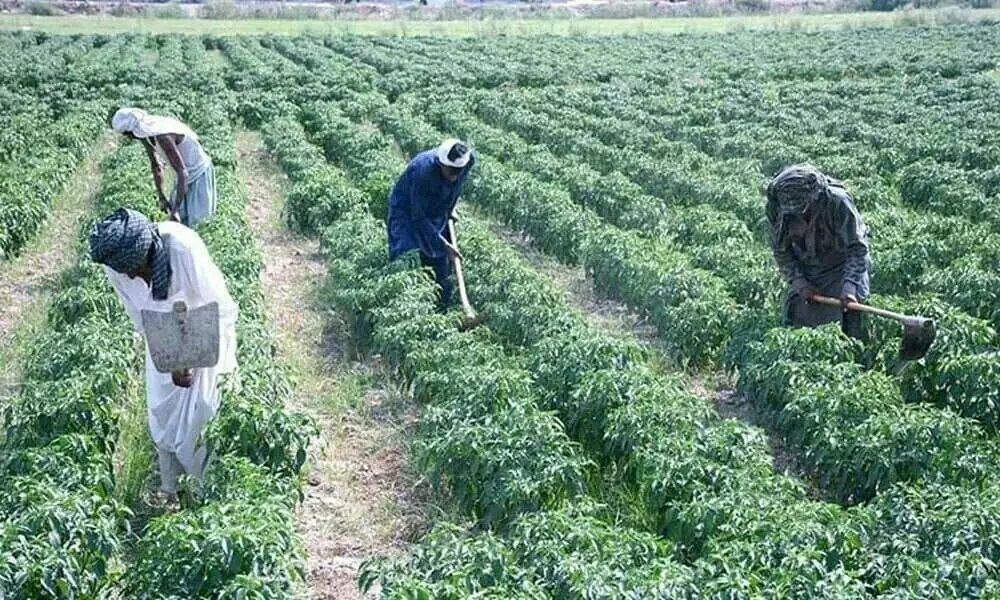

Progressive growers have pleaded for cooperative farming with a view to fostering the agriculture sector, ensuring food security, adopting technology and above all supporting small growers and generating more employment.
They said the government must form a fully-fledged mechanism for cooperative farming, including soft loans and support to small farmers.
The agriculture sector is the backbone of the national economy, employing a major share of rural population and ensuring food security of the country.
Also read: KSA eyes corporate farming investment in Pakistan
Sindh Chamber of Agriculture (SCA) senior vice president Nabi Bux Sathio said, “We must promote cooperative farming instead of corporate farming. If a couple of farmers together shift the mechanised farming, this modus operandi will be way more useful. We are against corporate farming including giving the state’s agricultural lands to multinational companies for farming.”
- Cooperative farming is a voluntary system where farmers pool land, labour, and capital to improve productivity, share machinery, and collectively market produce.
He said the country was facing an acute shortage of water, thousands of acres of lands in Cholistan, Tharparkar and others were lying barren.
Farmers face water crisis for four months including March, April, May and June, according to Sathio.
“There is little rain during this season every year and the country’s reservoirs also dry up as it is difficult to develop new agricultural lands in this current scenario,” Sathio said.
According to the country’s new agriculture census, a critical insight is shown as 95% of landholdings are now below 5.5 acres.
SCA official said the figures were witnessed in Punjab. “When it comes to the computerised record of landholdings of Sindh, 82% of landholdings are 12 acres, 18% landholdings go up 12 acres of lands including 16 acres, 25 acres, 50 acres, 100 acres and the like”.
Sindh Agriculture Research Council (SARC) President and progressive farmer Ali Palh said a large number of small farmers were usually there as massive farming was not easily possible everywhere in the world.
“Big farmers are generally unable to cover big landholdings for want of management, resources, supervision and that. It is good for big farmers to switch over to cooperative farming to utilise agricultural lands efficiently.”
He said, “Let me reminisce about the cooperative farming of olden days, when two brothers or family members used their respective workers on their respective lands, we call this method cooperative farming.”
“I think cooperative farming is far better than corporate farming. Corporate farming will cause unemployment, discourage farmers, and damage unique rural culture. The cooperative farming of olden days must take place, including a role of daily-wage earners, small farmers, big farmers and above all small farmers may progress in this method of farming.”
Also read: Cotton crop revival: APTMA holds briefing on cluster farming model
For example, Ali Palh continued, if millers wanted to make Gur or sugar, textile products and that, they should work with farmers to make them, they must give facilities, prerogatives to small farmers, they must promote both their own interests and the interests of small growers.
“If cooperative farming is adopted, small growers could not fall prey to exploitation”, he said. “Small farmers like cooperative farming that is amicable, useful, business-friendly, fearless, better growth and the like.”








 American Dollar Exchange Rate