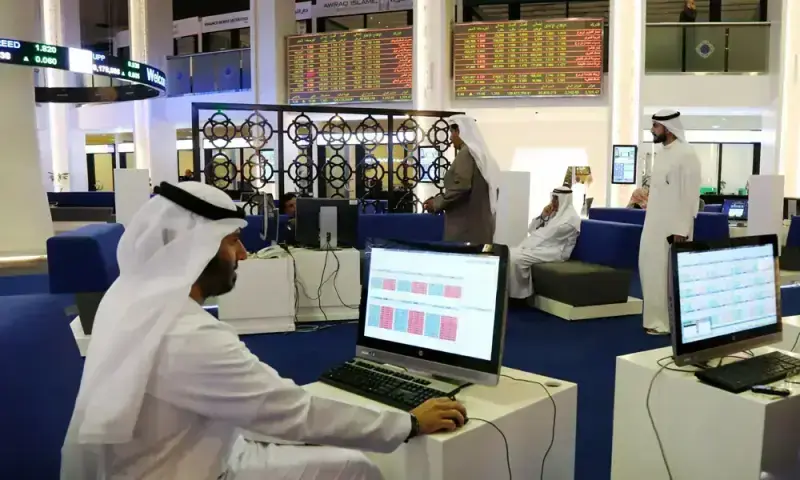

Most Gulf stock markets ended lower on Wednesday, tracking global peers as investors turned cautious ahead of Nvidia’s quarterly earnings and a key delayed U.S. jobs data report, while weaker oil prices also weighed on sentiment.
Oil, a key driver for Gulf financial markets, fell on oversupply concerns, though U.S. sanctions on major Russian producers helped limit losses. Brent crude was down 2.5% at $63.3 a barrel by 1300 GMT.
Dubai’s benchmark stock index was down 0.6%, pressured by broad-based losses. Emaar Properties fell 1.1% and Dubai Electricity and Water Authority slipped 2.6%.
The Abu Dhabi benchmark index fell 0.2%, extending losses into a sixth session and hitting a near five-month low. First Abu Dhabi Bank, the UAE’s largest lender, lost 1.2% and Abu Dhabi Islamic Bank declined 1.5%, while Presight AI Holding added 2.2%.
Separately, South Korea agreed to work with the United Arab Emirates on the U.S.-backed Stargate project to build a large artificial intelligence data campus in the Gulf state, Seoul said on Tuesday.
Saudi Arabia’s benchmark stock index was down 0.9%, with almost all sectors in negative territory, led by healthcare, real estate and information technology. Al Rajhi Bank declined 1.6% and Arabian Internet and Communications Services Co lost 1.7%.
Gulf bourses track global selloff as Fed rate cut hopes fade
“GCC markets mostly trended lower as investors stayed cautious ahead of Nvidia ’s earnings after the U.S. close,” said Daniel Takieddine, co-founder and CEO of Sky Links Capital Group, adding that the report is seen as a key gauge for the AI sector amid worries over stretched valuations and heavy capital flows into artificial intelligence.
The Qatari benchmark index snapped a five-session losing streak, rising 0.6%, with almost all stocks advancing. Industries Qatar gained 3%, while Ooredoo added 1.9%.
Markets are now awaiting Thursday’s delayed September non-farm payrolls report, with traders pricing about a 42% chance of a 25-basis-point Federal Reserve rate cut in December, down from near certainty a month ago.
U.S. monetary policy moves are closely followed in the Gulf, where most currencies are pegged to the dollar.
Outside the Gulf, Egypt’s blue-chip index ended little changed, supported by a 6.1% gain in Misr Cement and a 2.3% rise in E-Finance For Digital And Financial Investments , which said it was formulating a new three-year investment strategy.
—————————————-

SAUDI ARABIA	 down 0.9% to 10,999

KUWAIT	         up 0.4% to 9,381

QATAR	         rose 0.6% to 10,751

EGYPT	         ended flat at 40,509

BAHRAIN	         lost 0.7% to 2,035

OMAN	         fell 0.1% to 5,618

ABU DHABI	     down 0.2% to 9,858

DUBAI	         declined 0.6% to 5,862

—————————————-





 American Dollar Exchange Rate