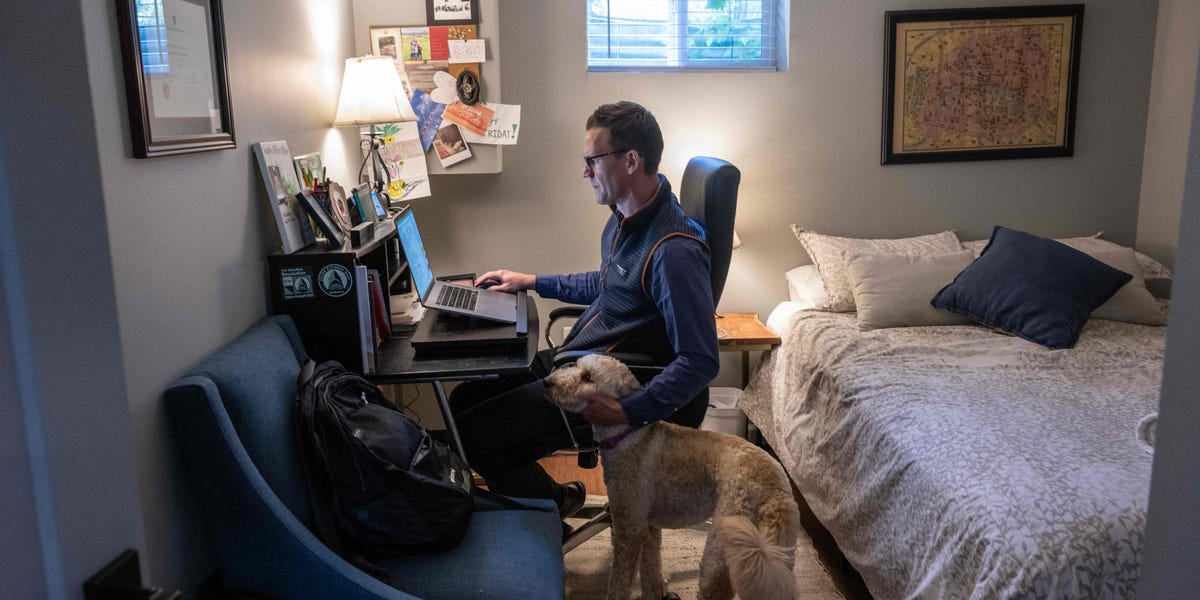
- Some companies are calling employees back to the office and hiring for in-person roles.
- But many Americans continue to work at least part of the week from home.
- Some workers could retain their flexible work arrangements but struggle to find a new remote role.
Americans who want to keep their work-from-home arrangements may need to cling to their current jobs.
Corporate giants like Amazon, AT&T, and JPMorgan have notified employees they must return to the office five days a week this year. This comes as the share of remote and hybrid postings on job platforms has ticked down in recent years — which has made landing one of these roles more difficult.
As of November, the share of remote and hybrid job postings on Indeed had declined to 7.8% from over 10% in 2022. On LinkedIn, the share of remote or hybrid postings had declined to roughly 21% as of December, down from 26% two years prior.
But remote and hybrid work hasn’t faded away. In December, roughly 23% of US workers worked from home at least part of the time, up from about 19% two years prior, per the Bureau of Labor Statistics. Meanwhile, about 10% worked completely from home.
“We keep hearing stories that ‘work-from-home is over,’ and while yes it is true for some firms, others must be doing the reverse,” Nicholas Bloom, a Stanford University economist and cofounder of the remote work research website WFH Research, told Business Insider. Bloom’s research shows that the share of paid full days worked from home in the US has been fairly steady over the past two years — fluctuating between roughly 25% and 30%.
Bloom and other economists told BI that the divide between remote/hybrid job postings and work-from-home rates suggests that some employers could be prioritizing in-person hires while letting some of their existing employees continue working more flexibly. They said this strategy could allow companies to boost their in-office attendance without drawing the ire of employees who’ve grown used to a remote or hybrid arrangement.
“We know that companies frequently make exceptions to return-to-office mandates for employees to avoid losing them, so policy changes might affect new hires more than incumbent employees,” Julia Pollak, chief economist at ZipRecruiter, told BI.
This approach would allow workers to retain their flexible work arrangements — but make it more difficult for them to snag a remote or hybrid role at another company, Kory Kantenga, head of economics, Americas, at LinkedIn’s Economic Graph Research Institute told BI.
“If you already have a job and you are grandfathered into this flexible work, you’re maintaining it in a lot of cases,” Kantenga said. “Companies are using those new positions to roll that flexible work back a little bit, but they’re not necessarily rolling it back for the workers who already have it.”
Why remote work could stick around
Even if more businesses prioritize in-person hiring, it could take a while for work-from-home rates to fall significantly, said Lisa Simon, chief economist at Revelio Labs. That’s because hiring, layoffs, and quits have slowed, which means that “very few people have actually changed jobs in the last two years” and businesses haven’t added many new workers who would be subject to recent RTO mandates, Simon told BI.
However, the modest share of available remote/hybrid jobs could be somewhat misleading. Simon said that a slowdown in hiring for white-collar roles — where flexible working arrangements are more common — could be pushing down remote/hybrid job postings.
Additionally, Bloom said some companies might not want to commit to a flexible working arrangement in the job posting, but could ultimately allow the employee to work from home at least some of the time.
“They don’t want to repeat the 2021 mistake of promising generous work-from-home only to have to painfully reverse this later,” he said. Bloom added that for some roles — like university professors — working from home on days when they don’t have classes is a norm of the job. However, a job posting might not classify this position as remote or hybrid.
Pollak said remote/hybrid roles are generally underrepresented in job postings because they tend to have lower turnover than the typical in-person job.
“A hotel may replace its entire staff of janitors three times a year, but only replace its remote customer support staff every two years,” she said.
Has your employer asked you to work from the office more days a week? Reach out to this reporter at jzinkula@businessinsider.com.

- Some companies are calling employees back to the office and hiring for in-person roles.
- But many Americans continue to work at least part of the week from home.
- Some workers could retain their flexible work arrangements but struggle to find a new remote role.
Americans who want to keep their work-from-home arrangements may need to cling to their current jobs.
Corporate giants like Amazon, AT&T, and JPMorgan have notified employees they must return to the office five days a week this year. This comes as the share of remote and hybrid postings on job platforms has ticked down in recent years — which has made landing one of these roles more difficult.
As of November, the share of remote and hybrid job postings on Indeed had declined to 7.8% from over 10% in 2022. On LinkedIn, the share of remote or hybrid postings had declined to roughly 21% as of December, down from 26% two years prior.
But remote and hybrid work hasn’t faded away. In December, roughly 23% of US workers worked from home at least part of the time, up from about 19% two years prior, per the Bureau of Labor Statistics. Meanwhile, about 10% worked completely from home.
“We keep hearing stories that ‘work-from-home is over,’ and while yes it is true for some firms, others must be doing the reverse,” Nicholas Bloom, a Stanford University economist and cofounder of the remote work research website WFH Research, told Business Insider. Bloom’s research shows that the share of paid full days worked from home in the US has been fairly steady over the past two years — fluctuating between roughly 25% and 30%.
Bloom and other economists told BI that the divide between remote/hybrid job postings and work-from-home rates suggests that some employers could be prioritizing in-person hires while letting some of their existing employees continue working more flexibly. They said this strategy could allow companies to boost their in-office attendance without drawing the ire of employees who’ve grown used to a remote or hybrid arrangement.
“We know that companies frequently make exceptions to return-to-office mandates for employees to avoid losing them, so policy changes might affect new hires more than incumbent employees,” Julia Pollak, chief economist at ZipRecruiter, told BI.
This approach would allow workers to retain their flexible work arrangements — but make it more difficult for them to snag a remote or hybrid role at another company, Kory Kantenga, head of economics, Americas, at LinkedIn’s Economic Graph Research Institute told BI.
“If you already have a job and you are grandfathered into this flexible work, you’re maintaining it in a lot of cases,” Kantenga said. “Companies are using those new positions to roll that flexible work back a little bit, but they’re not necessarily rolling it back for the workers who already have it.”
Why remote work could stick around
Even if more businesses prioritize in-person hiring, it could take a while for work-from-home rates to fall significantly, said Lisa Simon, chief economist at Revelio Labs. That’s because hiring, layoffs, and quits have slowed, which means that “very few people have actually changed jobs in the last two years” and businesses haven’t added many new workers who would be subject to recent RTO mandates, Simon told BI.
However, the modest share of available remote/hybrid jobs could be somewhat misleading. Simon said that a slowdown in hiring for white-collar roles — where flexible working arrangements are more common — could be pushing down remote/hybrid job postings.
Additionally, Bloom said some companies might not want to commit to a flexible working arrangement in the job posting, but could ultimately allow the employee to work from home at least some of the time.
“They don’t want to repeat the 2021 mistake of promising generous work-from-home only to have to painfully reverse this later,” he said. Bloom added that for some roles — like university professors — working from home on days when they don’t have classes is a norm of the job. However, a job posting might not classify this position as remote or hybrid.
Pollak said remote/hybrid roles are generally underrepresented in job postings because they tend to have lower turnover than the typical in-person job.
“A hotel may replace its entire staff of janitors three times a year, but only replace its remote customer support staff every two years,” she said.
Has your employer asked you to work from the office more days a week? Reach out to this reporter at jzinkula@businessinsider.com.







 American Dollar Exchange Rate