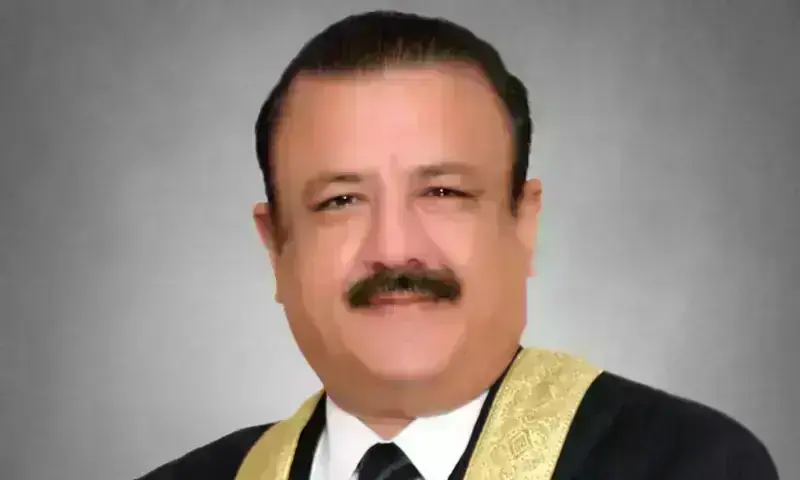

The Islamabad High Court (IHC) has turned down Justice Tariq Mehmood Jahangiri’s objections on a division bench, led by Chief Justice Sardar Muhammad Sarfraz Dogar, hearing challenges to the legitimacy of his law degree and appointment as a judge, it emerged on Tuesday.
The objections were raised by Justice Jahangiri, also an IHC judge, during the hearing of the petition challenging his qualification on Monday, with CJ Dogar and Justice Muhammad Azam Khan presiding over the proceedings.
The same bench previously also barred Justice Jahangiri from judicial work in September in the case, but the order was later set aside by the Supreme Court (SC).
Justice Jahangiri had appeared in person before the bench yesterday and presented his arguments.
A court order issued after the hearing, a copy of which is available with media, said he had raised preliminary objections on the constitution of a division bench instead of a single bench to hear lawyer Mian Dawood’s petition.
Moreover, Justice Jahangiri “expressed his no confidence” in the bench on the ground of filing of an intra-court appeal against CJ Dogar in the SC, the order stated.
The court, however, observed that “on the administrative side, keeping in view the sensitive nature of allegations of having an invalid/ fake degree having been levelled against a sitting judge of this court, it was deemed conducive, proper and in the fitness of things to constitute a division bench to hear this case instead of a single bench”.
It further said, “Even otherwise, the constitution of benches to hear cases, is the sole prerogative of the chief justice.”
The court also noted that “it is not a first instance of this kind wherein the division bench has been constituted to hear a certain petition”.
Based on these observations, the court turned down Justice Jahangiri’s objection to the constitution of the division bench to hear the case for “having no force”.
On Justice Jahangiri expressing a lack of confidence in CJ Dogar on the basis of an appeal filed against the latter in the SC, the court observed that the plea had been dismissed by the Federal Constitutional Court (FCC) on November 24.
In July, Justice Jahagiri, along with four other IHC judges, filed an intra-court appeal against the SC’s constitutional bench decision of upholding the seniority of the IHC that raised Justice Dogar to the top.
The five judges requested the SC not to consider Justices Sardar Mohammad Sarfraz Dogar, Khadim Hussain Soomro and Mohammad Asif as judges of IHC until they took fresh oaths in accordance with Article 194.
The intra-court appeal was fixed before the FCC following its establishment under the 27th Constitutional Amendment and eventually dismissed for non-prosecution.
Highlighting the plea’s dismissal in its order for Monday’s hearing, the IHC also cited various previous SC orders.
It noted that in the case Asif Ali Zardari vs The State (PLD 2001 SC 568), the SC had upheld that the “judge of a superior court is a keeper of his own conscience and it is for him to decide whether to hear or not to hear a matter before him”.
“In ‘Ms. Benazir Bhutto vs The President of Pakistan’ (1992 SCMR 140), the issue of transfer of case before the judge on the basis of bias was explained, and it was observed that there is a marked distinction in the approach on the question of bias between a case of a judge of a subordinate court and a case pertaining to a judge of a superior court in as much as in the former case, the superior courts do grant transfer applications on the ground of a judge having personal, pecuniary or proprietary interest in the subject matter whereas in the latter case, the Supreme Court does not grant transfer application on the above ground for want of power,” the IHC observed.
Moreover, it recalled that in M.H.Khondkhar vs The State (PLD 1966 Supreme Court 140), the SC held that an application for transfer “does not lie at all against a judge of the high court”. And in the same context, the SC “has already passed an exhaustive order in the case titled Muhammad Azam Khan Swati vs The State and another (2023 P Cr.L.J. 350)”.
In light of these rulings, the IHC also turned down Justice Jahangiri’s objection pertaining to a lack of confidence in Justice Dogar.
According to the court order, Justice Jahangiri also informed the court during Monday’s hearing that “no record relating to this case was provided to him” and requested time to engage the services of a private counsel and to obtain copies of the case.
At that, the court directed the Higher Education Commission (HEC) to provide Justice Jahangiri with its report on the matter along with annexures.
During a hearing of the case on December 8, the HEC, in its detailed report submitted to the IHC, endorsed Karachi University’s (KU) findings that the LLB degree of Justice Jahangiri was obtained through unfair means.
“The office is also directed to do the needful in this regard and provide copies of the instant petition along with annexures and reports of the HEC as well as of KU to the respondent,” the court order from Monday’s hearing said.
The court also summoned the KU registrar in person along with a record of Justice Jahangiri’s law degree at the next hearing on Dec 18 (Thursday).
The case
The controversy surrounding Justice Jahangiri’s law degree originated from a letter that began circulating last year on social media, purportedly from the University of Karachi’s (KU) controller of examinations.
Subsequently, a complaint pertaining to his allegedly fake degree was submitted to the Supreme Judicial Council — the top forum for judicial accountability that probes allegations of misconduct against judges — last year in July and a petition challenging his appointment was also filed in the IHC earlier this year by lawyer Mian Dawood.
The controversy has followed a protracted legal trajectory since Sept 16, when the same IHC division bench first took up the petition and issued an interim order restraining Justice Jahangiri from performing judicial functions until the maintainability of the petition could be decided.
The decision, made without issuing prior notice to the judge, had sparked debate within the legal community over whether a high court could suspend a sitting judge through an interim order. On Sept 29, the SC intervened, setting aside the restraining order.
A five-member constitutional bench, headed by Justice Aminuddin Khan, held that a high court could not bar a judge from performing judicial functions while hearing a quo warranto petition.
The ruling clarified that it addressed only the legality of the interim order and not the merits of the allegations. The SC later directed the IHC to decide all preliminary objections and proceed with the matter in accordance with law.
Justice Jahangiri was also one of the six IHC judges who wrote to the SJC last year, alleging interference in judicial affairs by intelligence agencies. The letter sparked a wider debate on judicial independence and led to demands for an inquiry.




 American Dollar Exchange Rate