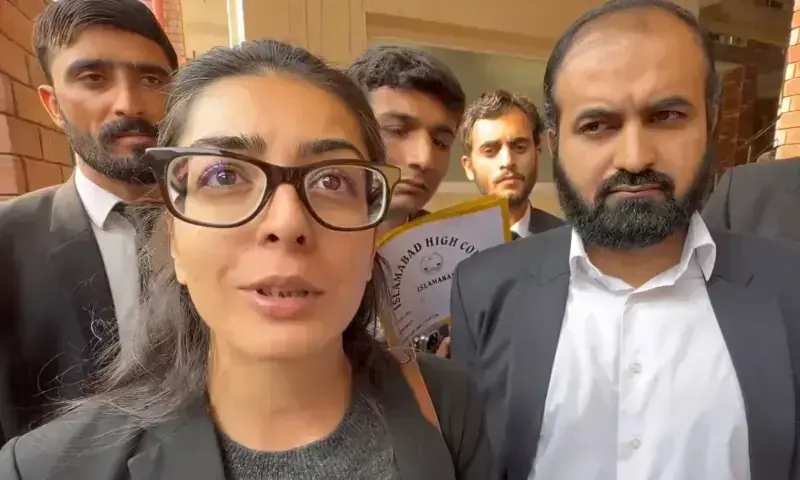

Lawyer and rights activist Imaan Zainab Mazari-Hazir and her husband, Advocate Hadi Ali Chattha, on Thursday objected after the apparent vanishing act of the court-appointed lawyer representing them in the controversial social media posts case and the appointment of a new counsel.
Judge Afzal Majoka, who has been presiding over the case’s proceedings, too, was also seemingly unaware of the finalisation of the appointment of the new counsel when Advocate Taimur Janjua showed up in the Islamabad district and sessions court instead of Advocate Shakeel Jatt.
Advocate Jatt, who attended the case’s hearing as Imaan and Hadi’s court-appointed defence counsel for the first time on Tuesday, had previously refused to cross-examine the prosecution’s witnesses, saying that he could not “ask questions dictated” to him.
“I am in favour of a fair trial. I cannot ask questions that are dictated [to me]. My conscience does not allow this,” he had said. The counsel had alleged without sharing any specific details that he had “received 15 questions with the instructions that he should ask them during the cross-examination”.
Advocate Jatt had also sought more time from the court to prepare for the case, but Advocate Janjua showed up at the hearing today to represent Imaan and Hadi.
When he informed the court that he had been appointed as the couple’s counsel, Judge Majoka said the court had not yet received a notification in this regard.
A three-member prosecution team present at the hearing assured the court that the relevant notification would be submitted.
For her part, Mazari objected to the change, questioning who had made the new appointment and through what process. She also raised concerns over the “disappearance” of Advocate Jatt.
Mazari contended that she or Chattha had not expressed any lack of confidence in Advocate Jatt and requested the court to record their statements on the matter.
She further raised doubts over an application said to be submitted by Advocate Jatt for his removal as the duo’s lawyer. Moreover, she questioned why the court had not objected to the disclosures made by Advocate Jatt at the previous hearing.
After the court provided a copy of Advocate Jatt’s application to Chattha, the latter requested the judge to summon the lawyer. He also contended the defence had “not rejected” the counsel.
However, the prosecution objected to Chattha’s request, arguing that “while a sessions judge is the appropriate authority to summon a state-appointed counsel, the court hearing the case is not the relevant forum for such an action”.
The proceedings were suspended for a while after Mazari and Chattha requested for time to consult the newly appointed counsel. Judge Majoka accepted their request and the hearing was later adjourned for Saturday.
Earlier in the day, the court had suspended the proceedings twice, first until 10 am and later until 11 am, awaiting the appearance of the accused and a clarification about the appointment of a counsel for them.
An order from the office of the Islamabad west district and sessions judge regarding the appointment, a copy of which is available with media, states: “Consequent upon the request made by Mr Muhammad Afzal Majoka, additional sessions judge Islamabad west, for the appointment of a defence counsel at state expenses, for Hadi Ali Chattha and Imaan Zainab Mazari accused […] Muhammad Taimoor Janjua is appointed as the defence counsel on state expenses.”
The proceedings were resumed after Mazari and Chattha held a meeting with Advocate Janjua. In a joint statement recorded before the court, the couple claimed that the new counsel was not following their instructions and that they did not trust him.
For his part, Advocate Janjua denied compelling them to follow any directions of his, saying that he only acted under the court’s instructions.
Chattha also filed an acquittal application during the hearing, urging the court to hear his arguments before calling the witnesses for cross-examination.
In his arguments, Chattha maintained that the first information report (FIR) registered in the case with the National Cybercrime Investigation Agency (NCCIA) was based on a “flawed source report”.
He alleged that the FIR was based on a source report that did not comply with legal requirements, and that screenshots submitted by the prosecution as evidence were taken from different devices and then combined to form a single image.
No mobile device had been seized, and no verification was obtained from the Pakistan Telecommunication Authority, he argued.
Moreover, the FIR was registered 22 days after the date visible in the timestamps in the screenshots, he further alleged.
Chattha also read out complainant Shehroz Riaz’s statement in the court.
He contended that the entire case was based on “just two Twitter accounts and a single report”. The NCCIA’s procedure for the registration of the FIR was not followed, he claimed, urging the court to accept his acquittal application.
The case against Imaan and Chattha has been registered with the NCCIA on accusations of attempting to incite divisions on linguistic grounds through social media posts and of creating the impression that the armed forces were engaged in terrorism within the country in the case.
The two were indicted in the case on October 30, a day after the latter was arrested outside the courtroom over non-appearance. Mazari said that there was video evidence of his presence both “inside and outside the courtroom”.
Speaking to reporters after his release, Chattha had maintained that he had appeared in court five minutes ahead of time for the proceedings on October 29, but the judge had issued an arrest warrant “to his face”.
Before Tuesday’s hearing, Mazari had also alleged that the court had “forcibly appointed [a] state defence counsel” for her and Chattha.








 American Dollar Exchange Rate