
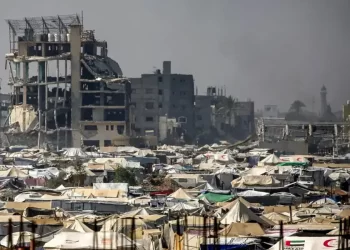
DEIR AL-BALAH, Gaza (news agencies) — Children in sandals trudge through water contaminated with sewage and scale growing mounds of garbage in Gaza’s crowded tent camps for displaced families. People relieve themselves in burlap-covered pits, with nowhere nearby to wash their hands.

In the stifling summer heat, Palestinians say the odor and filth surrounding them is just another inescapable reality of war — like pangs of hunger or sounds of bombing.
The territory’s ability to dispose of garbage, treat sewage and deliver clean water has been virtually decimated by eight brutal months of war between Israel and Hamas. This has made grim living conditions worse and raised health risks for hundreds of thousands of people deprived of adequate shelter, food and medicine, aid groups say.
Hepatitis A cases are on the rise, and doctors fear that as warmer weather arrives, an outbreak of cholera is increasingly likely without dramatic changes to living conditions. The U.N., aid groups and local officials are scrambling to build latrines, repair water lines and bring desalination plants back online.
COGAT, the Israeli military body coordinating humanitarian aid efforts, said it’s engaging in efforts to improve the “hygiene situation.” But relief can’t come soon enough.
“Flies are in our food,” said Adel Dalloul, a 21-year-old whose family settled in a beach tent camp near the central Gaza city of Nuseirat. They wound up there after fleeing the southern city of Rafah, where they landed after leaving their northern Gaza home. “If you try to sleep, flies, insects and cockroaches are all over you.”
Over a million Palestinians had been living in hastily assembled tent camps in Rafah before Israel invaded in May. Since fleeing Rafah, many have taken shelter in even more crowded and unsanitary areas across southern and central Gaza that doctors describe as breeding grounds for disease — especially as temperatures regularly reach 90 degrees Fahrenheit (32 degrees Celsius).
“The stench in Gaza is enough to make you kind of immediately nauseous,” said Sam Rose, a director at the U.N. agency for Palestinian refugees.
Conditions are exacting an emotional toll, too.
Anwar al-Hurkali, who lives with his family in a tent camp in the central Gazan city of Deir al-Balah, said he can’t sleep for fear of scorpions and rodents. He doesn’t let his children leave their tent, he said, worrying they’ll get sick from pollution and mosquitoes.
“We cannot stand the smell of sewage,” he said. “It is killing us.”
The U.N. estimates nearly 70% of Gaza’s water and sanitation plants have been destroyed or damaged by Israel’s heavy bombardment. That includes all five of the territory’s wastewater treatment facilities, plus water desalination plants, sewage pumping stations, wells and reservoirs.
The employees who once managed municipal water and waste systems have been displaced, and some killed, officials say. This month, an Israeli strike in Gaza City killed five government employees repairing water wells, the city said.
Despite staffing shortages and damaged equipment, some desalination plants and sewage pumps are working, but they’re hampered by lack of fuel, aid workers say.
A U.N. assessment of two Deir al-Balah tent camps found in early June that people’s daily water consumption — including drinking, washing and cooking — averaged under 2 liters (about 67 ounces), far lower than the recommended 15 liters a day.
COGAT said it’s coordinating with the UN to repair sewage facilities and Gaza’s water system. Israel has opened three water lines “pumping millions of liters daily” into Gaza, it said.
But people often wait hours in line to collect potable water from delivery trucks, hauling back to their families whatever they can carry. The scarcity means families often wash with dirty water.
This week, Dalloul said, he lined up for water from a vendor. “We discovered that it was salty, polluted, and full of germs. We found worms in the water. I had been drinking from it,” he said. “I had gastrointestinal problems and diarrhea, and my stomach hurts until this moment.”
The World Health Organization declared an outbreak of Hepatitis A that, as of early June, had led to 81,700 reported cases of jaundice — a common symptom. The disease spreads primarily when uninfected people consume water or food contaminated with fecal matter.
Because wastewater treatment plants have shut down, untreated sewage is seeping into the ground or being pumped into the Mediterranean Sea, where tides move north toward Israel.






 American Dollar Exchange Rate