
MUMBAI: India’s annual budget announcement was a bigger deal than usual this year: As the first full budget of Prime Minister Narendra Modi’s third term, it will set the tone for how the world’s fifth-largest economy confronts slowing growth and sagging markets.
But the year’s top economic policy event opted mainly for short-term economic relief through middle-class tax cuts, while passing up a chance to go big on reforms needed to reignite rapid growth – once the envy of the world at more than 8%.
The budget also scaled back the government’s emphasis on capital spending and infrastructure, another key driver for India’s growth ambitions since the pandemic.
Without a strategy to regain high growth rates and assure jobs for India’s young population, the budget disappointed analysts and markets, alarmed in recent months by weak earnings growth and an exodus of foreign investors.
“India is aspiring for 8% growth but we don’t have a path to 8% – a growth strategy is not there,” said Madhavi Arora, chief economist at Emkay Global Financial Services.
The government has forecast India’s GDP growth will slip to a four-year low of 6.4% in the current financial year to March 31 and stay close to that level next year as well, compared with 8.2% in 2023-24.
While the latest tax cuts may help urban consumers, who took some steam out of the economy as weak wage growth and high living costs curtailed their spending habits, economists see deeper problems that need to be addressed.
“Eight percent will require far deeper interventions in agricultural markets, human capital and ease of doing business,” said Dhiraj Nim, an economist at ANZ Research.
Modi, who returned to power in July of last year with a weaker-than-expected mandate, has turned to appeasing politically important constituencies in the months since the election, analysts said.
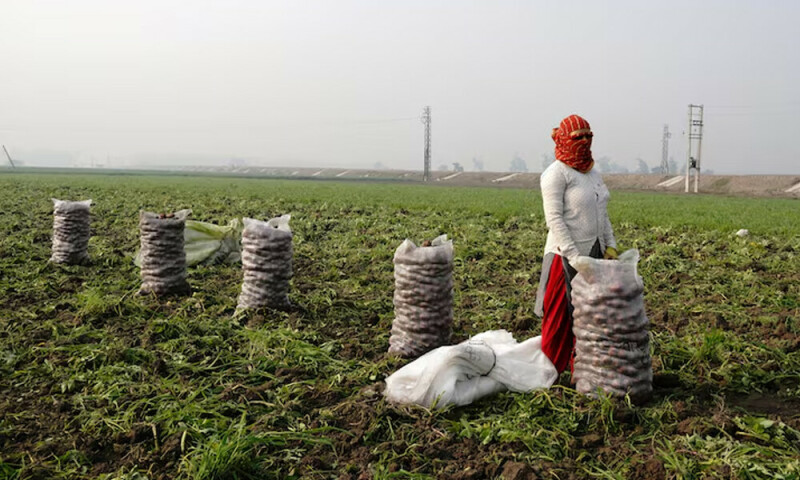
His party has reversed agricultural trade policies to favour farmers, offered cash handouts to women and, now, cut taxes for the middle class.
Analysts noted that this is not the first time, however, that Modi and his Bharatiya Janata Party failed to push economic reforms, which also got brushed aside in his previous two terms when the party had won more decisively and had greater political capital.
India’s Modi to seek to boost growth, ease cost of living in budget
“In 2019, the BJP got more than 300 seats and had a window (for reforms),” said Amit Ranjan, research fellow at Institute of South Asian Studies (ISAS), National University of Singapore.
“But the government gave in to the needs of electoral politics as the government knows reforms do not immediately benefit the large section of voters.”
In 2015, Modi let lapse an executive order making it easier for businesses to buy land, after failing to win support from opposition parties in the parliament.
And in 2020, both houses of parliament approved new labour codes, but they have yet to be implemented across all states.
Plans for large-scale privatisations of state-owned enterprises, aiming to reinvigorate them by reducing government involvement, have also faltered, with the government now opting to put fresh funds into ailing state firms.
Risking stagnation
The case for reforms, however, has not come just from analysts and economists, but from government leaders as well.
On Friday, India’s chief economic adviser, V. Anantha Nageswaran, made a pitch for rapidly easing rules covering land, labour and factories, among other areas, arguing that government should “get out of the way” as one way to push up growth.
“Business as usual carries a high risk of economic growth stagnation, if not economic stagnation,” Nageswaran said in a report presented a day ahead of the budget.
The tax cuts’ 1 trillion rupee ($11.56 billion) price tag also reduced the government’s leeway to further ramp up spending on infrastructure.
The budget includes 11.2 trillion rupees for capital expenditure in 2025-26, close to the level of spending planned for the current year, although actual outlays fell short of that due to delays linked to national and state elections.
“We think that capital expenditure and infrastructure development will provide a longer-term, longer-lasting boost to growth than things like tax measures,” said Christian de Guzman, senior vice president and lead sovereign analyst for India at Moody’s Ratings.
Since the COVID-19 pandemic, the government has raised capital expenditure sharply in the hope of fashioning an investment-led recovery but the strategy is yet to pay off, with job creation and wage growth remaining weak.
The slower increase in capital spending knocked the share prices of capital goods firms lower on Saturday, while the broader market ended marginally weaker.
“At the margin, there is a tilt towards supporting consumption through tax cuts for middle class households, relative to the public capex push seen over the last four years,” said Sonal Varma, Nomura chief economist, India and Asia ex-Japan.
“This shift takes into account the difficulty in executing public capex projects due to budget and institutional capacity constraints,” she said.





 American Dollar Exchange Rate