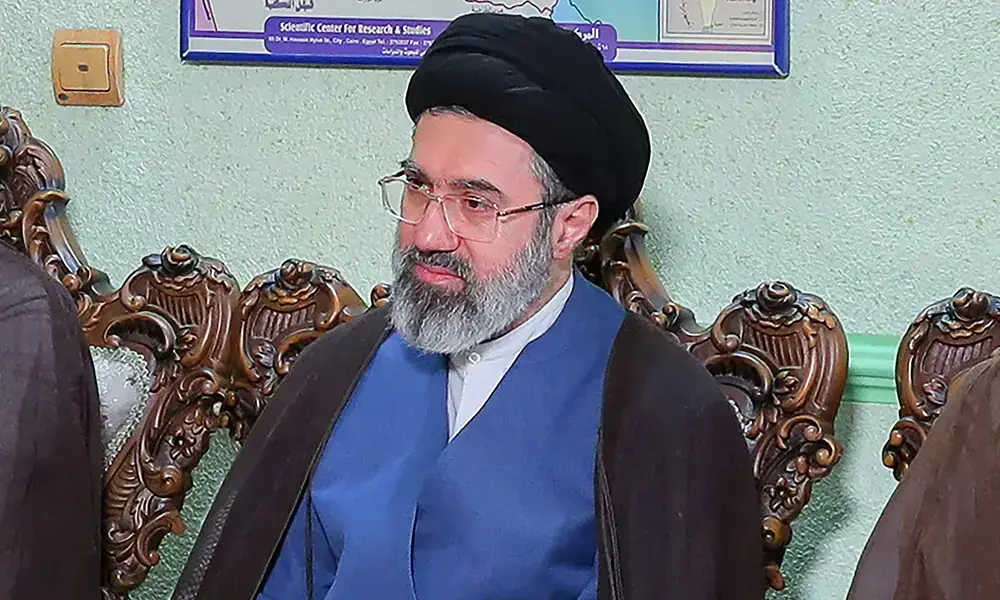

DUBAI: Iran’s new Supreme Leader Mojtaba Khamenei is still recovering from severe facial and leg injuries suffered in the airstrike that killed his father at the beginning of the war, three people close to his inner circle told Reuters.
Khamenei’s face was disfigured in the attack on the supreme leader’s compound in central Tehran and he suffered a significant injury to one or both legs, all three sources said.
The 56-year-old is nonetheless recovering from his wounds and remains mentally sharp, according to the people, who requested anonymity to discuss sensitive matters. He is taking part in meetings with senior officials via audio conferencing and is engaged in decision-making on major issues including the war and negotiations with Washington, two of them said.
The question of whether Khamenei’s health allows him to run state affairs comes during Iran’s moment of gravest peril for decades, with high-stakes peace talks with the United States opening in the Pakistani capital Islamabad on Saturday.
The accounts of the people close to Khamenei’s inner circle provide the most detailed description of the leader’s condition for weeks. Reuters couldn’t independently verify their descriptions.
Khamenei’s whereabouts, condition and ability to rule still largely remain a mystery to the public, with no photo, video or audio recording of him published since the air attack and his subsequent appointment as his father’s replacement on March 8.
Iran’s United Nations mission did not respond to Reuters questions about the extent of Khamenei’s injuries or the reason he has not yet appeared in any images or recordings.
Khamenei was wounded on February 28, the first day of the war launched by the U.S. and Israel, in the attack that killed his father and predecessor Ayatollah Ali Khamenei, who had ruled since 1989. Mojtaba Khamenei’s wife, brother-in-law and sister-in-law were among other members of his family killed in the strike.
There has been no official Iranian statement on the extent of Khamenei’s injuries. However, a newsreader on state television described him as a “janbaz”, a term used for those badly wounded in war, after he was named supreme leader.
The accounts of Khamenei’s injuries tally with a statement made by U.S. Secretary of Defense Pete Hegseth on March 13 when he said that Khamenei was “wounded and likely disfigured”.
A source familiar with U.S. intelligence assessments told Reuters that Khamenei was believed to have lost a leg.
The CIA declined to comment on Khamenei’s condition. The Israeli prime minister’s office didn’t respond to questions.
Alex Vatanka, senior fellow at the Middle East Institute, said that, regardless of the severity of his injuries, it was unlikely the new and inexperienced leader would be able to command the overarching power wielded by his father. While he is seen to represent continuity, it could take years for him to build up the same level of automatic authority, Vatanka added.
“Mojtaba will be one voice but it will not be the decisive one,” he said. “He needs to prove himself as the credible, powerful, overriding voice. The regime as a whole has to make a decision in terms of where they are going to go.”
Gas supply restored in Tehran after attack on infrastructure: state TV
One of the people close to Khamenei’s circle said images of the supreme leader could be expected to be released within one or two months and that he might even appear in public then, although all three sources stressed he would only emerge when his health and the security situation allowed.
‘We don’t know much about his world view’
In Iran’s theocratic system of rule, ultimate power is meant to be wielded by the supreme leader, a venerable Shi’ite Muslim cleric appointed by an assembly of 88 ayatollahs. The leader oversees the elected president while directly commanding parallel institutions including the Revolutionary Guards, a powerful political and military force.
Iran’s first supreme leader, Ayatollah Ruhollah Khomeini, enjoyed unquestioned authority as the charismatic leader of the revolution and the most learned cleric of his day.
His successor, Ali Khamenei, was a less revered cleric but had served as Iran’s president. He spent decades cementing his authority after his appointment in 1989, partly through promoting the power of the Revolutionary Guards.
His son Mojtaba does not command absolute power in the same way, senior Iranian sources have previously told Reuters. The Revolutionary Guards, who helped steer him into the top job after his father’s assassination, have emerged as the dominant voice on strategic decisions during the war. Iran’s U.N. mission didn’t respond to questions about the power wielded by the Guards and the new supreme leader.
As an influential figure in his father’s office, Khamenei had previously spent years involved in exercising power at the top levels of the Islamic Republic, officials and insiders have said, building ties with senior Guards figures.
While he is widely seen as likely to continue his father’s hardline approach due to his links to the Guards, we don’t know much about his world view, said Vatanka at the Middle East Institute.
Khamenei’s first communication with Iranians as supreme leader came on March 12, saying in a written statement read out by a television news presenter that the Strait of Hormuz should stay closed and warning regional countries to shut U.S. bases.
His office has since issued a few other brief written statements from him, including on March 20 when he welcomed in the Persian new year, which he named the “year of resistance”. Public statements of policy on Iran’s war stance, its approach towards diplomacy, neighbours, ceasefire negotiations and domestic unrest, have been made by other senior officials.
‘Where is Mojtaba?’ memes circulate online
Khamenei’s absence is widely discussed on Iranian social media and in messaging app groups, when the country’s patchy internet allows, with conspiracy theories widespread about his condition and who is running the country.
One popular meme circulating online is a picture of an empty chair under a spotlight with the slogan “Where is Mojtaba?”
However, some government supporters, including a senior member of the Basij militia, a volunteer paramilitary group run by the Revolutionary Guards, said that it was important for Khamenei to keep a low profile, given the threat posed by waves of U.S. and Israeli airstrikes that have already wiped out much of the country’s leadership.
A lower-ranking Basij member agreed.
“Why should he appear in public? To become a target for these criminals?” Mohammad Hosseini, from the city of Qom, said in a text message.



 American Dollar Exchange Rate