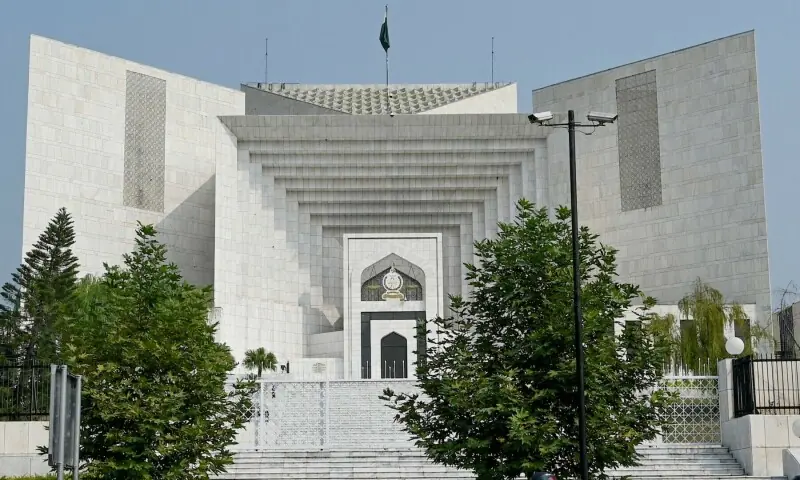

ISLAMABAD: Members of a Judicial Commission of Pakistan (JCP) subcommittee have forwarded several proposals to be considered while drafting rules for evaluating high court judges and setting criteria for their elevation.
Justice Jamal Khan Mandokhail-led subcommittee met on Friday with Attorney General for Pakistan (AGP) Mansoor Usman Awan, Pakistan Bar Council (PBC) representative Muhammad Ahsan Bhoon, Senator Farooq H. Naek from the treasury benches and Senator Barrister Syed Ali Zafar from the opposition in attendance.
The JCP subcommittee decided to consolidate and circulate each suggestion among all members for discussion at the next meeting, scheduled for the coming week and postponed proceedings, with an understanding to thoroughly discuss draft suggestions on framing benchmarks to assess judicial performance of sitting judges of the high courts.
One of the proposals was to consider the time period within which a judgement is delivered after it has been reserved by a high court judge, since inordinate delays ultimately frustrate litigants.
Members put forward suggestions, to be consolidated for discussion next week
The committee also suggested making it obligatory for high court judges to pronounce judgements within three months, as held in 2015 Messrs MFMY Industries Ltd case by a three-judge Supreme Court bench.
Presided over by Justice Saqib Nisar, the apex court in its ruling had held that a reasonable time for the pronouncement of judgements should be 90 days, since the enunciation of law requires considerable research, reflection and deliberation.
Ninety days, it noted, should be adequate for composition of judgements. If judges are unable to deliver judgements within this time period, they must record sufficient reasons and may order the case to be reheard.
Number of cases
Another proposal under consideration was for the JCP to evaluate how many cases a judge decides in a month, and whether those decisions involve substantive matters that advance jurisprudence or merely routine bail matters.
The proposals also included assessing whether a judge exhausts the entire cause list for the day or merely hears a few cases and adjourns the rest.
However, questions remain about how benchmarks will account for cases withdrawn after judges point out jurisdictional flaws. A legal expert, noted that such withdrawals save judicial time by avoiding unnecessary appeals, yet they are never reported in law digests. “Should a judge be penalised for thoroughly understanding the case and prompting withdrawal?” the expert asked.
The expert further explained that performance cannot simply be measured by the number of cases heard in a day, as much depends on the type of cases assigned by the chief justice. For example, civil revision cases are time-consuming and complex, whereas other categories may involve issuing directions to departments and can be decided more quickly. Comparing judges across such different case types would be unfair, he argued.
On June 19, Chief Justice of Pakistan (CJP) Yahya Afridi constituted the broad-based committee on judicial performance evaluation of high court judges. The committee, comprising members from the judiciary, parliament, executive, and legal fraternity, was tasked with preparing draft rules for annual judicial performance evaluations and developing criteria for the selection of judges.
The 26th Amendment to Article 175A allows the JCP to give underperforming high court judges time to improve, and if they fail, recommend their removal to the Supreme Judicial Council (SJC).
And after the completion of the period so granted, the performance of the judge is again found to be inefficient; the commission will send its report to the Supreme Judicial Council (SJC) with a recommendation to remove the judge.
Moreover, the commission will hold annual evaluations of high court judges and may set rules to define performance standards.
Published in media, September 27th, 2025








 American Dollar Exchange Rate