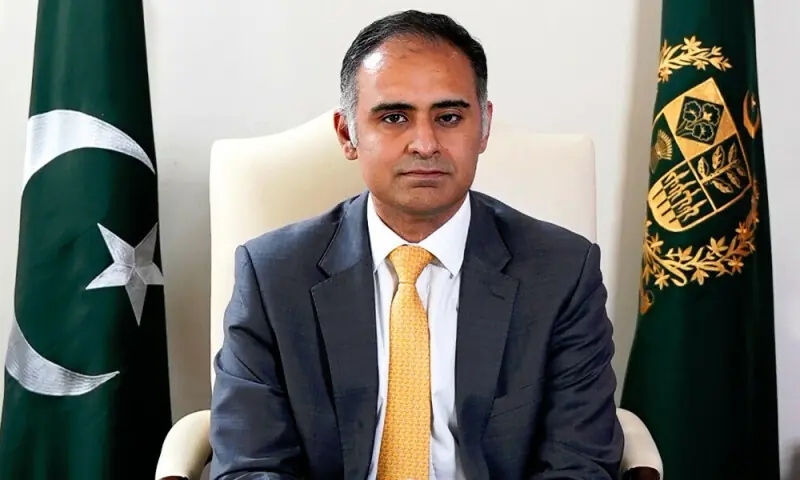

ISLAMABAD: Minister of State for Finance Bilal Azhar Kayani said Saturday that the government will intensify action against illegal cigarette brands and launch a massive operation in the tobacco retail markets on national level.
He clarified that no action will be taken against retailers selling legal cigarette brands, while non-compliant brands will be brought within the ambit of the law.
The Institute for Public Opinion Research (IPOR) arranged a policy discussion to present findings from its nationwide study titled “Track and Trace Compliance in the Tobacco Industry – (Volume II)”, revealing significant regulatory gaps in compliance with the Federal Board of Revenue’s (FBR) Track and Trace System (TTS).
Minister of State for Finance added that non-compliant brands will be brought within the legal framework, and monitoring and enforcement at the GLT (Green Leaf Threshing) stage have already been implemented, he added. He further stated that the government is committed to enforcing the “Track and Trace” system in the tobacco sector.
The minister also noted that retail outlets fall under the jurisdiction of provincial governments, which now have powers to take action against sellers of illegal cigarettes. Warehouses and transportation channels of the tobacco sector are also being monitored, he maintained.
In a related initiative, the government is promoting a cashless economy. Executive orders have made QR codes mandatory in Islamabad and provincial regions, requiring every retail outlet to provide at least one digital payment option. All retailers and merchants have been instructed to adopt digital payment methods. Federal and provincial authorities are working on legislation to support this initiative, which aims to formalise the economy and strengthen the “Cashless Pakistan” program.
He said the Prime Minister regularly seeks progress reports in meetings related to the Federal Board of Revenue (FBR), and strict action will be taken against sellers of smuggled or illegal goods.
Bilal Azhar Kayani added that warehouses and transportation in the tobacco sector are also being monitored, and enforcement of laws will ensure compliance as well as increase national revenue. He stated that the Prime Minister is personally overseeing the promotion of a cashless economy. QR codes have been made mandatory through executive orders in Islamabad and the provinces.
He added that legislation is also under way at the federal and provincial levels for this purpose to document the economy.
The event started with a presentation of the study findings by Tariq Junaid, Executive Director of IPOR, who outlined the scale and nature of non-compliance observed across the country.
Drawing on data collected from 1,520 retail outlets across 38 markets in 19 districts, he highlighted that 51 percent of cigarette brands available at the point of sale were non-compliant with one or more government-mandated requirements, including the absence of Track and Trace stamps, violations of the Minimum Legal Price (MLP), and missing graphical health warnings. The findings showed that non-compliant brands were largely comprised of smuggled and locally manufactured duty-not-paid cigarettes.
Dr Nasir Iqbal, Fiscal Policy Expert and Registrar at the Pakistan Institute of Development Economics (PIDE) emphasised that persistent non-compliance reflects deeper institutional coordination challenges and stressed the need to align enforcement mechanisms with broader public finance and governance reforms.
Copyright media, 2026






 American Dollar Exchange Rate