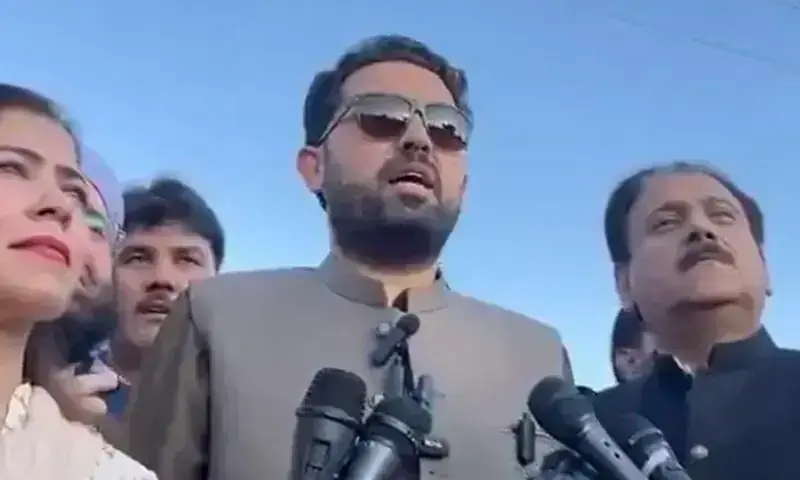

PESHAWAR: Khyber Pakhtunkhwa Chief Minister Sohail Afridi on Monday said a peaceful protest was a constitutional right and the April 9 protest in Rawalpindi was a one-day peaceful activity.
“The April 9 protest is meant to highlight concerns regarding democratic backsliding, economic decline, inflation, delays in the hearing into PTI founder Imran Khan’s cases, as well as his and his wife’s continued illegal detention and inhumane treatment,” Mr Afridi told a news conference at the KP House in Islamabad.
He called upon authorities to grant permission for the gathering, and any denial would compel participants to register protest at the point of obstruction.
“If conditions worsen or political workers are subjected to inhumane treatment, it will compel a reassessment of the future course of action, including consideration of options such as a long march and broader nationwide mobilisation,” he said.
Says long march, broader nationwide mobilisation can be considered
The CM said that his convoy would leave Peshawar for Rawalpindi at 11am on April 9, with participants joining it from various districts irrespective of weather conditions.
He said that the removal of a democratically elected government on April 9, 2022, through a foreign conspiracy, facilitated by closed door decisions domestically, marked the beginning of a sustained period of political and economic decline.
Mr Afridi said that during that period, key economic indicators improved, including GDP growth from 6.1 to 7 per cent, alongside proportional gains in agriculture, industry, and exports.
He highlighted the “erosion of purchasing power” during the current government’s time, noting that petrol prices surged from Rs150 per litre prior to April 9, 2022, to between Rs380 and 458, without any corresponding increase in incomes.
“Citizens are facing severe economic distress,” he said.
The chief minister criticised the current governance framework for “lacking a coherent policy direction and a meaningful reform agenda” and said the federal government’s political priorities appeared focused on the preservation of power companies and the continued illegal detention of PTI founder Imran Khan rather than economic stabilisation or public welfare.
He warned that under such conditions, sustainable development was not achievable and that the worsening economic conditions had disproportionately impacted lower-income groups, leading to widespread public disillusionment.
“People are increasingly questioning the direction in which the country is being steered,” he said.
On external accounts, the CM said that foreign exchange reserves, reportedly around $21 billion, were largely composed of borrowed or short-term inflows, while the trade deficit had exceeded $20 billion and exports were underperforming.
He cautioned that any repayment demands from friendly countries could push reserves below $10 billion, further intensifying macroeconomic vulnerability.
The CM said those conditions posed a significant risk of currency depreciation, which could lead to a substantial increase in Pakistan’s debt burden.
He said the KP government had developed a comprehensive contingency plan for anticipated monsoon-related emergencies.
Mr Afridi said that KP was the only province to have undertaken preemptive institutional coordination in this regard.
He said that military operations had historically not delivered sustainable solutions.
“This position is not limited to my party but reflects a broader consensus across all political and religious stakeholders, as demonstrated by a grand jirga convened under the provincial assembly, where a joint resolution to this effect was adopted unanimously,” he said.
The CM noted that despite 22 major military operations and over 16,000 intelligence based operations, terrorism continued to persist.
Referring to the Apex Committee, he said that a comprehensive strategy had been presented but it was not adopted. He said the challenge of terrorism could not be addressed through the use of force alone and required a collective approach inclusive of all stakeholders.
Mr Afridi said that an operation was announced without any clear objective or strategy in Tirah Valley on which he had repeatedly expressed reservations.
He said that the local displaced population was promised return to their homes within two months, but he had declared that he didn’t consider it feasible and couldn’t guarantee it.
“Our objective is to present the true situation in Pakistan to the world where fundamental freedoms are increasingly constrained and journalists, lawyers and people from other walks of life are facing growing challenges,” he said.
The CM said that political stability was a prerequisite for economic recovery but Pakistan currently faced great political uncertainty.
He warned that any irresponsible or adventurist attempt to revisit or undermine the Fata-KP merger could trigger a strong and adverse reaction.
Published in media, April 7th, 2026


 American Dollar Exchange Rate