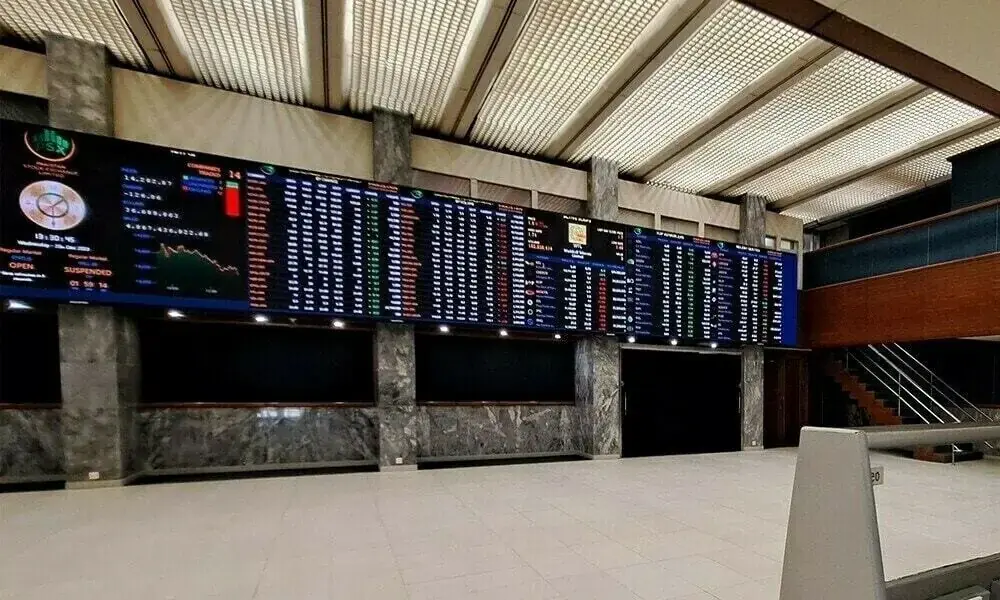
The Pakistan Stock Exchange (PSX) endured a sharply negative session, as the benchmark KSE-100 Index shed nearly 5,500 points amid persistent selling pressure on Monday.

After a relatively steady start, hitting an intra-day high of 174,336.85, the benchmark index gradually slipped into the red, reflecting cautious investor sentiment.
Selling intensified in the early afternoon, dragging the KSE-100 Index below key psychological levels, triggering a steeper decline. Although a slight recovery was seen towards the close, it remained modest amid strong bearish momentum and heightened volatility.
At close, the benchmark index settled at 167,691.08, down 5,478.63 points or 3.16%.
“The selling pressure is due to uncertainty on the geopolitical front, alongside this being a rollover week,” said Sana Tawfik, Head of Research at Arif Habib Limited (AHL), while speaking to media.
Analysts also attributed the decline to a fresh wave of uncertainty regarding US trade policy after US President Donald Trump announced a new rate of global tariffs.
Over the weekend, Trump announced a new 10% rate and then lifted it to 15%.
“During the trading day, the index fluctuated within the range of 174,336 to 166,886 points, largely influenced by rollover-week dynamics,” said Topline Securities in its market review.
Index-heavy constituents—including Fauji Fertilizer Company (FFC), Lucky Cement (LUCK), Engro Holdings (ENGROH), National Bank of Pakistan (NBP), and Habib Bank Limited (HBL)—emerged as the principal laggards, collectively dragging the benchmark down by 1,797 points during the session, added the brokerage house.
During the previous week, escalating geopolitical tensions between the United States and Iran triggered a sharp risk-off reaction across global financial markets, with Pakistan’s equity benchmark suffering a pronounced correction amid heightened uncertainty and rising oil prices. The KSE-100 Index at the PSX fell 6,434.02 points, or 3.6% week-on-week, to close at 173,169.70 points, marking one of the steepest weekly declines in recent sessions.
Globally, Wall Street futures and the dollar slid in Asia on Monday as confusion over US tariffs revived the “sell America” trade, while confidence in the entire AI sector was set to be tested by results from tech-diva Nvidia this week.
Gold gained, and oil prices eased ahead of another round of talks between the United States and Iran due in Geneva on Thursday, with the risk of US military strikes lingering if a deal is not done.
Uncertainty loomed large after the US Supreme Court struck down President Donald Trump’s emergency tariffs, leading him to announce a new 10% rate on the rest of the world, only to then lift it to 15% in a move that even seemed to surprise some of his own officials.
It was not yet clear when these tariffs would be imposed, what might be excluded and whether every country would be slapped with 15%. Some, including the UK and Australia, had 10% tariff rates under the former rules, while many countries in Asia had higher rates.
With so much up in the air, Asian markets were mixed, with MSCI’s broadest index of Asia-Pacific shares outside Japan up 0.8% in light trade.
Japan’s Nikkei was shut for a holiday, but futures traded down 1.0% at 56,605 versus a cash close of 56,825.
The chance of lower tariffs helped South Korea extend its bull run with a 1.2% rise, having already jumped 5.5% last week to all-time highs. Taiwan followed with a rise of 1.2% to a record peak.
Meanwhile, the Pakistani rupee registered a marginal gain against the US dollar in the inter-bank market on Monday. At close, the local currency settled at 279.55, a gain of Re0.01 against the greenback.
Volume on the all-share index declined to 461.26 million from 537.64 million recorded in the previous close.
However, the value of shares increased to Rs24.93 billion from Rs23.79 billion in the previous session.
K-Electric Ltd was the volume leader with 36.06 million shares, followed by WorldCall Telecom with 33.67 million shares, and B.O.Punjab with 26.67 million shares.
Shares of 479 companies were traded on Monday, of which 42 registered an increase, 389 recorded a fall, and 48 remained unchanged.




 American Dollar Exchange Rate