ISLAMABAD: The National Assembly on Tuesday unanimously adopted a resolution calling for an “aggressive” national response against the external sponsors and internal facilitators of terrorism.

The lower house of Parliament continued its discussion on the prevailing security situation in Balochistan in the wake of a series of deadly attacks across the province on Saturday.
Parliamentary Affairs Minister Dr Tariq Fazal Chaudhry tabled the resolution, which stated: “This House condemns in the strongest terms the recent terrorist incidents in Balochistan, in which not only innocent civilians were targeted but also heinous and inhumane tactics such as using women as weapons were adopted.”
The NA further demanded that an “immediate, aggressive, coordinated, and effective national response be ensured against these external sponsors and internal facilitators, funding, smuggling, and propaganda hubs, in which political, diplomatic, military, intelligence, legal, and rhetorical fronts are united”.
The resolution highlighted that “in several cases, evidence available points to external sponsorship, [and] particularly there are serious concerns over the role of India”.
It further said terrorism was “being supported in some neighbouring countries through logistical and operational facilitation, financial support, training, treatment, movement and propaganda networks”.
The resolution also expressed “deep sorrow and concern over the fact that terrorist networks are trying to use women against the state and society through exploitation, coercion and blackmail”, adding that it was completely contrary to Islamic, Pakistani and Baloch values.
It appreciated the “timely and effective measures taken by the security forces, law enforcement agencies, the provincial government of Balochistan and the civil administration”.
Expressing solidarity with the martyrs and the injured, the resolution asserted that attacks on “civilian populations, women, and children are unforgivable crimes, and the state must take decisive action against such elements on the principle of zero tolerance”.
The military’s media affairs wing said terrorists of Fitna-al-Hindustan carried out a large-scale coordinated attack across Balochistan on Saturday.
The security forces killed 92 terrorists as they responded to the incidents, with more militants being eliminated later to take the 48-hour tally to 177 on Monday.
Lawmakers sound alarm
Lawmakers from across the political spectrum, including those from the PTI, the PPP and the Jamiat Ulema-i-Islam-Fazl (JUI-F), sounded an alarm on the surge in terrorism in the province.
During some opposition speeches, the proceedings were not livestreamed on the NA’s YouTube channel.
Opposition Leader Mehmood Khan Achakzai suggested an addition in a resolution that would “recommend that the first right of the children of a province be acknowledged on their respective province’s resources”.
NA Speaker Ayaz Sadiq remarked that this was a “constitutionally protected” matter.
In his speech, PTI MNA Asad Qaiser said terrorist incidents were taking place in Balochistan and Khyber Pakhtunkhwa frequently.
“If we do not see its root causes and the basic issues leading to this, and do not assess it correctly […], the situation would not move forward,” he said.
Stating that Pakistanis are aggrieved when someone is killed in a terrorist incident, Qaiser said: “We need to see what the fundamental reason is for this insurgency in Balochistan and Khyber Pakhtunkhwa at the moment, and that insurgency is not being controlled in any way.”
He further said, “A state is like a mother, and when a state does not do justice to its children, does not give them basic rights, differentiates between them and does not treat them fairly, then it has to face such situations.”
The former NA speaker stressed the need to figure out the root causes behind the rising unrest in Balochistan. “The fundamental thing is democracy,” he added.
“When you do not give importance to the public and do not accept their opinions and suggestions, and when the people think they are beings of a lower level and their thoughts have no value,” he said, before the NA YouTube livestream was disrupted for over a minute.
The PTI leader then lamented that ex-premier Imran Khan was being denied the right to meet his family in jail. He contended that his imprisonment was “unlawful”, and his remarks were not aired for half a minute.
According to a clip uploaded by the NA, Speaker Ayaz Sadiq objected to certain remarks by Qaiser about the judiciary and expunged them.
Echoing the KP government’s stance, Qaiser lamented that the province was not being provided with the funds allocated for it.
He also highlighted the purported difference in the services provided to KP Chief Minister Sohail Afridi and Punjab CM Maryam Nawaz.
“The chief minister of a province sits outside the Adiala jail to beg for a meeting, but he is denied. On the other hand, the chief minister of a province uses a government airplane when going to China and Brazil. Is this not one country but two constitutions?” he said.
Noting the planned talks between the United States and Iran over their concerns, Qaiser said, “If Iran and America can sit for talks in Istanbul… then why not with Afghanistan, however much serious your concerns are?”
The PTI MNA affirmed that Pakistan’s cross-border terrorism concerns with Kabul should be addressed, but stressed the importance of using diplomatic channels for it.
“All our trade, our business, our livelihood is linked with Afghanistan, our survival is not [possible] without it,” he said. He asserted that his party wanted full implementation of the National Action Plan and the complete eradication of terrorism.
“Since we are the victims, make a policy after speaking to us. We want the end of terrorism,” Qaiser said, calling for civilian supremacy and strong economic and foreign policies.
Noting that even India and the US, which were seen as having strained relations, have now signed a trade deal, Qaiser contended that Pakistan was “moving towards isolation”.
“We should revisit our policies. The state should act like a mother and remain within its jurisdiction, […] and this parliament should be rightfully elected,” the PTI leader said.
JUI-F MNA Aliya Kamran questioned the “delayed” response of security forces during the attacks, and claimed the situation in some areas had yet to normalise, including in the Nushki district.
She said reliable information had not been received from some areas of the province so far, adding that questions raised regarding Balochistan must be answered.
“Where have the terrorists who escaped gone, and why is action not being taken against them?” she asked, stressing that the situation should be taken seriously.
She also urged the House to reflect on why even women were becoming suicide bombers, wondering what reasons were behind this trend. According to the defence minister, women were involved in at least “two attacks in the 12 cities targeted”.
“For God’s sake, save these children,” Kamran said, while suggesting the initiation of dialogue with the people of Balochistan.
Usman Badini, another JUI-F lawmaker, said Balochistan had been “on fire” for the past 48 hours.
“We are sitting here, crying and pleading. For God’s sake, take care of Balochistan,” he said.
“Where was the writ of the state at the time of the attack?” he asked.
“Balochistan gets electricity for only one hour […] the reason Balochistan is falling behind is the denial of rights,” the JUI-F leader noted.
Stating that the people of Balochistan were not beggars, as they had resources, Badini said, “There is no need for anyone to do politics in the name of Balochistan”.
He pointed out that those who spoke about their rights were labelled a traitor.
“Dialogue must be held with all those who accept the flag of Pakistan; otherwise, the problem will not be resolved,” he emphasised.
Speaking after Chaudhry tabled the resolution, PTI’s Noor Alam Khan highlighted the rise in terrorist incidents in KP, pointing out that even school and college buildings were targeted.
“Whoever is doing terrorism in Pakistan cannot be a patriot,” he said.
The PTI lawmaker requested that the terrorism concerns of KP also be incorporated in the resolution as “terrorism is the highest there”.
“Our women, sisters and daughters are unable to study there. Please [add] this in the resolution,” he said.
PPP MNA Sehar Kamran emphasised that the Balochistan attacks could not be seen in isolation, noting there was a “nexus” between the banned Tehreek-i-Taliban Pakistan (TTP) and India.
“The aim was not just to target Balochistan, but to target Pakistan,” she said, adding that those responsible for “external interference” wanted to create instability in the province and weaken the country.
Sehar backed Alam’s opinion that KP was also adversely impacted by terrorism.
“To attack nine to 12 places in a coordinated manner requires tactical and logistic support. I think it is clear that there is external involvement,” the PPP MNA said, stressing the need for national unity to combat it.
During his speech, Ejazul Haq of the PML-Zia pointed out that the benches of federal ministers were empty despite an “important matter” being discussed.
He noted that Opposition Leader Mehmood Khan Achakzai had made “correct” statements about the deprivation of Sui-supplied gas faced by the people of Balochistan.
A day ago, Defence Minister Khawaja Asif had briefed the lower house of Parliament on the security situation in Balochistan.
In his remarks on the NA floor on Monday, Asif had rejected any attempt to justify violence in the name of political or nationalist movements, saying the state’s “bottom line” was that no such rationalisation would be allowed.
Referring to the recent wave of coordinated terrorist attacks in Balochistan, he said these acts were being falsely portrayed as a freedom struggle to legitimise what he described as organised criminal activity.
‘Province being provided significant financial support’
State Minister for Interior Tallal Chaudhry said Balochistan receives more than 40 per cent higher share than Punjab under the National Finance Commission (NFC) Award, stressing that the province is being provided significant financial and development support by the federation.
Addressing the house, Chaudhry stated that under the NFC formula, Balochistan receives more than double the per capita funds compared to Punjab and Sindh.
The state minister said 91pc of the “financial resources spent in Balochistan are provided by the federal government”.
Chuadhry further noted that the province has seen major infrastructural and institutional development.
“Balochistan currently has 13 cadet colleges, 321 technical education institutions, and airports even in cities with populations of around 200,000.
“Balochistan has 13 major hospitals, 757 basic health centres, and more than 25,000 kilometres of roads,” he added.
Chaudhry questioned the targeting of public institutions, asking why attacks are carried out on schools and hospitals if the struggle is truly for rights. He emphasised that such acts “harm” ordinary citizens rather than addressing grievances.
“Blocking highways, exploding bridges, and hijacking trains? What is the motive behind it, as common people use them?” he questioned. The interior official asserted that terrorists have no linguistic or religious affiliation.
“TTP is using the beard (religion), and BLA is running their narrative upon Baloch identity; however, they have nothing to do with either of them.”
Responding to the question of why sporting events were being held in the country despite terrorist attacks, he said, “That’s what terrorists want.”
“Terrorists want to tell the world that by halting the business, trade, markets, and sporting events, they have paralysed us. We will not let this happen.”
Chaudhry also criticised New Delhi, saying that despite condemnations from all over the world of the Balochistan attacks, “only India” refrained from it.
He added that security forces were playing their part in the fight against terrorism, and the political leadership had to back them with a joint narrative.
Balochistan attacks
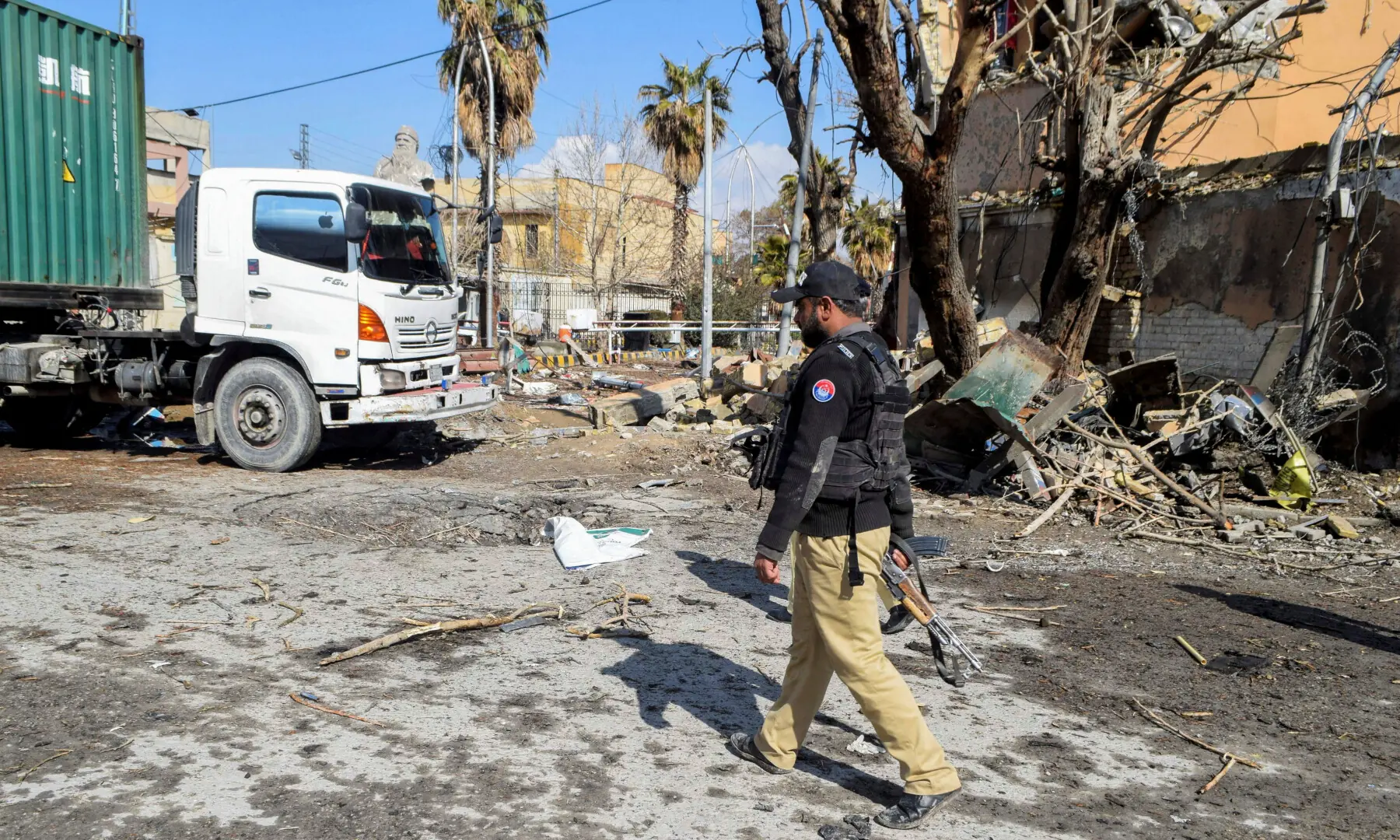
The attacks took place on Saturday in Quetta and several other parts of Balochistan, where militants carried out coordinated assaults on security forces and civilian targets across the province.
According to the military’s media wing, the January 31 attacks were reported from the provincial capital as well as Mastung, Nushki, Dalbandin, Kharan, Panjgur, Tump, Gwadar and Pasni, prompting an immediate and widespread security response.
The Inter-Services Public Relations said security forces and law enforcement agencies launched clearance operations in the affected areas, killing 92 terrorists, including three suicide bombers, while 15 security personnel were martyred.
The attacks also claimed the lives of at least 18 civilians, including women, children, elderly people and labourers, particularly in Gwadar and Kharan.
The military said intelligence reports confirmed that the assaults were orchestrated by terrorist leaders operating from outside Pakistan, who remained in contact with the attackers throughout the incidents.


 American Dollar Exchange Rate