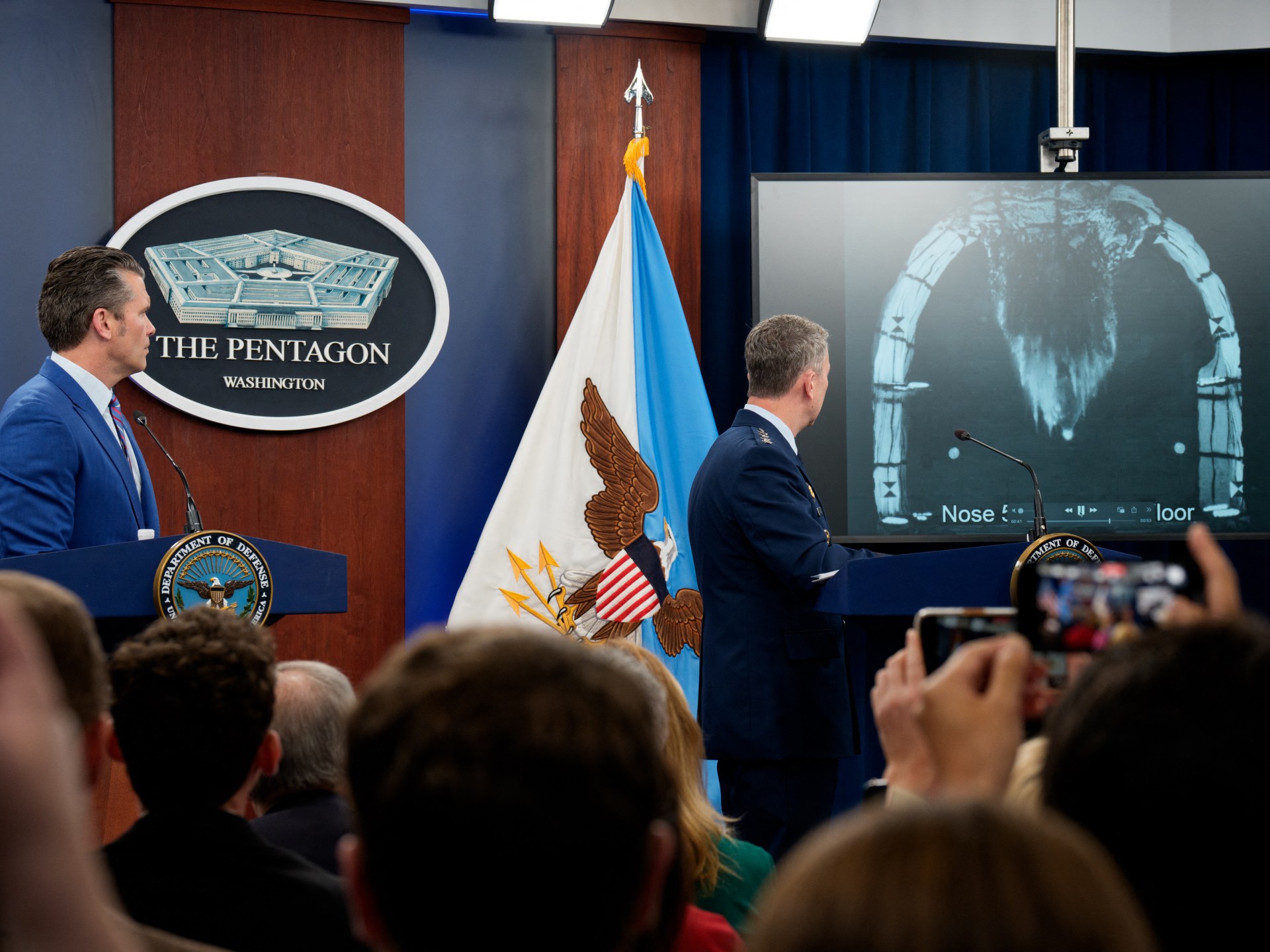
Citing intelligence assessments, NBC News and Washington Post report that only Fordow site was destroyed in US attack.

Washington, DC – New media reports in the United States, citing intelligence assessments, have cast doubt over President Donald Trump’s assertion that Washington’s military strikes last month “obliterated” Iran’s nuclear programme.
The Washington Post and NBC News reported that US officials were saying that only one of the three Iranian nuclear sites – the Fordow facility – targeted by the US has been destroyed.
The Post’s report, released on Friday, also raised questions on whether the centrifuges used to enrich uranium at the deepest level of Fordow were destroyed or moved before the attack.
“We definitely can’t say it was obliterated,” an unidentified official told the newspaper, referring to Iran’s nuclear programme.
Trump has insisted that the US strikes were a “spectacular” success, lashing out at any reports questioning the level of damage they inflicted on Iran’s nuclear programme.
An initial US intelligence assessment, leaked to several media outlets after the attack last month, said the strikes failed to destroy key components of Iran’s nuclear programme and only delayed its work by months.
But the Pentagon said earlier in July that the attacks degraded the Iranian programme by one to two years.
While the strikes on Fordow – initially thought to be the most guarded facility, buried inside a mountain – initially took centre stage, the NBC News and Washington Post reports suggested that the facilities in Natanz and Isfahan also had deep tunnels.
The Pentagon responded to both reports by reiterating that all three sites were “completely and totally obliterated”.
Israel, which started the war by attacking Iran without direct provocation last month, has backed the US administration’s assessment, while threatening further strikes against Tehran if it resumes its nuclear programme.
For its part, Tehran has not provided details about the state of its nuclear sites.
‘Impenetrable’
Some Iranian officials have said that the facilities sustained significant damage from US and Israeli attacks. But Supreme Leader Ali Khamenei said after the war that Trump had “exaggerated” the impact of the strikes.
The location and state of Iran’s highly enriched uranium also remain unknown.
“We don’t know where this material could be or if part of it could have been under the attack during those 12 days,” Grossi told CBS News last month.
According to Grossi, Iran could resume uranium enrichment in a “matter of months”.
Israel launched a massive attack against Iran on June 13, killing several top military officials, as well as nuclear scientists.
The bombing campaign targeted military sites, civilian infrastructure and residential buildings across the country, killing hundreds of civilians.
Iran responded with barrages of missiles against Israel that left widespread destruction and claimed the lives of at least 29 people.
The US joined the Israeli campaign on June 22, striking the three nuclear sites. Iran retaliated with a missile attack against an air base housing US troops in Qatar.
Initially, Trump said the Iranian attack was thwarted, but after satellite images showed damage at the base, the Pentagon acknowledged that one of the missiles was not intercepted.
“One Iranian ballistic missile impacted Al Udeid Air Base June 23 while the remainder of the missiles were intercepted by US and Qatari air defence systems,” Pentagon spokesperson Sean Parnell told media in an email last week.
“The impact did minimal damage to equipment and structures on the base. There were no injuries.”






 American Dollar Exchange Rate