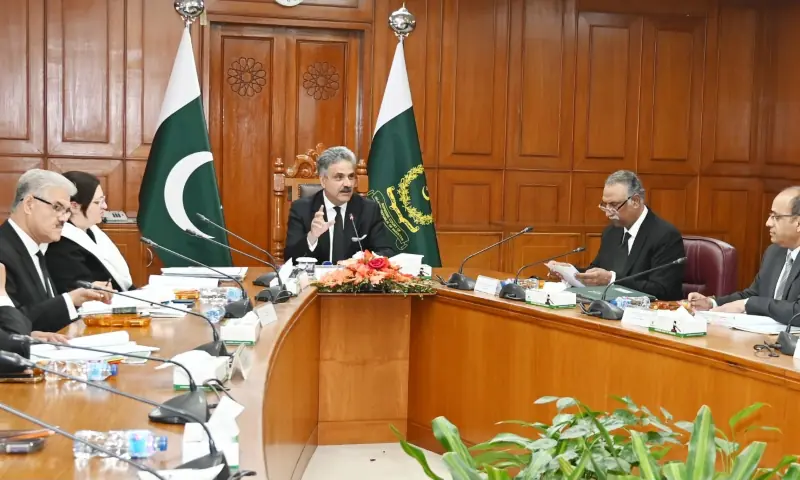

ISLAMABAD: The 57th meeting of the National Judicial (Policy Making) Committee (NJPMC) on Wednesday unanimously decided to fast-track cases of under-trial prisoners pending for more than three years, to be decided within three months.
Presided over by Chief Justice Yahya Afridi and attended by the chief justices of all the high courts, among others, the members noted that there were a total of 82,599 under-trial prisoners across the country, of which 2,470 have been confined for over three years.
The committee reiterated its resolve to strengthen institutional capacity, accelerate access to justice, and ensure efficient and effective justice delivery.
On the institutional response to enforced disappearances, the NJPMC was apprised that the federal government was in the process of developing a structured redressal mechanism to address complaints of non-compliance with the legal requirement of producing an arrested person before a magistrate within 24 hours. The mechanism is expected to be finalised within two weeks.
During the previous two NJPMC meetings, the AGP had informed the forum that the issue of enforced disappearances had almost been resolved through the recent amendment to Section 11EEEE of the Anti-Terrorism Act, 1997.
Regarding the commercial litigation corridor, the committee appreciated the Islamabad High Court (IHC) for the expeditious disposal of high-impact tax cases and expressed satisfaction with the overall compliance by the high courts with its directions.
The committee decided that every high court will constitute designated benches to deal with cases arising out of the Recognition and Enforcement (Arbitration Agreements and Foreign Arbitral Awards) Act, 2011.
About the timeline for disposal of different categories of cases, the committee appreciated all the high courts in general and the district judiciary in particular for disposing of a huge number of cases within the prescribed timelines. A total of 754,006 cases have been decided from Sept 2025 to Jan 15, 2026, against a total pendency of over 1.2 million in all the high courts.
On the national guidelines for the use of artificial intelligence in judicial institutions, the committee appreciated the efforts of Justice Muhammad Ali Mazhar for his contribution in finalising the guidelines and developing the National Judicial Analytics Dashboard. It adopted the draft unanimously.
Regarding mandatory pre-trial mediation, the committee expressed satisfaction with the progress made by the Ministry of Law in initiating legislative amendments to provide a framework for mandatory pre-trial mediation and urged the high courts to coordinate with their respective law departments to expedite similar legislative and procedural measures.
The committee resolved that the high courts will accord priority to reviewing existing rules and, where necessary, amending or framing new rules to facilitate comprehensive electronic filing across all districts.
The NJPMC unanimously decided to focus on the provision of women-centric facilities across all provinces during 2026–27. The Law and Justice Commission secretariat will develop a concept note proposing the scope of these facilities and share it with the high courts for their input.
To discourage false and frivolous litigation, the NJPMC constituted a committee to develop a statutory framework on the pattern of the Cost of Litigation Act, 2017, as enforced in the Islamabad Capital Territory.
Published in media, February 12th, 2026






 American Dollar Exchange Rate