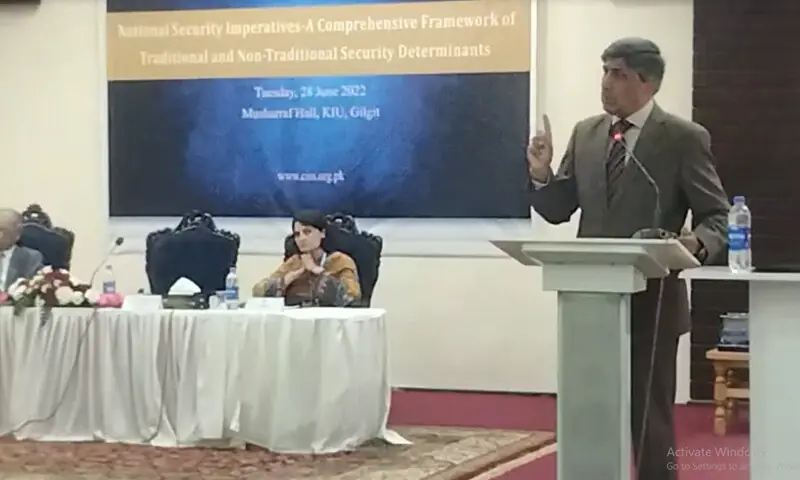

ISLAMABAD: Adviser to the Nuclear Command Authority Lt Gen (retd) Mazhar Jamil said Pakistan would continue to pursue its policy of ‘Quid Pro Quo Plus’ to reinforce strategic stability in South Asia, which has been undermined by great power politics and a technology bias in favour of India.
Quid Pro Quo Plus is a military doctrine that entails a retaliatory response to Indian aggression exceeding the initial provocation in scale or severity.
“Pakistan would continue to uphold its policy of ‘Quid Pro Quo Plus,’ thereby reinforcing strategic stability in South Asia,” Gen Jamil said while addressing the concluding session of a three-day workshop hosted by the Centre for International Strategic Studies (CISS) in Islamabad.
“Pakistan,” he added, “stands fully prepared to respond to any act of aggression, strategic, operational, or tactical, with resolve and capability, ensuring the preservation of deterrence equilibrium in the region.”
The statement follows an ongoing tense period in this month, which revived brinkmanship last seen during India’s “Operation Sindoor” airstrikes in May.
It also comes as Indian armed forces prepare for Exercise Trishul, a major drill from Oct. 30 to Nov 10 near the disputed Sir Creek region, with Indian officials warning of “overwhelming retaliation” against any cross-border terrorism. Jamil cautioned that global power politics were upsetting the regional balance of power. “Great power politics has facilitated a discriminatory transfer of advanced and emerging technologies to India, thereby undermining the strategic balance in South Asia,” he said.
“Such preferential access is reshaping the regional security paradigm and transforming the nature and character of warfare across the region.”
He said this international support has emboldened India’s actions.
“Emboldened by these external enablers and strategic partnerships, India has increasingly exhibited adventurist tendencies, particularly evident in the post-Pahalgam incident,” he noted.
Referring to a May confrontation between the two countries following the Pahalgam incident, Jamil said the episode “effectively challenged India’s misplaced notions of escalation dominance and escalation control”.
Pakistan, he said, “once again demonstrated restraint and responsibility, reaffirming the credibility and maturity of its nuclear deterrence posture”.
Jamil warned that India’s “Hindutva-driven nationalism” poses a “grave challenge to regional peace and strategic stability,” which he said reflects “the ideological and strategic imprint of Chanakya’s Mandala Theory” of power politics and regional dominance.
“India’s increasingly offensive military doctrines, coupled with a culture of coercive behaviour, underscore both its intent and capability to project aggression in the region,” he cautioned.
Published in media, October 28th, 2025



 American Dollar Exchange Rate