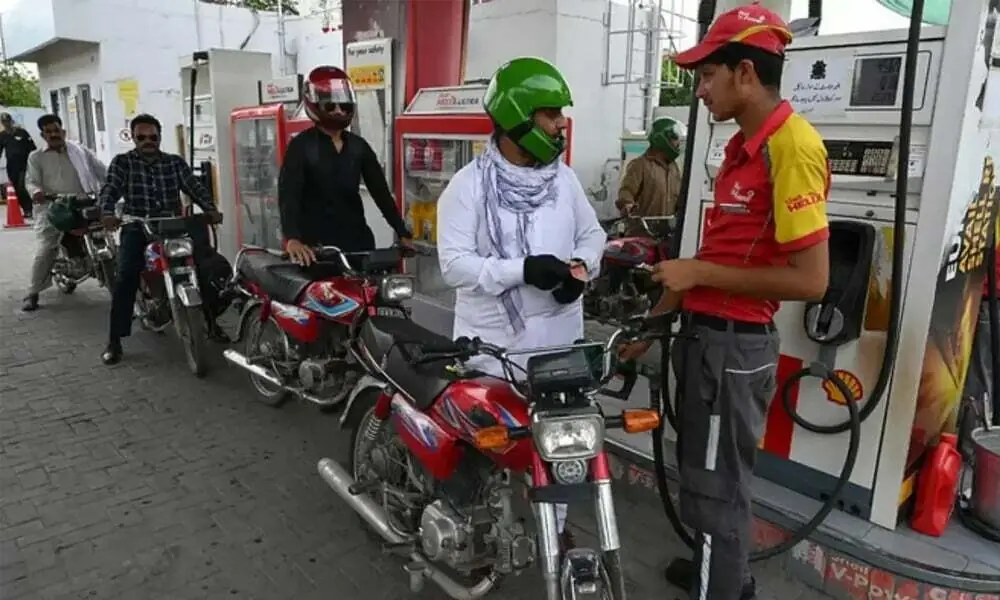
Pakistan government on Friday announced a hike of Rs55 per litre in the prices of petrol and diesel in line with increasing international oil prices.
The announcement was made in a press conference by Petroleum Minister Ali Pervaiz Malik alongside Deputy Prime Minister and Foreign Minister Ishaq Dar and Finance Minister Muhammad Aurangzeb.
With the increase of Rs55, the petrol price jumped to Rs321.17 per litre, with effect from midnight. Meanwhile, diesel price soared to Rs335.86 per litre.
Dar said during the press conference that the new prices will come into effect from midnight.
He began with a discussion on the ongoing conflict involving Iran, the United States, and Israel, noting that the war had begun to spill over into the wider region.
“The war between Iran, the US, and Israel has now spilled over,” he said, adding that the situation had significantly affected global petroleum markets.
“In this scenario, petroleum product prices are rising sharply. Various products have seen an increase of around 50 to 70 percent,” he noted.
He said many countries were witnessing an automatic pass-through of higher global oil prices to domestic fuel prices.
“In many countries, the trickle-down effect is visible, where petroleum prices increase automatically,” he said.
However, he added that Pakistan had taken a cautious approach under the direction of Prime Minister Shehbaz Sharif.
“In Pakistan, the prime minister has been very careful. Deliberations have been ongoing for the past two to three weeks,” he said.
He noted that a permanent committee, led by Ali Pervaiz Malik and Finance Minister Muhammad Aurangzeb, had been reviewing the situation regularly.
The development comes in line with the escalating crisis in the Middle East after the United States and Israel launched strikes on Iran, killing its Supreme Leader Ayatollah Ali Khamenei.
Iran retaliated with strikes on Israel as well as US bases in Gulf countries, and announced it wouldn’t allow vessels to pass through the Strait of Hormuz.
On Friday, Brent crude futures were up $5.42, or 6.35%, at $90.83 a barrel at 10:37am. CST (1637 GMT). West Texas Intermediate crude (WTI) was up $7.81, or 9.81%, at $88.96.
In the previous review on February 28, the government had increased the petrol price by Rs8 per litre, taking the rate to Rs266.17 per litre. It had also surged the price of diesel by Rs5.16 to Rs280.86.
Earlier on Friday, Prime Minister Shehbaz Sharif ordered an immediate nationwide crackdown on the hoarding of petroleum products, directing provincial governments to shut down petrol pumps and cancel the licences of those involved in creating artificial shortages.
Last week, the premier constituted an 18-member high-level committee to assess the impact of rising international oil prices on the country’s economy.

Pakistan government on Friday announced a hike of Rs55 per litre in the prices of petrol and diesel in line with increasing international oil prices.
The announcement was made in a press conference by Petroleum Minister Ali Pervaiz Malik alongside Deputy Prime Minister and Foreign Minister Ishaq Dar and Finance Minister Muhammad Aurangzeb.
With the increase of Rs55, the petrol price jumped to Rs321.17 per litre, with effect from midnight. Meanwhile, diesel price soared to Rs335.86 per litre.
Dar said during the press conference that the new prices will come into effect from midnight.
He began with a discussion on the ongoing conflict involving Iran, the United States, and Israel, noting that the war had begun to spill over into the wider region.
“The war between Iran, the US, and Israel has now spilled over,” he said, adding that the situation had significantly affected global petroleum markets.
“In this scenario, petroleum product prices are rising sharply. Various products have seen an increase of around 50 to 70 percent,” he noted.
He said many countries were witnessing an automatic pass-through of higher global oil prices to domestic fuel prices.
“In many countries, the trickle-down effect is visible, where petroleum prices increase automatically,” he said.
However, he added that Pakistan had taken a cautious approach under the direction of Prime Minister Shehbaz Sharif.
“In Pakistan, the prime minister has been very careful. Deliberations have been ongoing for the past two to three weeks,” he said.
He noted that a permanent committee, led by Ali Pervaiz Malik and Finance Minister Muhammad Aurangzeb, had been reviewing the situation regularly.
The development comes in line with the escalating crisis in the Middle East after the United States and Israel launched strikes on Iran, killing its Supreme Leader Ayatollah Ali Khamenei.
Iran retaliated with strikes on Israel as well as US bases in Gulf countries, and announced it wouldn’t allow vessels to pass through the Strait of Hormuz.
On Friday, Brent crude futures were up $5.42, or 6.35%, at $90.83 a barrel at 10:37am. CST (1637 GMT). West Texas Intermediate crude (WTI) was up $7.81, or 9.81%, at $88.96.
In the previous review on February 28, the government had increased the petrol price by Rs8 per litre, taking the rate to Rs266.17 per litre. It had also surged the price of diesel by Rs5.16 to Rs280.86.
Earlier on Friday, Prime Minister Shehbaz Sharif ordered an immediate nationwide crackdown on the hoarding of petroleum products, directing provincial governments to shut down petrol pumps and cancel the licences of those involved in creating artificial shortages.
Last week, the premier constituted an 18-member high-level committee to assess the impact of rising international oil prices on the country’s economy.




 American Dollar Exchange Rate