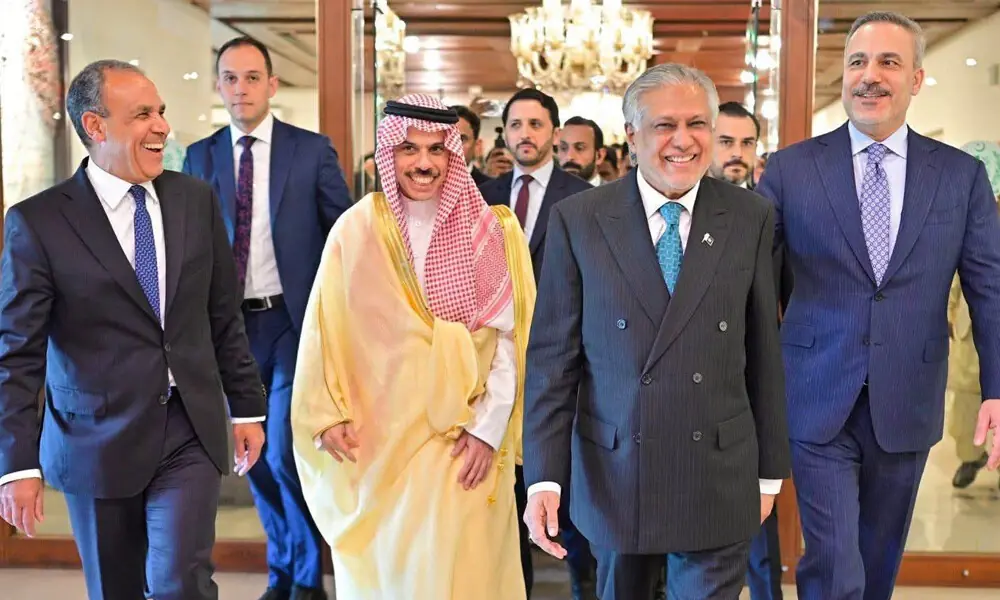

ISLAMABAD/ISTANBUL: Pakistan hosted talks with Turkiye, Egypt and Saudi Arabia on Sunday as part of its efforts to broker an end to the war on Iran, with initial discussions focused on proposals to reopen the Strait of Hormuz to shipping, sources familiar with the matter said.
Foreign ministers from the three regional powers landed in Islamabad for the talks as Iran warned the US against launching a ground attack and global oil prices surged amid continued fighting between Iran, the US and Israel.
The countries meeting in Pakistan have floated proposals to Washington tied to maritime traffic and reopening the Strait of Hormuz, five sources familiar with the matter told Reuters, as part of wider efforts to stabilise shipping flows.
The Strait of Hormuz was previously a conduit for about a fifth of global oil and liquefied natural gas supplies, but Iran has effectively halted shipping flows through it in response to the US and Israeli air strikes that began a month ago.
Proposals on reopening Hormuz
Pakistan, which like Turkiye borders Iran, has leveraged its close ties to both Tehran and Washington to emerge as a key diplomatic channel in the conflict, while Ankara and Cairo have also played a role.
A source from Pakistan said proposals, including from Egypt, had been forwarded to the White House by the countries before Sunday’s meeting and that they included Suez Canal-style fee structures.
Two other Pakistani sources said Turkiye, Egypt and Saudi Arabia could form a consortium to manage oil flows through the waterway, and had asked Pakistan to participate.
The first Pakistani source said Islamabad had not been formally asked to join and maintains that it will not.
The proposal for a management consortium had been discussed with the US and Iran, the sources said. The first Pakistani source said the country’s army chief Asim Munir had been in regular contact with US Vice President JD Vance.
Egypt’s and Pakistan’s foreign ministries did not respond to a request for comment. The Saudi government media office and the White House did not immediately reply to a comment request.
A Turkish diplomatic source said Ankara’s priority was securing a ceasefire.
“Ensuring the safe passage of ships could serve as an important confidence-building measure in this regard,” the person said, requesting anonymity.
Earlier on Sunday, Pakistan’s Foreign Minister Ishaq Dar held separate one-on-one meetings with his Turkish and Egyptian counterparts, stressing dialogue and sustained diplomatic engagement, the foreign office said.
Separately, Dar said in a post on X that Iran had agreed to allow 20 more Pakistani-flagged ships through the Strait of Hormuz.
AFP adds: The four-way meeting between the top diplomats of the Muslim nations lasted several hours in Islamabad.
Pakistan has emerged as a key facilitator between Iran and the United States as their war drags on, relaying messages between the two sides.
Foreign Minister Dar said the talks, held under tight security at his ministry but without any US, Israeli or Iranian representation, came at a “critical moment”.
“Our candid and constructive discussions focus on the evolving regional situation and advancing peace and stability, while strengthening our partnership and deepening cooperation,” he wrote on X.
Egypt’s foreign ministry said the talks addressed efforts to stop the conflict from escalating, as well as encouraging “a negotiations track” between Tehran and Washington to prevent the region “slipping into a state of complete chaos”.
Dar, who is also Pakistan’s deputy prime minister, held separate bilateral talks with his counterparts – Badr Abdelatty from Egypt, Hakan Fidan from Turkey, and Saudi Arabia’s Faisal bin Farhan. All three visitors also met Munir.
Pakistan and Saudi Arabia have a mutual defence pact and in another meeting, Sharif told Farhan that Riyadh had shown “remarkable restraint” in the crisis.
“While emphasising the Kingdom’s leadership role in the Muslim Ummah (worldwide community), the Prime Minister stressed upon the need to forge unity within the Islamic countries at this critical time,” a statement read.





 American Dollar Exchange Rate