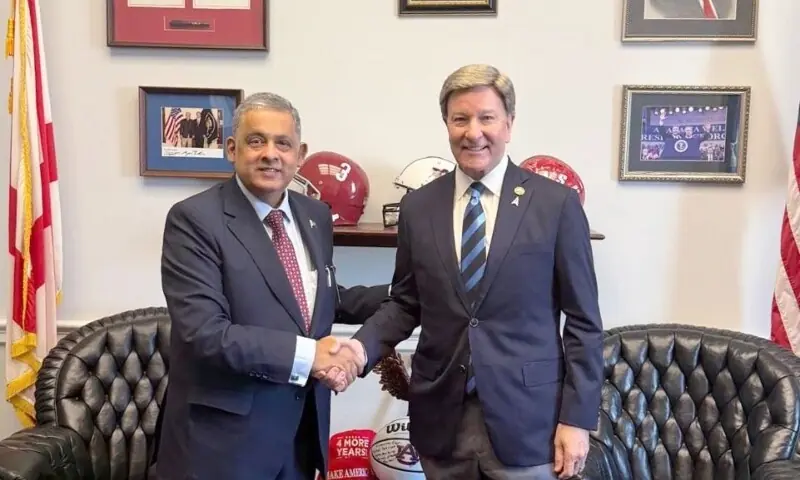

WASHINGTON: Pakistan has called for the launch of a high-level economic dialogue with the United States at the earliest and urged a shift in bilateral engagement from geopolitics to geoeconomics during a series of meetings between the country’s envoy Rizwan Saeed Sheikh and senior members of Congress.
Meeting House Foreign Affairs Committee Chairman Brian Mast and House Armed Services Committee Chairman Mike Rogers, Pakistan’s Ambassador to the US said 2026 should be treated as a “year of action” to translate shared intentions into concrete economic cooperation.
“Our focus is shifting from geopolitics to geoeconomics,” he said, according to one of two handouts issued after the meeting, and stressed the need for institutionalised engagement in sectors such as energy, defence, minerals, information technology and artificial intelligence.
Ambassador Sheikh said Pakistan’s low-cost, high-quality manufacturing base positioned it well to meet growing US market needs, highlighting surgical instruments, textiles and sports goods as areas with strong export potential.
He said that “2026 should be the year of action for a long-term, sustainable partnership based on economic cooperation”, noting that footballs manufactured in Sialkot had been used in five consecutive Fifa World Cups.
US State Secretary Marco Rubio has recently spoken positively about expanding ties with Pakistan, describing the relationship as one with significant untapped potential.
“We see an opportunity to expand our strategic relationship with Pakistan,” Rubio said in October 2025, adding that Washington valued Islamabad’s long history of cooperation, particularly in counter-terrorism.
At the same time, Rubio sought to reassure regional partners, saying that closer engagement with Pakistan does not come at the expense of US ties with India.
“I don’t think anything we’re doing with Pakistan comes at the expense of our relationship or friendship with India, which is deep, historic, and important,” he had said, describing US policy as pragmatic and interest-based.
US President Donald Trump, however, has also highlighted strains in Washington’s dealings with New Delhi.
Speaking at a political gathering this week, Trump said: “I have a very good relationship with Prime Minister Modi … he’s not that happy with me because they’re paying a lot of tariffs now,” referring to trade and energy-related differences between the two countries.
Meanwhile, in his meeting with US lawmakers, Ambassador Sheikh also praised the US president’s political judgment and personal engagement in helping de-escalate tensions following the military escalation between Islamabad and New Delhi in May 2025.
According to the handouts, the discussions in Washington also focused on regional security challenges, with the Pakistani ambassador warning that terrorism originating from Afghanistan continued to pose serious threats to Pakistan’s security as well as to regional and international peace.
He told congressional leaders that terrorist incidents in Pakistan increased by 40 per cent in 2024 and by a further 25pc in 2025, attributing the rise to militant groups operating from Afghan soil.
He expressed concern over the continued misuse of advanced weapons left behind during the US withdrawal from Afghanistan.
Addressing South Asian tensions, Ambassador Sheikh referred to the events of May 2025 and said India’s “irresponsible and aggressive behaviour” had lowered the threshold of escalation in the region.
He warned that confrontation between two nuclear-armed neighbours had moved beyond conventional conflict to include advanced technologies, describing the use of dual-capable weapons in a region of 1.7 billion people as deeply alarming.
Ambassador Sheikh cautioned that decisions based on misperceptions or miscalculations could undermine regional peace and reiterated that the unresolved issue of Kashmir and the right of self-determination of its people remained central to lasting stability in South Asia.
Both sides agreed on the need to institutionalise structured and regular dialogue on issues of mutual interest, including economic cooperation and security.
Ambassador Sheikh also extended invitations to congressional leaders to visit Pakistan to strengthen parliamentary and people-to-people ties.
About his meeting with Rogers, the envoy said on X that the two discussed the “ascendantly evolving Pak-US partnership”.
“Focused on regional security challenges, the escalating and sponsored terrorism from Afghanistan, and the subsequently urgent need to address the leftover military equipment. Emphasised that a stable, standalone Pak-US relationship remained vital to regional as well as global peace, security and stability,” he said.
About his meeting with Mast, the ambassador said he thanked him for his leadership and continued support during a year of positive trajectory in Pak-US relations.
“Noted that 2026 must be a year of action — moving from good intent to concrete content based on structured and sustained engagement, geared to translating our ties into a long-term partnership on its own merits,” he said.
“Also exchanged views on regional and global developments. Sought support for enhanced counterterror cooperation, and invited him to visit Pakistan,“ he said.



 American Dollar Exchange Rate