
Pakistan has sought support from the United States (US) to engage the International Monetary Fund (IMF) and the World Bank “to help remove obstacles hindering the sustainable growth” of the power sector.
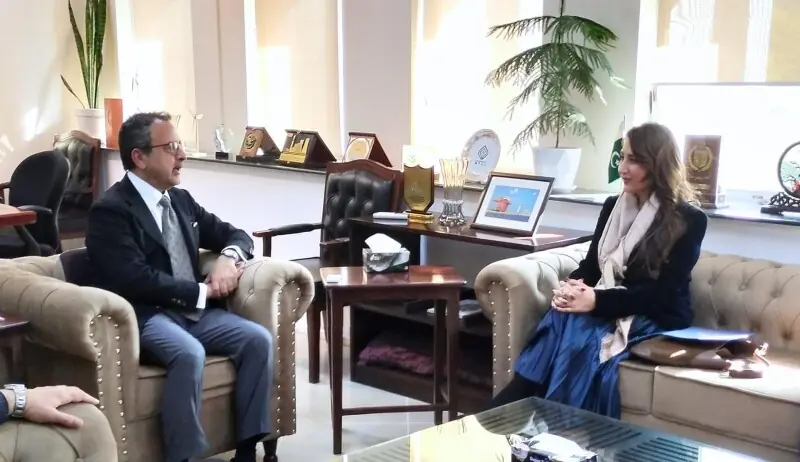
The development came as Pakistan’s Power minister Awais Ahmed Leghari met US Ambassador Natalie Baker on Monday.
“During the meeting, Mr Awais Leghari requested the Ambassador’s support in engaging US-based multilateral development partners and international financial institutions, including the IMF and the World Bank, to help remove obstacles hindering the sustainable growth of Pakistan’s power sector.
“He [Leghari] emphasised the importance of development partners’ assistance in enabling Pakistan to implement structural reforms and improve sectoral performance,” the Power Division said in a statement.
Leghari also briefed Ambassador Baker on the recently launched Surplus Power Package, highlighting its potential to boost economic activity by offering competitively priced electricity to industrial consumers.
“He requested US support in extending this package to greenfield industries, which would further stimulate investment and industrial growth.”
The discussion also covered ongoing efforts to address inefficiencies across the power distribution system, particularly in reducing technical and commercial losses and improving recoveries.
“Ambassador Baker appreciated the Power Ministry’s continued reforms and commended the government’s progress in reducing inefficiencies and managing circular debt through targeted, data-driven interventions.
“Both sides also discussed investment opportunities for US investors, especially in Pakistan’s power transmission sector, where significant potential exists for private sector participation. Ambassador Baker expressed keen interest in these opportunities,” the Power Division said.
Pakistan govt inks financial advisory pact for privatisation of two Discos
The meeting further touched upon the privatisation of distribution companies (Discos), as the minister requested the Ambassador’s support in encouraging US investors to consider acquiring Discos currently being offered for privatisation, noting that private sector participation remained essential for enhancing operational efficiency and service delivery.
‘Govt will not procure power in future’
During the day, the minister also met Frederic Ribieras, CEO of GE Vernova’s Hydro Power, to discuss Pakistan’s clean energy transition, private-sector investment, and collaboration in hydropower and energy storage.
“The minister reiterated the government’s shift toward a market-driven power sector, noting that future power generation will be led by the private sector as the government will not procure power in future,” the Power Division said.
He highlighted transmission constraints and encouraged global investors to explore business-to-business (B2B) opportunities, stating that companies like GE Vernova could serve as strong technical and investment partners.
According to Leghari, Pakistan is pursuing a least-cost energy strategy and recently achieved nearly 56% clean energy generation.
The minister emphasised the need for Battery Energy Storage Systems (BESS) due to challenges in wind power take-off.
“Mr Ribieras suggested pumped-storage hydropower as another option. The minister welcomed the idea and said the government is open to reviewing all least-cost solutions.”
Ribieras expressed interest in hydropower technologies, the Power Division said. “The minister supported this interest and said a list of potential investment projects can be shared with GE Vernova.”
During the meeting, Leghari also highlighted the privatisation of Discos and stressed stronger coordination with the Power Planning & Monitoring Company (PPMC), especially for initiatives like AMI meter deployment where GE Vernova’s expertise could be beneficial.
“GE Vernova’s leadership appreciated Pakistan’s policy direction and showed interest in hydropower and storage opportunities. It was agreed during the meeting to maintain close engagement to advance sustainable, reliable, and cost-effective energy solutions for Pakistan,” the Power Division said.



 American Dollar Exchange Rate