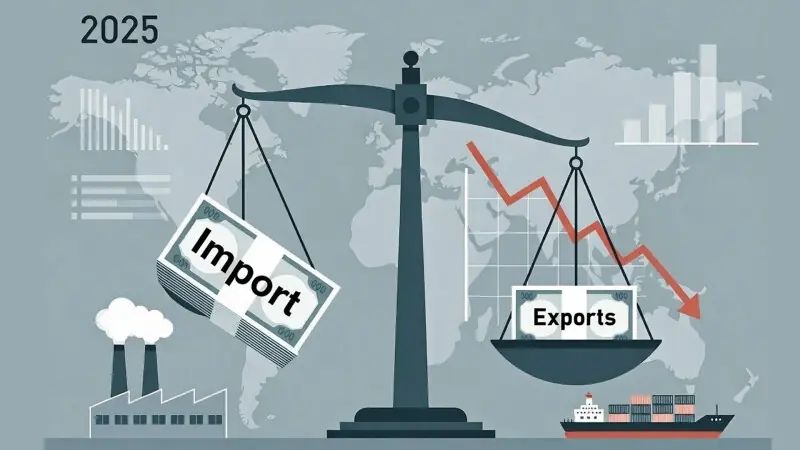

KARACHI: Pakistan’s economy has remained stuck in a recovery and stabilisation phase for the third consecutive year, failing to transition into a growth trajectory in 2025 as imports surged while exports declined, leading to persistent imbalances in external trade.
The robust growth in workers’ remittance inflows partially offset weak export performance, providing additional foreign exchange that facilitated higher imports.
However, a significant portion of these remittances was channelled into the import of automobiles and fuel, highlighting a structural fault line in the economy, i.e. reliance on imports for consumption rather than investment in export-oriented industries.
Pakistan’s GDP grew by 3.04% in FY25, while surging by 3.71% in the first quarter of FY26 (July – September 2025). However, this growth rate remains well below the 5–6% required to generate sufficient employment opportunities for the country’s expanding workforce.
“The question is how long we can afford the stabilisation phase,” Ismail Iqbal Securities Head of Research Saad Hanif told media.
READ MORE: From tanks to jets: Pakistan’s $13bn defense deals set to supercharge economy
He said that a growth rate of around 3%-3.5% would keep a significant number of people out of the job market, contributing to a rising poverty level in the country.
“We have spent precious foreign exchange reserves notably on imports for local consumption, like expensive cars, importing some 35-40 new models of cars alone in 2025. Instead, the available funds should have been utilised to set up, support and grow new export industries.”
The country’s import of goods increased by 9% to $64.93 billion in CY25 compared to $59.54 billion in CY24, according to the Pakistan Bureau of Statistics’ (PBS) data.
The data suggests the import in the transport group (predominantly by cars) soared 76% in the first 11 months (Jan-Nov) of CY25 to $3.14 billion compared to $1.78 billion in the same period of the last year. In contrast, growth in imports of other commodities remained far lower compared to the vehicle segment in percentage terms.
READ MORE: Pakistan’s exports remain on downward trajectory
Meanwhile, export of goods dropped over 5% to $30.65 billion in CY25, compared to $32.32 billion in CY24, according to PBS.
Accordingly, the overall trade deficit widened by 26% to $34.75 billion in CY25 compared to $27.22 billion in CY24.
Finance Minister Muhammad Aurangzeb had been highly optimistic about the country’s agriculture sector; however, the floods during the monsoon season disrupted those plans.
On the other hand, the stagnant economic conditions mixed with political tensions have convinced thousands of Pakistanis, including highly skilled professionals, to emigrate to foreign countries seeking better prospects.
“The exports have remained sluggish for the past decade. We have to chalk out policies and give incentives to boost exports to reach a higher growth phase,” Hanif said.
AKD Securities Head of Research Muhammad Awais Ashraf, however, projected “the exports may not take off in the ongoing calendar year 2026 [FY26] as well due to low commodity prices in global markets.
The low commodity prices, however, would keep the country’s import bill contained as well. This would keep the current account deficit manageable.“
He said boosting foreign direct investment (FDI) in Pakistan’s economy has remained a big challenge, as they remained low at around $2-2.5 billion a year in Pakistan.
On the other hand, Saad Hanif believes that FDI and local investment would remain low unless the government cuts tax rates on industries. “Who will invest when industries are subject to pay 40% of their income in taxes?”
“The challenges in the economy have remained bigger than the issues addressed,” he said, adding, “the short-term measures like an increase in the price of power and gas and a surge in tax rates for the sectors already compliant cannot help the domestic economy to migrate into a growth phase from stabilisation at present.”
The analyst maintained that the government has to carry out reforms and make structural changes, particularly in energy, export and tax sectors.
“It will have to bring exporters, agriculturalists, wholesalers, and retailers into the tax net to give tax relief to industrial sectors and increase the collection of revenue in taxes. It has to cut energy tariffs to make power affordable for industries and to make exports competitive,” he added.
READ MORE: OPINION: If wishes were horses: the $63bn export illusion
During the calendar year, the world’s three leading credit rating agencies – Fitch Ratings, S&P Global Ratings, and Moody’s Ratings – upgraded Pakistan’s sovereign credit ratings and assigned a stable outlook between April and August 2025, reflecting improving macroeconomic stability. These upgrades were driven by Pakistan’s adherence to IMF-supported reforms, improved external financing conditions, and a reduced near-term risk of default on foreign debt obligations.
Separately, the International Monetary Fund (IMF) disbursed a total of $2.2 billion to Pakistan under a 37-month Extended Fund Facility (EFF) and a 28-month Resilience and Sustainability Facility (RSF) during 2025. This includes $2 billion under EFF and another $200 million under RSF.
The IMF programme has improved the balance of payment situation and supported the nation in continuing to make foreign debt repayments smoothly and on time. The lending agency held two successful economic reviews under the EFF and initiated climate financing under the RSF in 2025.
PIA privatisation
In December 2025, the long-awaited privatisation of Pakistan International Airlines (PIA) was completed, as the Arif Habib-led consortium acquired a 75% stake in the national carrier for Rs135 billion, marking the largest privatisation in Pakistan in nearly two decades.
The privatisation directly supports Pakistan’s IMF programme objectives, which emphasise fiscal consolidation, structural reforms, and reducing the burden of state-owned enterprises on public finances.
The new management is expected to take management control of the airlines around April 2026 and make efforts to make it a profitable institution over the next couple of years.





 American Dollar Exchange Rate