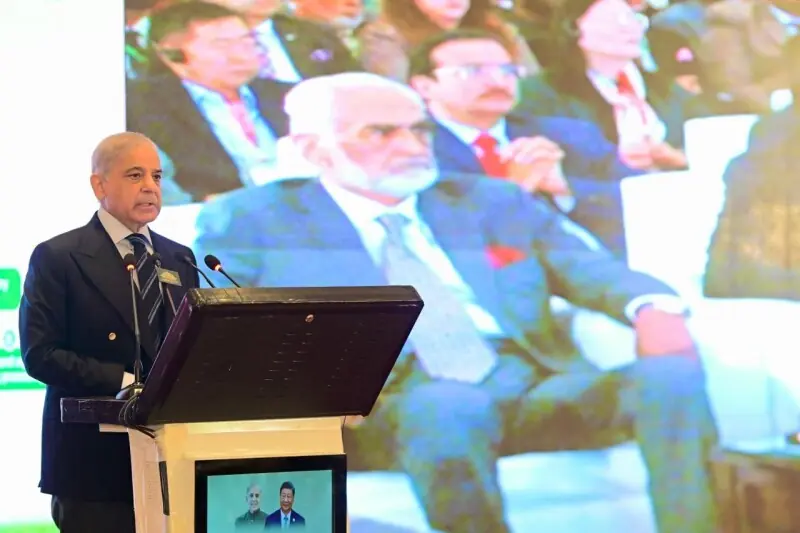

Prime Minister Shehbaz Sharif on Monday said Pakistan could fast-track economic growth by leveraging China’s experience, technology and expertise, particularly in agriculture, information technology and artificial intelligence.
Speaking at the Pak-China Agri-Investment Conference, the prime minister said China’s rapid development offered valuable lessons for Pakistan, adding that effective utilisation of Chinese skills and know-how could help the country achieve in months what would otherwise take years.
He said Pakistan’s economy had moved from stabilisation to a phase of sustainable growth, citing declining inflation, a significant cut in the policy rate, improved exports and better overall macroeconomic indicators.
Calling agriculture the backbone of Pakistan’s economy, the prime minister stressed the need to raise productivity through modern farming techniques, efficient water management, value chains, cold storage and value addition.
READ MORE: Trump invites PM Shehbaz to join US-led Noard of Peace on Gaza
He said China was providing advanced agricultural technology and training, which could play a critical role in transforming Pakistan’s agri-economy.
The prime minister said several business-to-business (B2B) and government-to-government (G2G) memoranda of understanding signed between Pakistan and China in 2024 and 2025 were now being converted into practical commercial agreements.
Highlighting human capital development, he said 1,000 Pakistani agriculture graduates had been trained at Chinese universities and research institutions and would support farmers upon returning home, helping improve yields and farm incomes.
READ MORE: PM Shehbaz stresses expanding trade, investment ties with Australia
Shehbaz Sharif reiterated Pakistan’s commitment to operationalising CPEC 2.0, describing it as a key platform for deeper economic cooperation and long-term growth.
The premier added that Pakistan and China were celebrating 75 years of diplomatic relations this year, reflecting a time-tested partnership.
He also termed Pakistan’s large youth population a major asset, saying young people were being equipped with modern skills in agriculture, IT and artificial intelligence to accelerate economic growth.
Chinese Ambassador Jiang Zaidong, addressing the conference, welcomed Pakistan’s recent economic progress and said GDP growth had exceeded 3% last year, reaching 3.71% in the first quarter of FY26.
He said inflation had eased to around 4%, the current account posted a surplus of $2.1 billion, and foreign exchange reserves had risen to $21.2 billion, reflecting improving economic stability.
The ambassador said China would deepen cooperation under its upcoming 15th Five-Year Plan and prioritise agricultural collaboration, with a target to raise bilateral agricultural trade to $1 billion and expand cooperation in modern farming technologies.





 American Dollar Exchange Rate