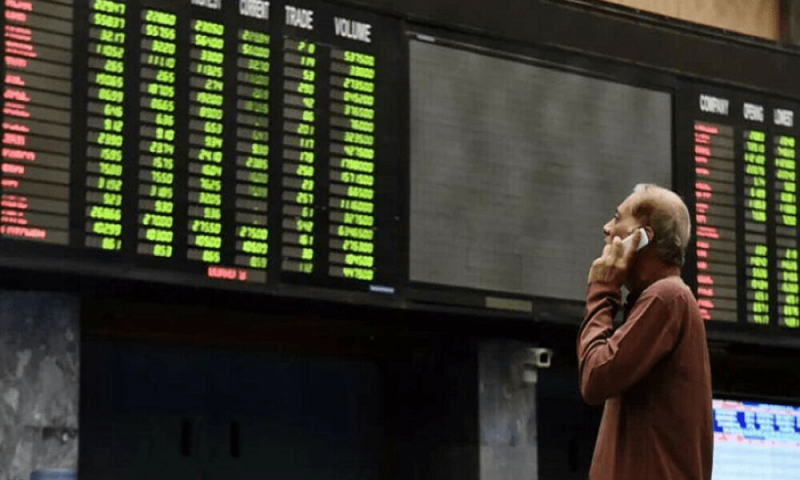
After initial buying momentum, profit-taking gripped the Pakistan Stock Exchange (PSX), causing the benchmark KSE-100 to settle with a loss of over 1,400 points on Tuesday.
The market kicked off trading on a positive note, pushing the KSE-100 Index to an intra-day high of 140,331.01.
However, profit-taking was observed in the final hours of trading, dragging the benchmark to an intra-day low of 137,636.37.
At close, the benchmark index settled at 137,964.81 level, a decrease of 1,415.24 points or 1.02%.
In a key development, Finance Minister Muhammad Aurangzeb left for his second visit to the United States in two weeks to finalise a trade deal with Washington, his office said late on Monday.
The trip comes after Foreign Minister Ishaq Dar said on Friday that the U.S. and Pakistan were “very close” to a trade deal that could come within days.
“A final discussion on the Pakistan-US trade dialogue will take place during the visit,” the finance ministry said in a statement, adding that a trade agreement will benefit both countries.
On Monday, PSX saw modest upward momentum, fueled by investor interest in cement and technology stocks ahead of the monetary policy announcement and key corporate earnings.
The benchmark KSE-100 Index gained 172.77 points, or 0.12%, to close at 139,380.06 points
Internationally, Asia shares eased on Tuesday while the euro nursed its losses as investors pondered the downside of the US-EU trade deal and the reality that punishing tariffs were here to stay, with unwelcome implications for growth and inflation.
The initial relief over Europe’s 15% levy quickly soured when set against the 1% to 2% that stood before President Donald Trump took office. Leaders in France and Germany lamented the outcome as a drag on growth, pulling down stocks and bond yields across the continent while slugging the single currency.
Trump also flagged a “world tariff” rate of 15% to 20% on all trading partners that were not negotiating a deal, among the highest rates since the Great Depression of the 1930s.
A further risk to world growth came from a sudden spike in oil prices after Trump threatened a new deadline of 10 or 12 days for Russia to make progress toward ending the war in Ukraine or face tougher sanctions on oil exports.
The air of caution saw MSCI’s broadest index of Asia-Pacific shares outside Japan slip 0.7%. Japan’s Nikkei eased 0.8% while Chinese blue chips fell 0.1%.
This is an intra-day update

After initial buying momentum, profit-taking gripped the Pakistan Stock Exchange (PSX), causing the benchmark KSE-100 to settle with a loss of over 1,400 points on Tuesday.
The market kicked off trading on a positive note, pushing the KSE-100 Index to an intra-day high of 140,331.01.
However, profit-taking was observed in the final hours of trading, dragging the benchmark to an intra-day low of 137,636.37.
At close, the benchmark index settled at 137,964.81 level, a decrease of 1,415.24 points or 1.02%.
In a key development, Finance Minister Muhammad Aurangzeb left for his second visit to the United States in two weeks to finalise a trade deal with Washington, his office said late on Monday.
The trip comes after Foreign Minister Ishaq Dar said on Friday that the U.S. and Pakistan were “very close” to a trade deal that could come within days.
“A final discussion on the Pakistan-US trade dialogue will take place during the visit,” the finance ministry said in a statement, adding that a trade agreement will benefit both countries.
On Monday, PSX saw modest upward momentum, fueled by investor interest in cement and technology stocks ahead of the monetary policy announcement and key corporate earnings.
The benchmark KSE-100 Index gained 172.77 points, or 0.12%, to close at 139,380.06 points
Internationally, Asia shares eased on Tuesday while the euro nursed its losses as investors pondered the downside of the US-EU trade deal and the reality that punishing tariffs were here to stay, with unwelcome implications for growth and inflation.
The initial relief over Europe’s 15% levy quickly soured when set against the 1% to 2% that stood before President Donald Trump took office. Leaders in France and Germany lamented the outcome as a drag on growth, pulling down stocks and bond yields across the continent while slugging the single currency.
Trump also flagged a “world tariff” rate of 15% to 20% on all trading partners that were not negotiating a deal, among the highest rates since the Great Depression of the 1930s.
A further risk to world growth came from a sudden spike in oil prices after Trump threatened a new deadline of 10 or 12 days for Russia to make progress toward ending the war in Ukraine or face tougher sanctions on oil exports.
The air of caution saw MSCI’s broadest index of Asia-Pacific shares outside Japan slip 0.7%. Japan’s Nikkei eased 0.8% while Chinese blue chips fell 0.1%.
This is an intra-day update




 American Dollar Exchange Rate