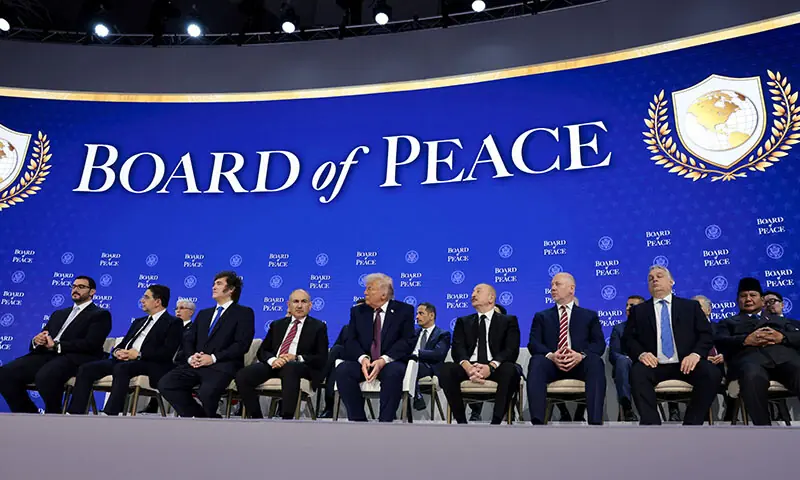

The PTI on Thursday rejected the government’s decision to join US President Donald Trump’s ‘Board of Peace’ initiative, stating that any such decisions should be made following consultation with all stakeholders.
Originally meant to oversee peace in Gaza after Israel’s two-year war on the Palestinian enclave, the Board of Peace’s charter envisions a wider role in resolving international conflicts.
A group of leaders and senior officials from 19 countries — including Pakistan — gathered on stage on Thursday with Trump at a signing ceremony in Davos, Switzerland, to put their names to the founding charter of the body.
In a statement, the PTI said it did not accept the government’s decision to join the Board of Peace.
The party emphasised that decisions of international significance should always be made following consultations with all major political stakeholders and with full transparency.
“The government should at least have discussed such a major decision openly within the available parliamentary structures before moving forward,” the statement, posted on X, said.
The party added that Pakistan’s participation in any international peace initiative should “complement and reinforce the United Nations’ multilateral system”, rather than creating parallel power structures that could adversely affect global governance.
“Under former prime minister Imran Khan’s leadership, [the] PTI has consistently emphasised that Pakistan’s foreign policy must safeguard national sovereignty, uphold constitutional norms, and reflect a broad national consensus,” the party said.
It added that the PTI stood with Palestinians and, as such, “will not accept any plans against the wishes of the people of Palestine”.
“We are deeply saddened and concerned by the atrocities and oppression they continue to face, and we strongly desire that the Palestinian people achieve their freedom and secure their legitimate rights,” the PTI added, reiterating their stance on the creation of an independent Palestinian state with Al-Quds Sharif (Jerusalem) as its capital.
It added that this position was articulated by party founder Imran during his tenure as prime minister and reflected Pakistan’s commitment to human rights and international law.
“[The] PTI calls upon the government of Pakistan to withdraw any formal participation in the Board of Peace until a complete consultative process has been conducted,” the PTI said, outlining the various steps of the process.
These included thorough parliamentary scrutiny and debate, consultation with all major political leadership — including Imran — and conducting a referendum on the board’s membership “to ensure public confidence”.
“[The] PTI reiterates that Pakistan must continue to act as a responsible, principled, and peace-oriented nation, whose global engagements reflect dignity and legality, consistent with the charter of the United Nations and are based on national consensus,” the party concluded.
PTI Senator Barrister Ali Zafar, in his own post on X, slammed Pakistan’s decision, calling its haste “not only inappropriate but also beyond comprehension”.
“It was the government’s responsibility to take parliament into confidence on this important matter and inform it of all details, which has not been done,” he said.
He reiterated Imran and the party’s “absolutely clear and unequivocal” position that the PTI would not support any agreement that violated the rights of the Palestinian people, or which the Palestinian people reject.
Decision guided by national interest, collective priorities of Ummah: minister
Meanwhile, Parliamentary Affairs Minister Dr Tariq Fazal Chaudhry told the National Assembly on Thursday that Pakistan’s decision to join the Board of Peace was guided by national interest and the collective priorities of the Ummah, not political considerations.
Responding to a point of order raised by PTI Chairman Barrister Gohar Ali Khan, he said the move was taken in the interest of the Palestinian people, reaffirming Pakistan’s stance on the Palestine issue.
He noted that UN Security Council resolutions called for a permanent ceasefire and reconstruction of Gaza, adding that Pakistan’s participation in the Board of Peace aimed to support these efforts while safeguarding both Palestinian and national interests.
Chaudhry further stressed that the matter should not be reduced to political point-scoring, urging unity and consensus in the House.
The minister added that the situation in Gaza and atrocities against Palestinians had not only shaken the Islamic world but had also sparked protests across the globe, with people from different religions and schools of thought condemning Israeli actions in large numbers.
He said Pakistan had always raised its voice against oppression in Palestine and India-occupied Kashmir, warning that the unresolved Kashmir dispute remained a nuclear flashpoint.







 American Dollar Exchange Rate