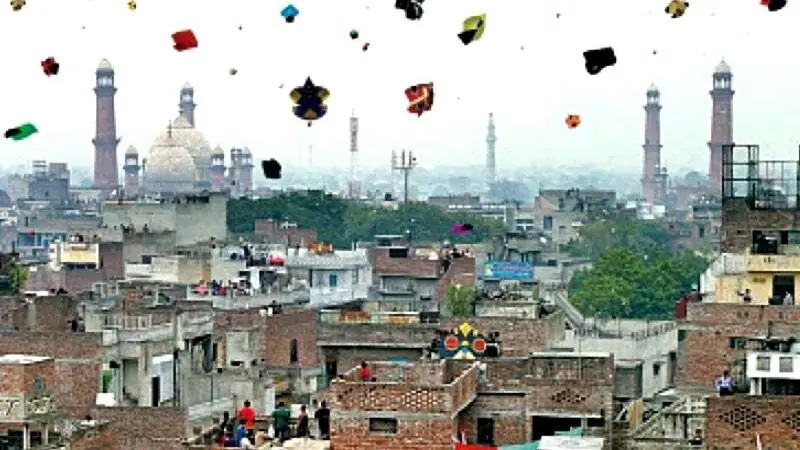

After a hiatus of 18 years, the Punjab government on Tuesday lifted the ban on kite flying and allowed the celebration of Basant with strict regulations.
The festival was banned in 2007 because of an increasing number of deaths and serious injuries caused by sharp strings, particularly to motorcyclists and pillion riders, as well as by celebratory gunfire.
Basant Panchami, with ‘panchami’ meaning the fifth day of the lunar month Magh, is a celebration of future crop prosperity, spring, and good luck. Historically, in the 19th century, Maharaja Ranjit Singh held an annual Basant fair and introduced kite flying as a regular feature. The association of kite flying with Basant soon became a tradition centred in Lahore, which remains the regional hub of the festival throughout Punjab even today. However, the festival has also traditionally been celebrated in other parts of Punjab, including Indian Punjab. Over time, the festival began to be celebrated across the country.
During the festival, the city sky is filled with colourful kites of all shapes and sizes flown from rooftops. The kites are controlled with strings usually embedded with thin shards of glass, which help cut the threads of competing kites more effectively.
Under the Punjab Regulation of Kite Flying Ordinance 2025, promulgated by Governor Sardar Saleem Haider Khan, teenagers under 18 are barred from kite flying. A fine of Rs50,000 will be imposed for the first violation and Rs100,000 for subsequent violations. In case of non-payment of the fine, action will be taken against the father or guardian.
Kite flying associations will be registered with the relevant deputy commissioner of the district, and shopkeepers will also be registered, who will be linked to a QR code. To identify a seller or manufacturer, every kite will have a QR code.
The violators will be imprisoned for three to five years, and they will pay a fine of up to Rs2 million for violation of the rules.
As per the ordinance, the manufacturing of only thread-based kite strings will be allowed. Use of metallic, chemical-coated, or sharp strings has been strictly banned, and anyone found using them will face severe legal consequences.
It said manufacturers, traders and sellers of kite flying material would have to be registered with the deputy commissioner or authorised officer, subject to the payment of a fee.
The ordinance could not be taken up on Wednesday, as the assembly session was adjourned to Thursday due to a quorum issue. The expected passage of the ordinance will allow shopkeepers to sell kites.
Despite its promulgation by the governor, the ordinance needs to be passed by the provincial legislature to become an act.
As per its statement of objects and reasons, the ordinance generally prohibits kite flying in Punjab but also empowers the government to allow permissible kite flying under a regulatory framework at “specific places and days”.
Furthermore, it provides for the registration of manufacturers, traders and sellers of permissible kite flying material, as well as that of kite flying associations.
It also provides punishments to deter people who may violate its provisions and provides measures for whistle-blowers to identify those involved in the violations.
The Punjab government brought the festival to a drastic end in 2007 following deaths due to sharp strings.
Motorcyclists were particularly vulnerable to injuries or even fatal accidents while speeding through the narrow lanes of the Walled City, where almost invisible stray kite strings could appear out of nowhere. The strings, allegedly laced with glass and metal, caused multiple critical injuries to bikers.







 American Dollar Exchange Rate