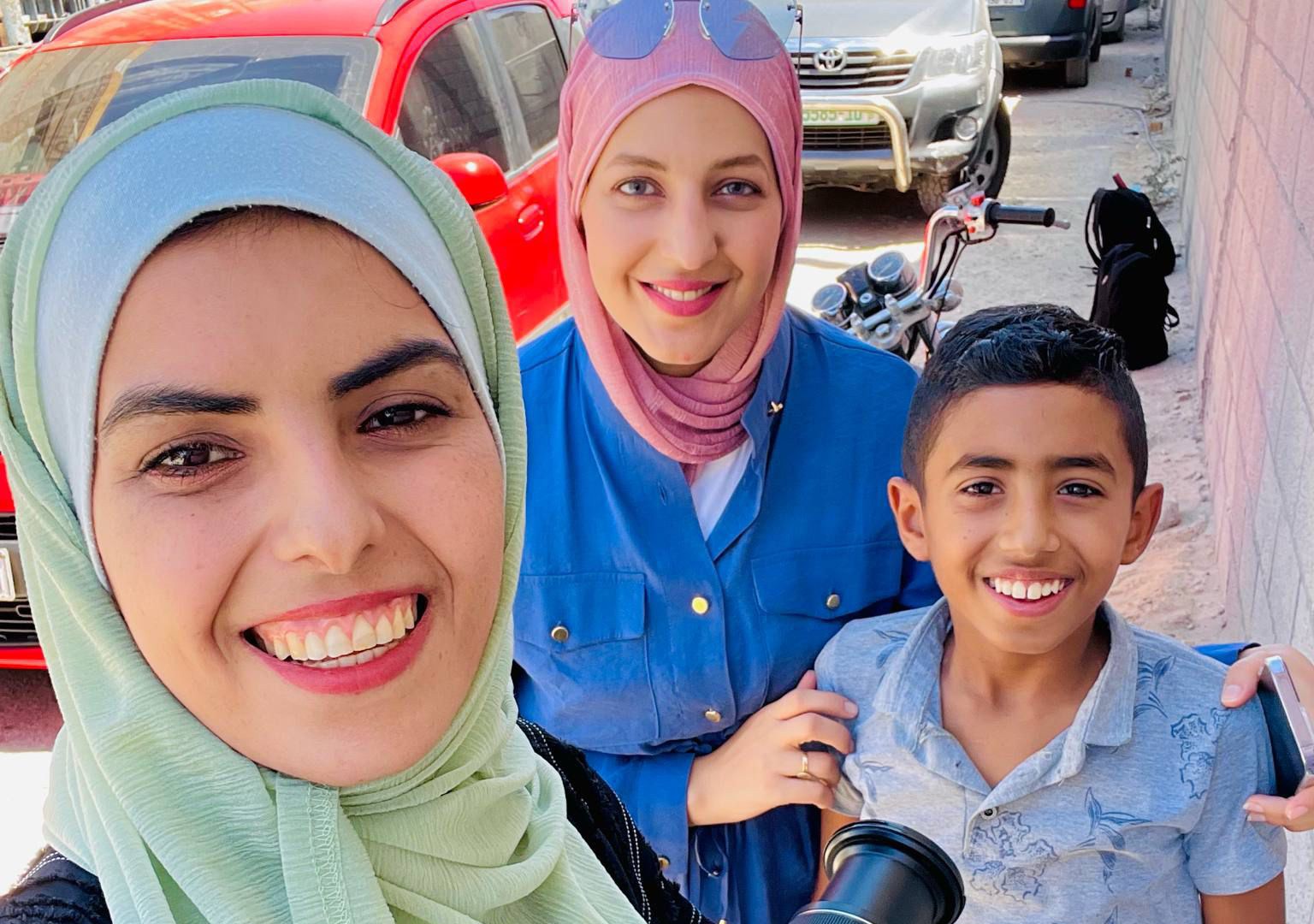
I want to remember Mariam.

I want to remember the beautiful smile that brightened her face. I want to remember the courageous journalist she was, the strong woman, the person who was a friend to everyone.
I want to remember her striving to capture all the moments – the moments of grief, of pain, sorrow, laughter and love in Gaza.
I want to remember her as the loving mother to her son, Ghaith. I want to remember her as the sister who brought happiness to her home, the daughter who was so close to her parents.
She’s the daughter who sacrificed and donated her kidney to her father to keep him alive.
I used to look at her in that very thin body, out there in the field, going to the front lines, capturing all those unfolding events fearlessly with just one kidney in her body.
I’ll always remember how she always, even at the worst times when she herself was too tired to take it, would choose to comfort you and tell you that it’s going to be OK. It’ll pass.
It’ll pass … I remember her words.
I will remember her in the face of Ghaith, her son, who looks so much like her. And I hope that one day, when he grows up and gets married, he names his daughter after Mariam, like she asked him to in her final letter to him.
Israel’s war forced me to leave Gaza at the end of 2023 with my family. I can’t imagine going back and not seeing Mariam, not waiting for her to come to sit beside me or looking over to check on her.
It didn’t take us much to become friends. We met often when we were out in the field.
If she were there first, I’d go stand next to her, and if I got there first, she’d come stand close. If we were covering something really bad or dangerous, we’d be checking on each other with our eyes, just to make sure the other was OK.
So many memories with Mariam in the field.
The world in a boy’s eyes
Between those moments of struggle, coverage, tear gas, bullets and explosions, we had moments in which we could just sit for a couple of minutes and speak about our kids.
Ghaith was her world. And it broke her heart when she had to send him off to his dad in the United Arab Emirates after the war started to keep him safe.
All she wanted was to know that he was safe, that he wasn’t hungry, that he wasn’t thirsty.
After she sent him, she missed him so much but was relieved to know that he was safe, he was not hearing bombs.
She told me that when he called her and cried because he missed her, she would tell him the war would be over soon and she would come to him – that he should focus on that, think about the day they would meet again.
She clung to that last bit of hope because of Ghaith. She longed to hold him, to see him.
When I saw the news about Mariam, I was in such disbelief that I kept calling my colleagues in Gaza and asking one question: Is Mariam alive?
When they said no, I just hung up and called someone else to ask the same question.
My husband was telling me she’s gone, but I was insisting that she was fine, that they made a mistake in including her photo with the other murdered journalists.
And until now, I just feel that she’s going to text me, she’s going to respond to one of my stories.
I can’t imagine going back to Gaza and not seeing Mariam in the field and not seeing all these friends and colleagues that have gone.





 American Dollar Exchange Rate