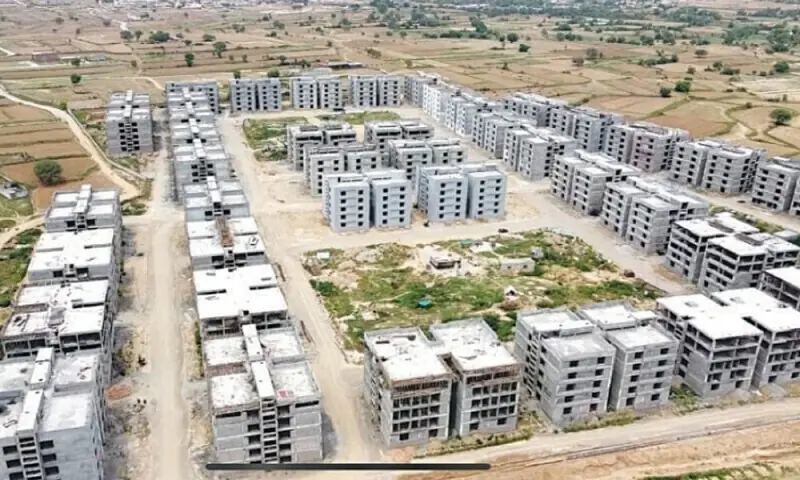

Rising land costs, expanding city populations, and changing lifestyle were pushing builders and developers in Pakistan towards vertical living and compact housing, real estate experts said.
Pakistan is facing an estimated housing shortage of 10 to 12 million residential units, and the gap continues to widen each year with rising population and urban migration, according to the experts who say the country’s property market is gaining momentum and rising primarily due to a persistent supply–demand imbalance.
“Urbanisation is accelerating, household sizes are shrinking, and younger families want their own homes earlier than before,” Shahzad Akbar Janjua, a real estate sector expert, told media.
“Despite economic slowdowns, real estate remains the most trusted long-term asset class, offering security and inflation hedging that other investments often fail to provide,” he maintained.
“Improved connectivity, new residential corridors, and the availability of smaller, more affordable housing formats such as townhouses and apartments are also drawing both end-users and investors. Even in periods of slow buying, strategic investment opportunities continue to emerge across upcoming, well-planned communities.”
Housing sector facing sharp slowdown owing to various factors
Janjua said Pakistan was facing an estimated housing shortage of 10 to 12 million residential units, and the gap continued to widen each year as population and urban migration increased.
“Major cities like Lahore, Karachi, and Islamabad require thousands of new units annually just to keep pace with demand. Because traditional large homes are no longer affordable for most middle-income families, the greatest shortfall is now in compact, mid-sized units apartments and townhouses. Without consistent development of these formats, the urban housing deficit will continue to grow,” he said.
According to Janjua, property prices have risen sharply due to higher land acquisition costs, increased construction materials prices, and overall inflation in labour and development inputs.
In urban areas, he continued, demand for limited land was driving prices even higher, pushing buyers toward vertical living and compact units.
“Apartments and townhouses have therefore become the new affordability segment. In rural and peri-urban areas, prices are rising more slowly but steadily, driven by infrastructure expansion, road links, and suburban migration.
“Overall, the shift towards smaller, efficiently designed residential formats is a direct response to cost pressures and changing buyer behaviour.”
Another real estate expert Ahmed Saljouk said, “Pakistan’s real estate market is experiencing a renewed surge largely because housing demand has outpaced supply for several years”.
“Even with economic pressures, the desire for secure, well-planned living remains strong, especially among young middle-income families entering the market for the first time.
Saljouk said the shift was driven by affordability, land optimisation, and evolving lifestyle needs.
“Large plots are no longer viable for most buyers, while compact units offer better price accessibility. Vertical and community-based living also allow developers to integrate security, utilities, and green spaces more efficiently.
Eliminating FED alone won’t revive Pakistan’s real estate, says ABAD chairman
Buyers today prioritise convenience, connectivity, and maintenance-friendly living provides qualities that apartments and townhouses can deliver more effectively than traditional sprawl-based development models.”
He said horizontal expansion required large, contiguous land parcels, which were increasingly scarce and extremely costly near urban centres.
“Expanding cities outward also strains infrastructure and raises development expenses for roads, utilities, and services. Compact formats whether its vertical or townhouses which utilise land more efficiently and help keep unit prices accessible.
“It’s not simply about cost; it’s about practicality. Modern buyers prefer manageable spaces in well-planned communities rather than distant, spread-out housing schemes that lack connectivity and amenities,” Saljouk said.






 American Dollar Exchange Rate